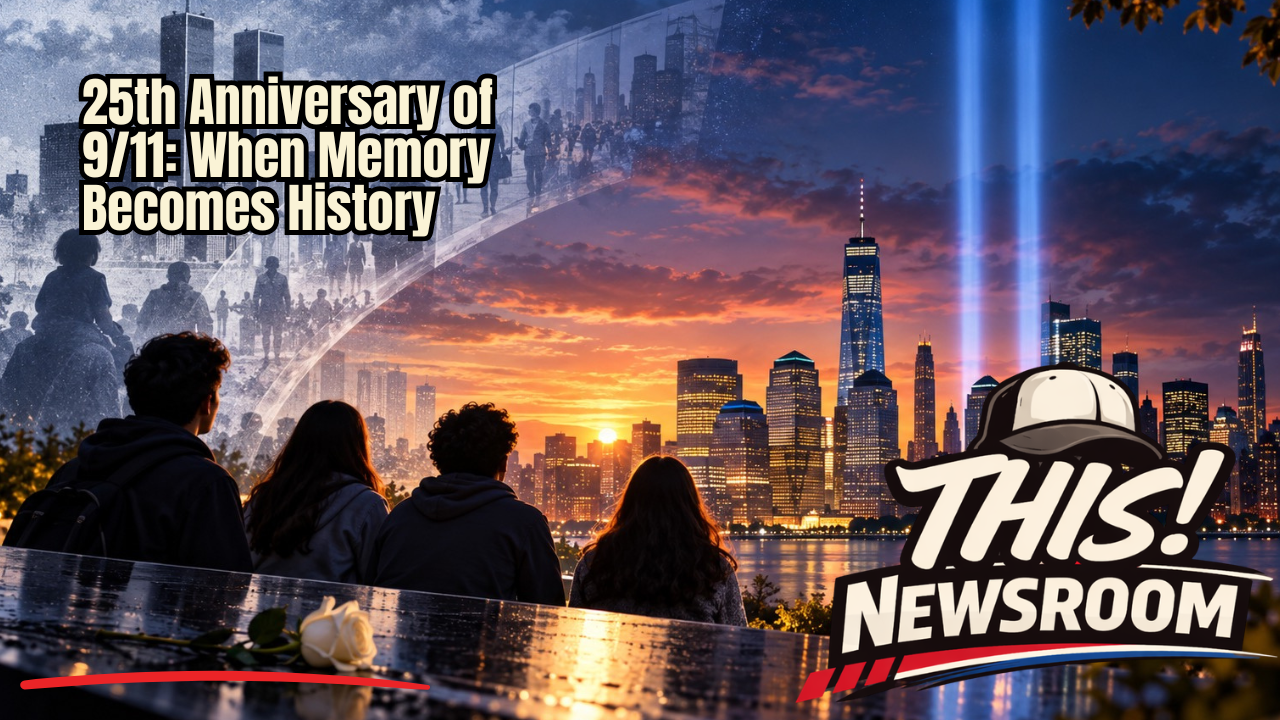
Twenty-five years after September 11, 2001, the 25th anniversary of 9/11 represents something different for America.
Millions of people alive today were not yet born when the attacks happened. Millions more were simply too young to remember them.
For one generation, September 11 remains a vivid personal memory. For the next, it increasingly belongs to history.
Those who lived through that Tuesday morning often remember exactly where they were when the news broke. Teachers rolled televisions into classrooms. Coworkers crowded around office screens. Families called one another as confusion quickly turned into fear.
Then came the images that would become permanently associated with the day: smoke pouring from the World Trade Center, the second airplane striking the South Tower, the attack on the Pentagon and the horrifying realization that America was under attack.
Later came the collapse of the towers.
For millions of Americans, those images did not come from a documentary or history lesson.
They watched them happen live.
Twenty-five years later, America is approaching a significant transition. September 11 is slowly moving from something the country collectively remembers experiencing to something future generations will primarily learn about.
A Generation That Has No Memory of 9/11
Consider how much time has passed.
Someone born the day after September 11, 2001, turns 25 this year.
Many adults beginning careers today have no meaningful personal memory of the attacks. College students were born years afterward. Children sitting in classrooms today know the Twin Towers primarily through photographs, videos, museum exhibits and stories told by their parents or grandparents.
To them, September 11 already feels like history.
That does not make the day less important. In many ways, it makes the responsibility to preserve its meaning even greater.
A generation that experienced 9/11 firsthand could remember simply by closing its eyes.
The generations that follow will need someone to tell them the story.
The Difference Between Knowing History and Remembering It
Knowing something happened is different from remembering what it felt like when it happened.
Most Americans know the importance of December 7, 1941.
We learn about Pearl Harbor in school. Documentaries show the attack. Museums preserve artifacts from that morning. History books explain how the attack pushed the United States into World War II.
Yet almost no one alive today personally remembers waking up on December 8, 1941, and wondering what might happen next.
Pearl Harbor has largely completed its transition from living memory into history.
September 11 is now beginning a similar journey.
Today, millions of Americans can still say, “I remember where I was.”
Twenty-five years from now, that number will look very different.
By September 11, 2051, the attacks will stand half a century behind us. Someone who was 30 in 2001 will be 80. A 20-year-old will be 70. A 10-year-old child will be 60.
As decades pass, fewer people will remember the morning firsthand.
Eventually, the way Americans talk about September 11 will change.
“I remember when that happened” will slowly become “I learned about when that happened.”
What Happened on September 11, 2001
Nineteen al-Qaeda terrorists hijacked four commercial airplanes on the morning of September 11, 2001.
Two planes struck the World Trade Center towers in New York City. Another crashed into the Pentagon outside Washington, D.C.
Passengers and crew members aboard United Airlines Flight 93 fought the hijackers after learning what had happened elsewhere. Their actions prevented the aircraft from reaching its intended target before it crashed near Shanksville, Pennsylvania.
Nearly 3,000 people lost their lives that day.
Numbers help us understand the scale of the tragedy, but numbers alone cannot explain September 11.
Behind every statistic was a person.
Some people had stopped for coffee before heading upstairs to their offices.
Parents had dropped children off at school.
Flight attendants expected another ordinary workday.
Firefighters entered buildings while thousands of people rushed in the opposite direction.
Police officers, paramedics and strangers helped people they had never met.
Passengers aboard Flight 93 realized what the hijackers intended to do and made the extraordinary decision to fight back.
History tends to compress enormous events into dates, statistics and paragraphs.
Real life is never that simple.
Thousands of individual stories formed September 11.
Preserving those stories matters just as much as preserving the timeline.
We Should Remember September 12, Too
The story did not end when September 11 ended.
America woke up the following morning grieving, frightened and uncertain.
Something else appeared alongside the fear.
Unity.
People lined up to donate blood. Volunteers traveled to New York. Communities collected supplies and raised money for victims’ families.
American flags suddenly appeared everywhere.
They hung from houses, businesses, bridges, construction equipment and highway overpasses.
Candlelight vigils brought strangers together.
First responders traveled from across the country to help.
Neighbors checked on neighbors.
For a brief period, many of the divisions that dominate American life seemed less important than what the nation had experienced together.
That feeling did not last forever.
National unity rarely does.
Still, younger Americans deserve to know that it existed.
September 11 revealed humanity at its worst.
September 12 showed something very different.
It demonstrated courage, generosity, service, compassion and an extraordinary willingness among ordinary people to help one another.
That deserves a place in our memory too.
What “Never Forget” Means 25 Years Later
For years, the words Never Forget carried a relatively simple meaning.
Millions of Americans did not need anyone to explain what September 11 felt like because they remembered it themselves.
After 25 years, those words begin to carry another responsibility.
Never forget now means teach.
Parents must tell children what happened.
Teachers must explain why the attacks changed America and the world.
Museums must preserve artifacts and firsthand accounts.
Journalists and filmmakers must record the voices of survivors, families and first responders while those voices can still tell their own stories.
Communities must continue reading the names of those who died.
Future generations deserve more than a paragraph in a textbook.
They deserve to understand that ordinary people woke up on September 11 expecting an ordinary Tuesday.
They deserve to hear about firefighters climbing upward while everyone else tried desperately to get down.
They should know about the passengers aboard Flight 93.
They should understand the magnitude of nearly 3,000 individual lives lost.
Most importantly, they should understand that history happened to real people.
What Will 9/11 Mean Another 25 Years From Now?
Imagine September 11, 2051.
America will commemorate the 50th anniversary of the attacks.
Adults born in the 2020s and 2030s will occupy positions of leadership throughout government, business, education, journalism and public safety.
Some elected officials discussing September 11 may have parents who themselves were too young to remember the attacks.
For that generation, 2001 may feel as distant as 1976 feels today.
The World Trade Center attacks could eventually occupy a place in American consciousness similar to Pearl Harbor: enormously consequential, deeply respected and universally recognized, yet unmistakably historical.
Time naturally creates distance.
We cannot prevent that.
Nor should remembrance depend on pretending that time has stood still.
The challenge is ensuring that distance does not erase humanity.
Pearl Harbor should never become merely “December 7, 1941.”
September 11 should never become merely “September 11, 2001.”
Behind both dates were people.
Passing the Memory of September 11 Forward
Those of us old enough to remember September 11 now occupy an important position.
We are becoming the bridge between memory and history.
Our generation can explain that those famous images once appeared without warning on live television.
Nobody watching knew what would happen next.
No one understood how significantly the day would alter American life.
Parents searched desperately for loved ones.
Children waited for mothers and fathers who never came home.
Firefighters climbed stairways toward danger.
Strangers carried strangers.
Passengers fought back.
Thousands died.
Millions grieved.
Then, amid enormous tragedy, Americans reached for one another.
Another 25 years will eventually pass.
Many people who vividly remember September 11 today will no longer be here to explain what the day felt like.
That reality makes the 25th anniversary of 9/11 more than another milestone.
It marks the beginning of a generational handoff.
We cannot preserve living memory forever.
We can preserve its stories.
Tell your children about that morning.
Tell them about those who were lost.
Share the stories of firefighters, police officers, paramedics, military personnel and ordinary citizens who ran toward danger.
Tell them about Flight 93.
Explain what New York looked like before the skyline changed.
Describe what America felt like on September 11.
And perhaps just as importantly, tell them what America felt like on September 12.
Twenty-five years ago, history unfolded in front of millions of us.
Twenty-five years from now, September 11 will sit much more firmly within the pages of American history.
Our responsibility is not to stop that transition.
Our responsibility is to make sure that when memory becomes history, history remembers what memory once knew.