
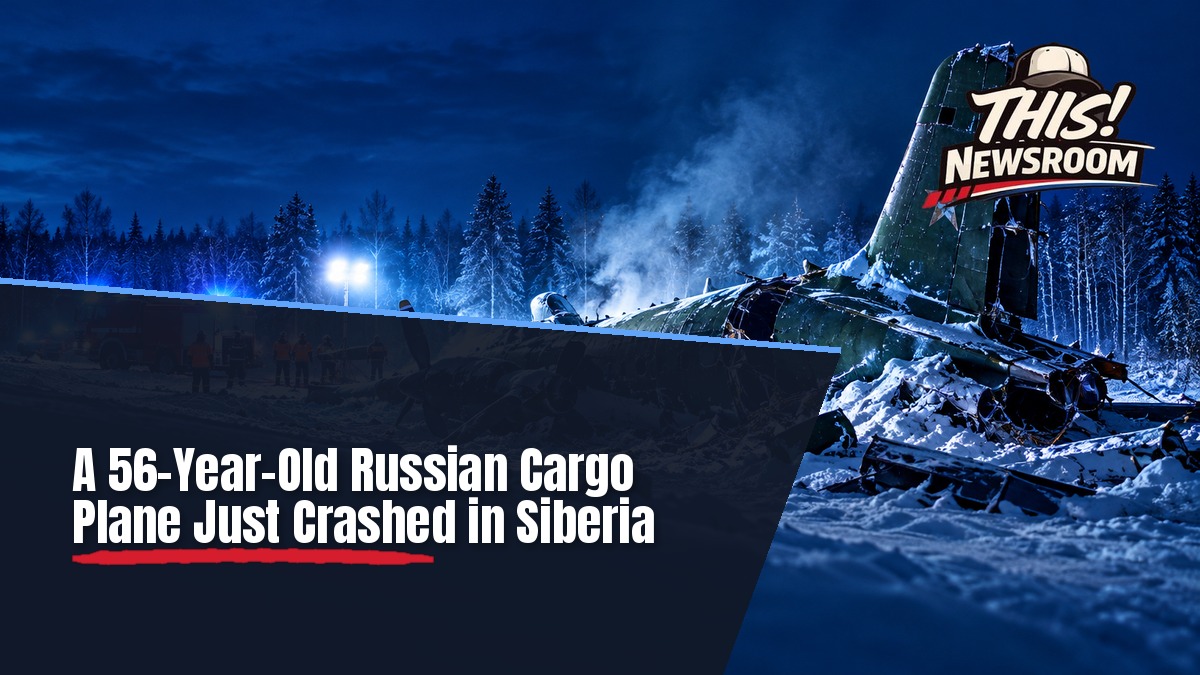
Nineteen people were aboard a Russian military transport plane when it went down in Siberia on Tuesday, and the Defense Ministry says none of them survived. The Russian Siberia plane crash is already being blamed by the ministry on a technical malfunction.
The aircraft was an An-12, a Soviet-designed four-engine turboprop. According to NBC News, citing the AP, it went down in an unpopulated area near the village of Yagunovo in the Kemerovo region. That is roughly 3,000 kilometers (1,860 miles) east of Moscow. The ministry says the plane was on a scheduled flight.
What we know about the Kemerovo plane crash
Local reports put the crash around 9:30 p.m. local time. Governor Ilya Seredyuk reported it on his official channel on the MAX messaging platform. He did not name the aircraft at first.
The first death tolls were lower. Early reports from Russian outlets, relayed by Reuters, said 17 were dead. Other reports said 13. The AP, CNN and Al Jazeera now use the ministry’s later figure of 19, so that is the number to rely on.
The ministry says emergency crews have put out the fire at the site. It also gave a preliminary cause. CNN quotes the statement, relayed by Russian state news agency RIA, as saying the cause is “a technical malfunction.” The ministry added that a commission from the Russian Aerospace Forces is working at the site.
What nobody has confirmed about the Siberia plane crash
Many important details are still missing. The ministry has not said who the 19 people were. An An-12 typically flies with a crew of about six, so most of those aboard were not crew. Whether they were soldiers, passengers or both is unknown. Officials have released no names.
Anonymous Russian Telegram channels are claiming an engine fire in the air, a fuel leak and a failed emergency landing near Kemerovo. Some say the flight was Novosibirsk to Kansk, carrying spare parts. Officials have confirmed none of that, so it should be treated as rumor for now. No one outside Russia has verified any of it either, and Russian media are relaying the ministry’s statements secondhand.
Details from Russian officials often arrive thin or not at all. Our coverage of Trump’s meeting with Putin’s envoy Dmitriev shows how that plays out.
Why this Russian military plane crash matters
Here’s the thing: the plane involved is old. The An-12 has been in service since the late 1950s. FlightGlobal says the Russian air force’s An-12 fleet averages more than 56 years old.
It keeps flying because Moscow’s military has leaned on aging aircraft for decades, and no replacement has taken over the work. The An-12 can carry up to 20 tonnes. Crews use it to move people, cargo and equipment, and to airdrop them. Whether age played any role in this An-12 crash is not established, and nobody should claim it yet.
There is also no verified link to the war in Ukraine, and nothing in the reporting ties this crash to American interests. For most readers in the U.S., this is a tragedy abroad, not a security story. For the security angle, see our reporting on a U.S. soldier arrested in Britain on suspicion of spying for Russia. This story is worth watching mainly if the investigation points somewhere bigger.
What happens next after the Russian Siberia plane crash
The Aerospace Forces commission is investigating, and officials have announced no findings or deadline. Watch for three things: the victims’ names, a final cause, and confirmation of what the plane was carrying. Belarusian President Alexander Lukashenko has already sent condolences to Vladimir Putin, according to Vedomosti.
Nineteen people were on board, and none survived. Who they were is still the question that matters most.