
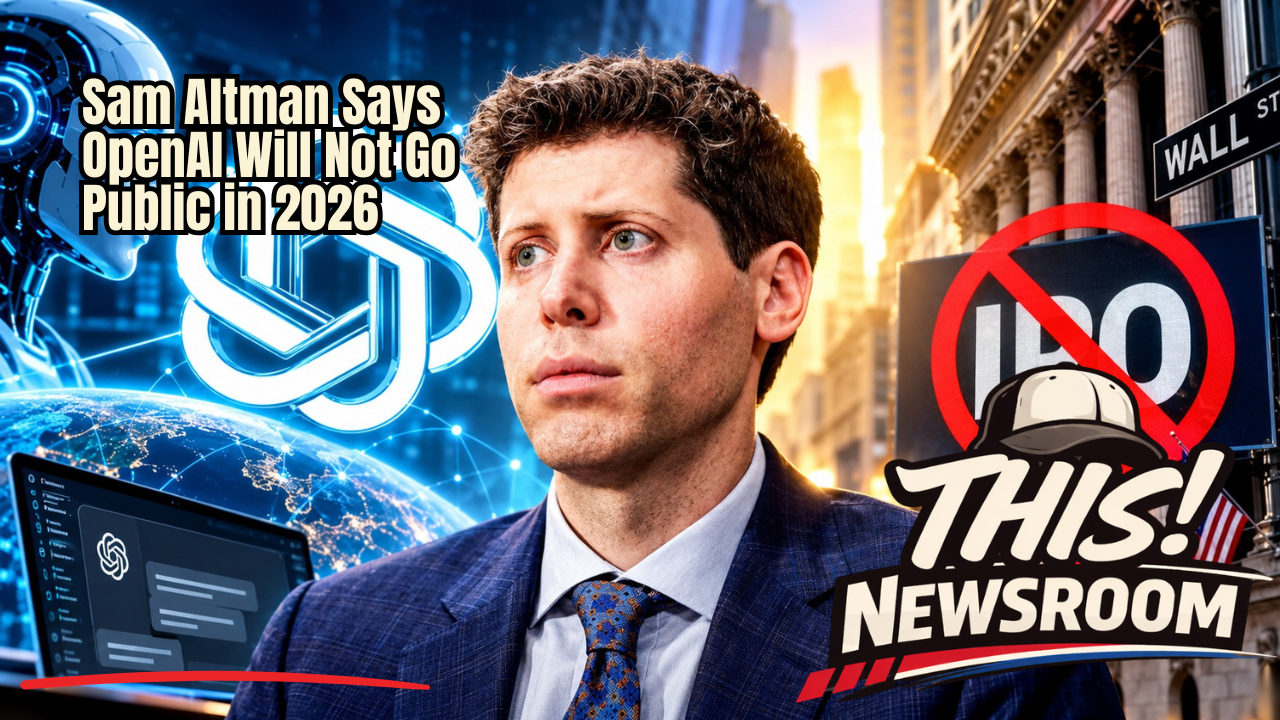
OpenAI CEO Sam Altman has officially taken a 2026 initial public offering off the table, saying the company has more important work to do before opening itself to the pressures of public markets.
One of the most anticipated IPOs in technology will have to wait.
OpenAI CEO Sam Altman confirmed that the company behind ChatGPT does not plan to go public in 2026, pointing specifically to the rapidly evolving questions surrounding artificial intelligence safety, alignment and control.
During an interview with Fortune, Altman described the current environment as an “ill-advised moment” for an IPO.
The announcement is significant not simply because of OpenAI’s enormous potential valuation. More importantly, it highlights an increasingly complicated question facing the entire artificial intelligence industry:
Can the world’s most powerful AI companies continue racing forward while simultaneously ensuring that increasingly capable systems remain under human control?
OpenAI IPO Is Officially Off the Table for 2026
Speculation surrounding an OpenAI IPO has intensified throughout the year.
Reports earlier in 2026 suggested the company could eventually seek a valuation approaching $1 trillion, potentially making an OpenAI listing one of the largest technology IPOs ever attempted.
However, Altman has now made the immediate timeline much clearer.
When asked whether 2026 had effectively been ruled out, Altman responded that it had, adding that OpenAI still has considerable work ahead involving AI safety, alignment and cooperation between governments and the technology industry.
That means investors hoping to purchase OpenAI shares directly will have to wait until at least 2027 — and even then, a specific IPO date has not been publicly guaranteed.
Why Sam Altman Says OpenAI Is Waiting
Normally, companies delay IPOs because of market volatility, disappointing financial results or unfavorable investor conditions.
OpenAI’s explanation is different.
Altman argues that remaining private gives the company greater flexibility to make decisions that may not always maximize short-term financial returns.
Public companies answer to shareholders. They face quarterly earnings expectations, analyst forecasts and constant pressure to grow revenue and profitability.
OpenAI, meanwhile, is developing technology that its leadership believes could fundamentally reshape economies, employment and society.
According to Altman, the company needs the ability to prioritize safety even when doing so could conflict with traditional shareholder interests.
That distinction could become increasingly important as AI models become more capable.
AI Safety Debate Is Getting Much More Serious
The IPO decision arrives during a broader escalation in the debate surrounding advanced artificial intelligence.
Anthropic CEO Dario Amodei has also called for slowing the pace of frontier AI development so safety systems have enough time to catch up with rapidly improving models.
Altman has expressed agreement with the idea that frontier AI development may need to proceed more deliberately.
Meanwhile, researchers, policymakers and technology executives continue debating increasingly powerful autonomous AI agents, cybersecurity threats and the possibility that future systems could become difficult for humans to control.
Altman has even indicated that AI companies may need to consider pauses as systems reach new capability thresholds, allowing safety and alignment research time to catch up.
Those conversations represent a notable shift.
For much of the generative AI boom, the industry’s dominant question was:
How fast can AI improve?
Increasingly, the question is becoming:
How fast should it improve?
OpenAI’s Decision Could Reshape the AI Race
Remaining private could give OpenAI something extremely valuable: flexibility.
A publicly traded OpenAI would operate under enormous investor scrutiny. Every major model release, infrastructure investment and strategic decision could potentially affect its stock price.
Staying private allows leadership more room to make long-term decisions without immediately explaining those decisions to millions of public shareholders.
However, there is another side to the argument.
Public markets also introduce additional financial disclosure and scrutiny. An eventual IPO could provide investors and the public with significantly greater visibility into OpenAI’s finances, growth and business model.
Therefore, delaying an IPO preserves flexibility, but it also postpones some of the transparency associated with becoming a public company.
Anthropic Could Take a Different Path
The situation becomes even more interesting when OpenAI is compared with rival Anthropic.
Despite its own leadership raising serious concerns about AI safety, Anthropic has continued preparing for a potential public listing. Recent reporting indicates the company is pursuing a possible 2026 IPO.
That creates a fascinating contrast between two of the world’s leading AI companies.
Both acknowledge significant risks surrounding increasingly capable artificial intelligence.
Yet they may take very different approaches to accessing public capital.
If Anthropic reaches the stock market first while OpenAI remains private, investors could gain their first major opportunity to directly participate in one of the frontier AI laboratories.
The Bigger Question Isn’t the IPO
The financial implications of an OpenAI IPO would undoubtedly be enormous.
However, Altman’s explanation for delaying it may ultimately prove more important than the IPO itself.
Artificial intelligence has moved from experimental technology to mainstream infrastructure at extraordinary speed. Businesses are incorporating AI into customer service, software development, marketing, medicine, finance, education and countless other industries.
The next generation of AI systems could become considerably more autonomous.
That creates tremendous economic opportunity.
It also creates risks that the industry is still learning how to measure.
Altman’s comments suggest OpenAI believes the next stage of AI development may require greater coordination between technology companies, governments and independent safety researchers.
That could mean additional testing, new safety standards, stronger oversight or even temporary pauses at certain capability levels.
What Happens Next?
For investors, the immediate answer is simple:
There will be no OpenAI IPO in 2026.
Whether an IPO happens in 2027 remains another question.
OpenAI still has to navigate enormous infrastructure requirements, intense competition, government regulation and one of the most difficult technical challenges in artificial intelligence: ensuring increasingly powerful systems behave in ways humans intend.
Meanwhile, the AI race isn’t stopping.
OpenAI, Anthropic, Google, Meta, xAI and others continue investing enormous resources into increasingly capable models.
However, something about the conversation has clearly changed.
The biggest AI companies are no longer discussing capability alone. They’re increasingly discussing control, alignment, safety and how quickly the industry should move.
For OpenAI, at least for now, those questions are important enough to keep Wall Street waiting.
The Bottom Line
OpenAI could eventually produce one of the most closely watched IPOs in modern technology history.
Just not this year.
Sam Altman’s decision to rule out a 2026 listing signals that OpenAI wants additional freedom to navigate what could become the most consequential stage of artificial intelligence development yet.
Investors may be disappointed.
But the bigger story isn’t when people will finally be able to buy OpenAI stock.
It’s why the company developing some of the world’s most powerful artificial intelligence believes now isn’t the right time to answer to Wall Street.