
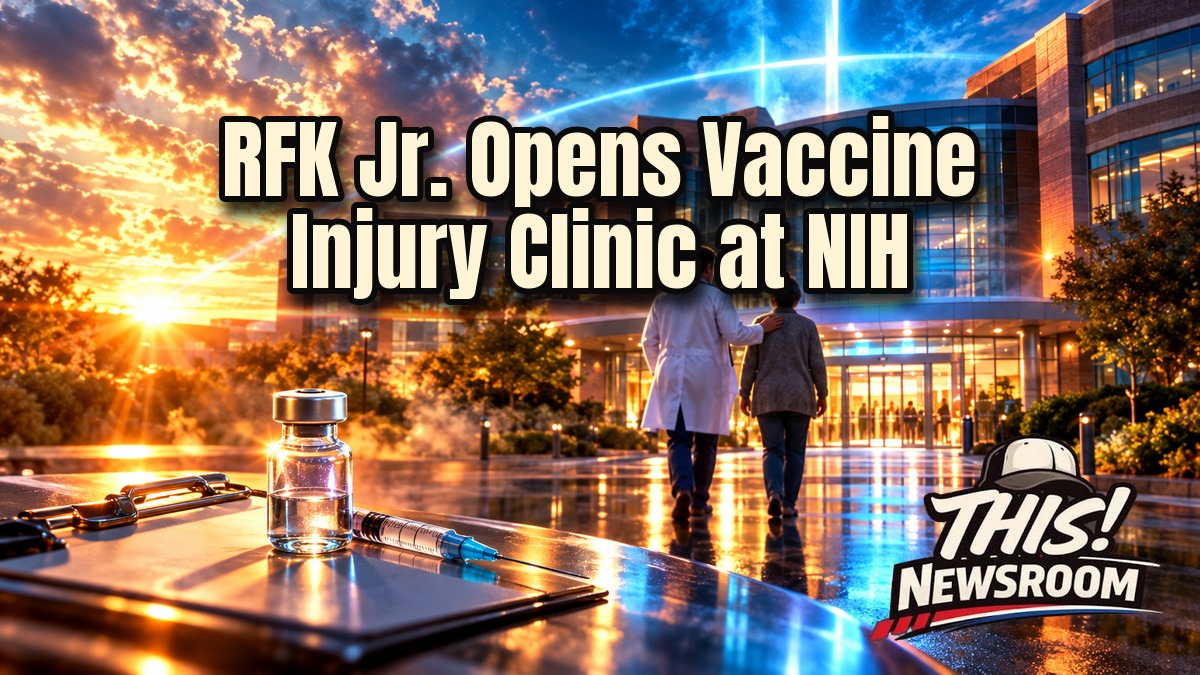
A new vaccine injury clinic is now open at the National Institutes of Health. It is the centerpiece of a bigger push by Health Secretary Robert F. Kennedy Jr. to study what happens to people after they get vaccinated. The clinic opened Monday, Oct. 5, at NIH headquarters in Bethesda, Maryland. The Department of Health and Human Services then announced it Thursday, according to Reuters and The Hill.
The pitch is simple. People who say they got sick after a shot will be treated and studied in one place. The reaction from the medical world, however, is not simple at all.
What the NIH vaccine clinic will do
The vaccine injury clinic will treat and study patients who report health problems after vaccination. That is according to the HHS statement Reuters cited. It sits inside the NIH Clinical Center and is part of what HHS calls an agency-wide effort. CNN reports that Kennedy unveiled it Monday during a visit to the NIH.
The New York Times, as relayed by Becker’s Hospital Review, said it was Kennedy’s first NIH trip as secretary. He reportedly met patients who believe vaccines injured them.
The program may not stay in Bethesda, though. NIH notices posted in June describe a research program that could expand to centers nationwide. They also call for large studies of long-term vaccine outcomes. Even so, there is no date for any expansion.
A vaccine injury initiative that also targets the reporting system
The wider vaccine injury initiative also targets VAERS, the federal system where anyone can report a suspected vaccine side effect. HHS proposed reforms to that system, CNN reports. It also floated paying doctors for the time they spend filing reports, to “encourage” more of them.
Here is where the details get fuzzy. The Hill says HHS is “mulling” a reimbursement program. CNN, in contrast, calls it a set of proposals. The Washington Examiner says the Centers for Medicare and Medicaid Services “will reimburse” doctors. The NYT, via Becker’s, describes a new billing code. Is it live, or still on the drawing board? That is unclear. Treat it as proposed until HHS or CMS says otherwise.
Kennedy’s case for new research
Kennedy framed the move as listening to people who feel ignored. “We must listen to patients and families who report vaccine injuries\u2014not dismiss or gaslight them,” he said in the HHS statement. He added that the goal is a health system that “follows the evidence, and uses what we learn to make vaccines safer.”
At Monday’s event he argued the science has gaps. “We have not done the studies that need to be done to understand who’s vulnerable to those kind of injuries,” he said. That comes from CNN footage shared by HHS. His push fits a pattern. He has also gone after food additives, as the phase-out of artificial food dyes shows.
Critics question the vaccine safety clinic
Many experts are not buying the framing. Dr. Paul Offit directs the Vaccine Education Center at Children’s Hospital of Pennsylvania, and he did not mince words. “Robert F. Kennedy Jr. has a bias,” he told CNN. “His bias is that vaccines cause chronic disease,” he said. He added that it does not matter how many studies show Kennedy is wrong.
Official health sources, meanwhile, say serious problems are rare. The CDC’s website says there is a “very remote chance” of vaccines causing serious reactions, injuries or death. The American Academy of Pediatrics says childhood vaccines are tested in placebo-controlled and comparison-group trials, then monitored after approval. Critics worry the new vaccine injury clinic could blur that line between signal and proof.
Here is the thing worth knowing about VAERS. Because anyone can file a report, it collects unvetted signals, not confirmed causes. A report in the system does not prove a vaccine caused a problem. Researchers use it to spot patterns worth checking, and then they check.
Why this matters to you
This lands in a tense moment for public health. Reuters notes that Kennedy fired all 17 independent members of the CDC vaccine advisory committee in his first year. He replaced them with panelists, and many of them share his skepticism. His changes to the childhood schedule face legal challenges. Measles has also come back across the US as vaccination rates slip. In fact, the vaccine injury clinic is one more piece of a broader agenda. It echoes his push for nutrition training in medical schools.
Trust is part of the story too. KFF polling in February found confidence in the CDC had dropped. Pew polling last fall, however, found most voters across parties still trusted the childhood schedule.
So who decides what counts as an injury, and how will anyone tell a real signal from noise? HHS has not said how patients qualify for the clinic, how big it is, or what it costs. Those answers will tell us whether this becomes serious science or a political lightning rod.