
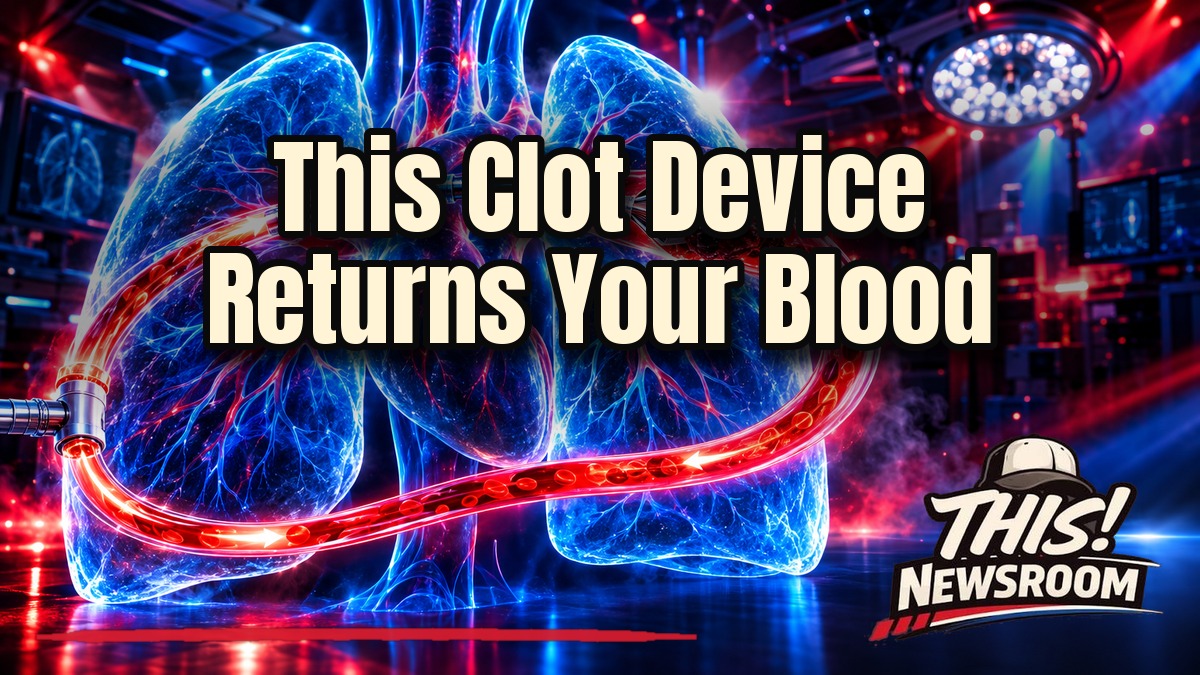
When a clot lodges in the lungs, every drop of blood counts. The FDA just cleared a pulmonary embolism thrombectomy system that gives patients back the blood it pulls out along with the clot.
Endovascular Engineering, known as E2, announced on Oct. 12 that the agency granted 510(k) clearance for two products: the Hēlo Thrombectomy System and Hēlo Return, a blood-return system. The details come from the company’s release on PR Newswire. E2 is a Menlo Park, California, medical device company focused on venous blood clots.
How this pulmonary embolism thrombectomy system works
A pulmonary embolism, or PE, is a clot that lodges in the arteries of the lungs. Many describe it as a leading cause of cardiovascular death and disability. Thrombectomy means removing the clot through a catheter rather than operating or relying only on drugs.
According to E2, the Hēlo system uses a dual-action approach. It combines continuous aspiration, which is suction, with mechanical clot disruption. The device has a 15F crossing profile and steerable navigation. A 24F funnel at the tip ingests the clot. The cleared indication covers non-surgical removal of emboli and thrombi from the pulmonary arteries and venous vasculature.
Why the blood-return piece matters for PE clot removal
Here’s the thing about suction-based clot removal: it also pulls out blood, and patients with a PE are often already fragile. Hēlo Return provides workflow-integrated blood return during the procedure.
E2 says the add-on produced “near-zero” blood loss in its ENGULF trial. It also calls Hēlo Return the first blood-return system cleared for use with continuous vacuum aspiration. Those are company claims.
The release also says the platform showed the highest clot reduction and the lowest estimated blood loss across all PE thrombectomy IDE studies. However, that is a comparison across different studies, and no independent outlet has verified it.
What is actually new here
The timeline needs some care. Medical Device Network reports the foundational Hēlo platform first won FDA clearance in December 2025. Meanwhile, an FDA 510(k) letter for the Hēlo Thrombectomy System is dated Dec. 18, 2025. So the thrombectomy system itself is not brand new.
What changed is the pairing. The outlet says Hēlo Return “completes” the platform. The release describes both devices as newly cleared.
Even so, the sources do not explain how the new Thrombectomy System clearance differs from the earlier one. They also do not state the exact clearance dates for the new filings, only the Oct. 12 announcement.
A 510(k) clearance is not the same as a full FDA approval. It means the agency found the device substantially equivalent to one already on the market. The Class II classification here lists Indigo Aspiration System – Lightning as the primary predicate. If you follow FDA device news, our look at the RingConn smart ring clearance shows how thin the fine print can get.
A crowded, expensive race for lung clot removal
E2 is not a lone inventor. It raised an $80 million Series C in April to commercialize Hēlo, according to Fierce Biotech. The same report notes the big names circling this space. Stryker bought Inari Medical, maker of FlowTriever, for $4.9 billion. Boston Scientific agreed to buy Penumbra in a deal valued at $14.5 billion.
In other words, the market has already shown that any blood clot removal device is worth real money. A smaller company with a pitch about saving blood now has its two key clearances in hand.
What to watch next
E2 CEO Dan Rose said the clearances let the company accelerate plans “to deliver this complete solution to a broad range of physicians and patients.” The company has announced no launch dates or pricing. So the open questions are practical ones. How quickly will hospitals adopt it? And will the blood-saving results hold up in everyday use outside a trial?
For anyone who may someday land in an emergency room with a clot in the lungs, the news is simple. Doctors now have more refined tools for clearing it, and this one aims to leave more of your own blood where it belongs. Cardiovascular risk takes many forms, as our piece on masked high blood pressure and fall risk shows.