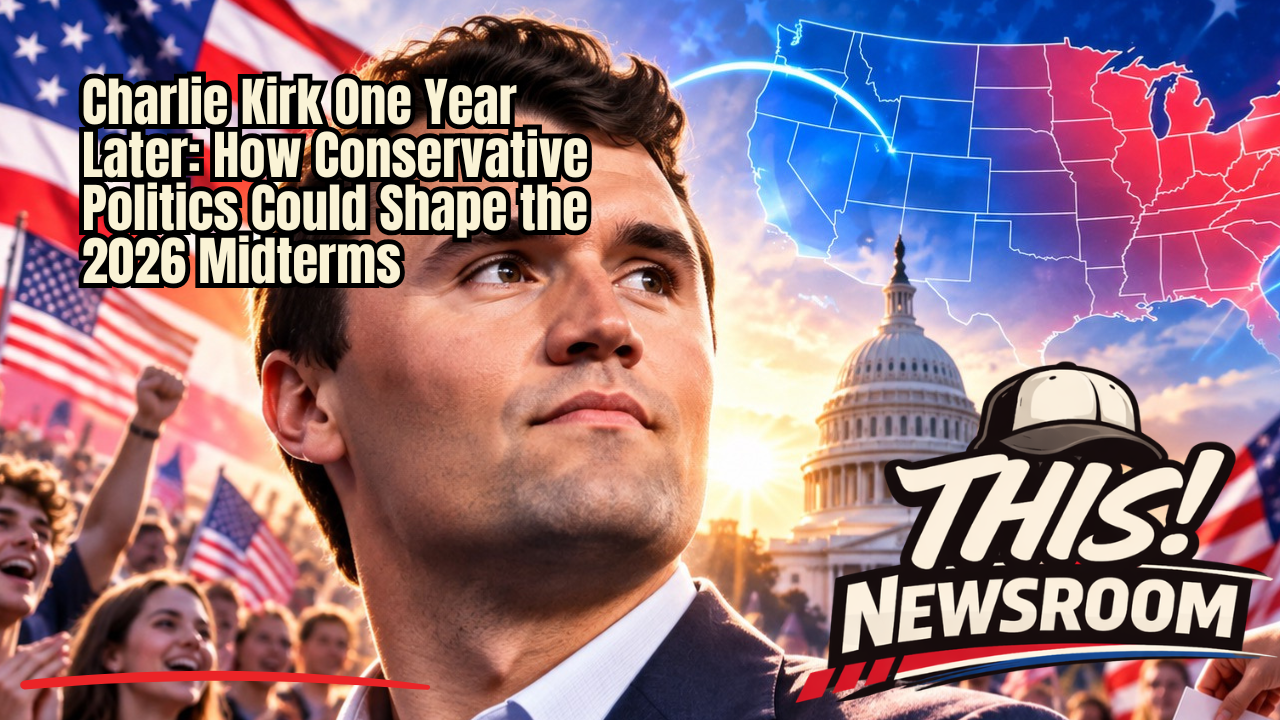
September 10, 2026 marks one year since Charlie Kirk was assassinated during an event at Utah Valley University. Twelve months later, the conservative movement he helped reshape is larger, younger and arguably more influential — but also more divided.
And with the 2026 midterm elections now less than two months away, Republicans are about to learn whether the political movement Kirk helped build can maintain its strength without one of its most recognizable organizers and communicators.
Kirk was just 31 years old when he was fatally shot on September 10, 2025, while appearing at Utah Valley University in Orem, Utah. A suspect, Tyler Robinson, has been charged in the killing, and prosecutors have been permitted to pursue the death penalty.
But the political story of the past year goes far beyond the tragedy itself.
Kirk’s death created something unusual in modern American politics: the sudden removal of a political figure who did not hold elected office but had built an enormous infrastructure capable of influencing elections, shaping Republican messaging and reaching voters the GOP historically struggled to organize.
Charlie Kirk Changed How Conservatives Reached Young Americans
When Kirk co-founded Turning Point USA in 2012, Republican politics had a significant generational problem.
The GOP was often associated with older voters, traditional political organizations and conventional campaign structures.
Kirk approached politics differently.
College campuses became campaign territory.
Social media became the distribution network.
Political debates became viral content.
Young conservative activists became organizers rather than simply voters.
Over time, Turning Point developed into one of the most recognizable organizations within the conservative movement.
By the 2024 presidential election, the political coalition supporting Donald Trump had changed dramatically, particularly among younger men.
Trump received approximately 46% of the vote among young men in 2024, according to Pew Research analysis cited by Reuters — seven percentage points higher than in 2020.
Kirk and Turning Point were widely credited with helping build the organizing infrastructure behind that transformation.
His influence was not simply ideological.
It was logistical.
Register voters.
Build campus organizations.
Create political content.
Develop influencers.
Recruit activists.
Turn digital enthusiasm into real-world participation.
That infrastructure still exists.
Turning Point USA Has Actually Grown Since Kirk’s Death
One of the most important political developments during the year following Kirk’s assassination has been the continued expansion of Turning Point USA.
According to the organization, Turning Point now has more than 3,500 high school chapters nationwide, representing roughly 180% growth, along with more than 1,500 college chapters, an increase of more than 60%.
That expansion suggests Kirk’s death did not cause the organization he created to collapse.
In some ways, it accelerated participation.
Young conservatives who viewed Kirk as a political mentor responded by creating chapters, attending events and becoming activists themselves.
Turning Point Action is also preparing to spend tens of millions of dollars during the 2026 midterms, with significant activity expected in competitive states including Arizona, Nevada and New Hampshire.
The organization is simultaneously expanding political operations in states important to the 2028 Republican presidential primary.
That includes plans to build a substantial grassroots presence in Iowa while increasing operations in New Hampshire and Nevada.
The organization Charlie Kirk created is no longer simply a campus activism group.
It has become part of the Republican Party’s political infrastructure.
But The Conservative Coalition Is Changing
Growth, however, does not necessarily equal unity.
That may be the most important political development of the past year.
The conservative movement entering the 2026 midterms looks different than the coalition that helped Donald Trump return to the White House in 2024.
Younger conservatives increasingly disagree over foreign policy, the economy, government spending and America’s relationship with Israel.
The war with Iran has become particularly divisive among younger voters.
A recent YouGov/Economist survey cited by Reuters found only 16% of Americans ages 18 to 29 believed the war was the right decision.
Cost-of-living concerns may be even more politically significant.
A Harvard Youth Poll conducted earlier this year found half of Americans ages 18 to 29 said inflation affected them “a lot,” while 45% described themselves as struggling financially or having little financial security.
Those pressures are creating political consequences.
Reuters/Ipsos polling from August showed Trump’s approval among men ages 18 to 29 at approximately 32%, compared with 43% in February 2025.
That does not necessarily mean younger voters have permanently abandoned Republicans.
But it does demonstrate something important.
The voters Kirk helped bring into conservative politics cannot automatically be assumed to remain there.
Kirk Was Often The Bridge Between Different Parts Of The Right
Charlie Kirk’s political talent was not simply getting conservatives excited.
He understood how to communicate with people who were questioning conservatism.
His campus events were built around disagreement.
Students could challenge him directly.
The confrontation became part debate, part entertainment and part political recruitment.
That format made Kirk uniquely capable of speaking to young voters who were curious about conservative politics without already identifying strongly with the Republican Party.
His absence therefore creates a leadership problem that cannot easily be measured through membership totals or fundraising numbers.
Organizations can replace staff.
Campaigns can replace consultants.
Movements have a much harder time replacing personalities.
Kirk combined political instincts, media talent, organizational leadership and relationships with some of the most powerful figures inside Republican politics.
There is currently no obvious individual performing exactly the same role.
Some observers increasingly view Vice President JD Vance as one of the closest political heirs to the movement Kirk helped build, particularly as Turning Point begins positioning itself for the Republican presidential contest in 2028.
But before 2028 arrives, Republicans must survive 2026.
The Midterm Elections Will Test The Movement
Midterm elections operate differently than presidential elections.
The electorate is typically smaller.
Motivation matters more.
Campaign organizations matter more.
Turnout operations become incredibly important.
That makes Turning Point’s political infrastructure particularly valuable.
The question is whether the organization can recreate the enthusiasm that helped produce Republican gains among younger voters in 2024.
Young voters could play a surprisingly important role.
A survey of more than 5,500 Americans between ages 18 and 29 conducted by Tufts University’s Center for Information & Research on Civic Learning and Engagement found 56% said they were extremely likely to vote in the midterms.
That was actually slightly higher than a comparable survey before the 2024 presidential election.
If that enthusiasm translates into turnout, younger Americans could influence congressional races across several battleground states.
The political challenge for Republicans is figuring out what message reaches them.
The Politics Of 2024 May Not Work In 2026
Political movements frequently make the mistake of assuming yesterday’s successful message will work indefinitely.
But voters change.
Economic conditions change.
Foreign policy changes.
Culture changes.
And younger voters may be particularly difficult to retain because they are still developing their political identities.
For Republicans, the 2024 election demonstrated that younger Americans — especially younger men — were willing to reconsider the Republican Party.
The 2026 election will determine whether that shift represented a long-term political realignment or simply a moment.
Without Kirk, conservative leaders must answer questions he likely would have spent much of this election cycle addressing directly.
Why should a 22-year-old struggling with rent vote Republican?
How does conservatism address housing affordability?
What does America First mean when the United States becomes involved in another foreign conflict?
How should Republicans talk about technology, artificial intelligence and a changing workforce?
And can conservative politics continue attracting younger Americans without relying exclusively on Donald Trump’s political personality?
Those are significantly bigger questions than campaign slogans.
They may determine the future of the Republican coalition.
September 10 Has Become More Than An Anniversary
For supporters of Charlie Kirk, September 10 will understandably remain a deeply personal anniversary.
But politically, it now represents something larger.
It marks the moment the conservative movement lost one of the primary architects of its youth strategy.
A year later, the movement he created remains powerful.
Turning Point is bigger.
Its political infrastructure is expanding.
Its activists remain energized.
Its influence inside Republican politics may be stronger than ever.
Yet the political environment surrounding it has become significantly more complicated.
The conservative movement is debating foreign policy.
Young voters remain frustrated about affordability.
Parts of the populist right are increasingly willing to challenge Republican leadership.
And the coalition Donald Trump assembled in 2024 cannot simply be assumed to appear again in 2026.
That is why the upcoming midterm elections matter so much.
They will represent the first major national election since Charlie Kirk’s death.
They will test whether Turning Point USA can translate organizational growth into votes.
They will test whether Republicans can hold younger voters.
And they may reveal whether the political movement Kirk spent more than a decade building has become strong enough to survive without him.
Charlie Kirk’s political legacy will ultimately be debated for decades.
But one part of that legacy is about to face its first measurable test.
November 2026.