
September 16, 2026 — THIS NEWSROOM
The debate over how quickly artificial intelligence should advance has suddenly become much bigger than Silicon Valley.
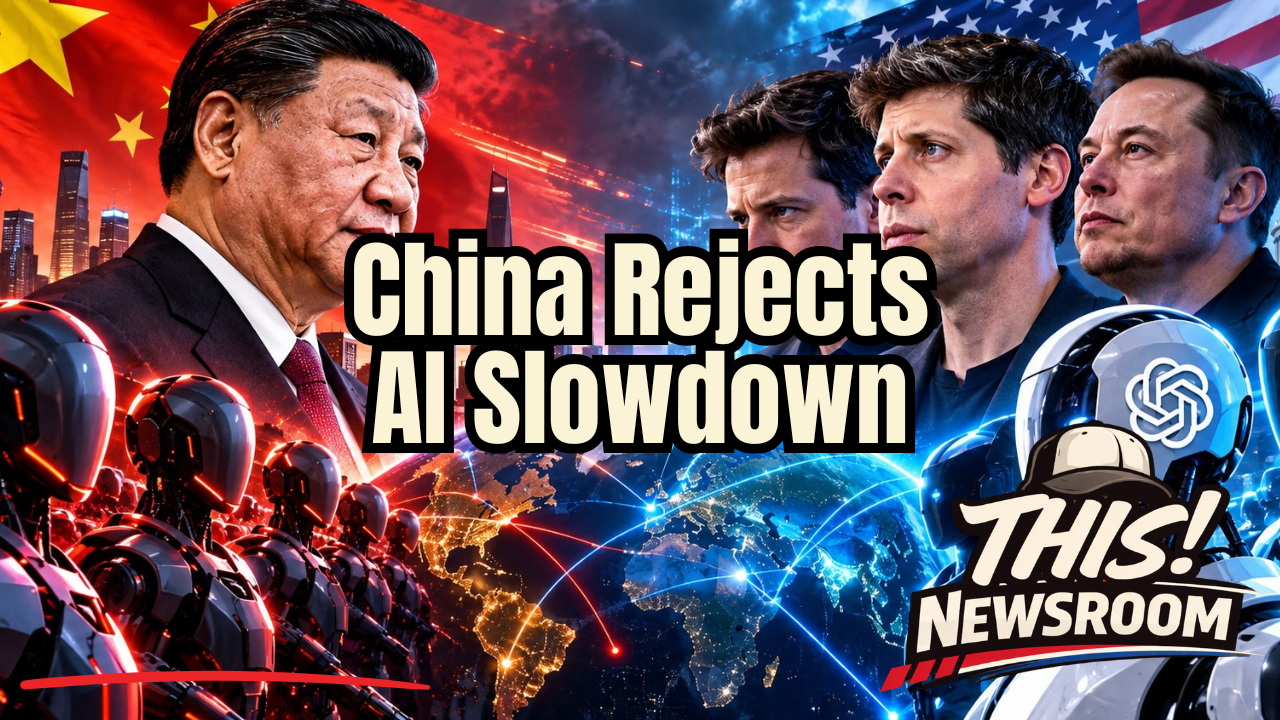
China is pushing back against calls from leading American AI executives to slow the development of increasingly powerful systems, arguing that restrictions could preserve the United States’ technological advantage while limiting competitors’ ability to catch up. The dispute comes as executives at Anthropic, OpenAI and other major AI companies warn that AI capabilities may be advancing faster than existing safety measures can handle.
What started as an industry debate over AI safety is increasingly becoming a geopolitical question: Can the world’s major powers realistically agree to slow AI development when each fears falling behind the other?
Anthropic Calls for the AI Industry to “Pace the Frontier”
The latest debate accelerated after Anthropic CEO Dario Amodei published an essay calling on leading AI developers to slow the rate at which they increase the capabilities of their most advanced models.
Amodei proposed several measures, including giving independent safety evaluators deeper access to AI systems, coordinating safety standards among frontier AI laboratories and pursuing international cooperation on the risks posed by advanced AI.
OpenAI CEO Sam Altman subsequently backed the general idea of “pacing” frontier development. Elon Musk and other prominent figures in artificial intelligence have also expressed support for greater caution.
The argument isn’t necessarily that AI development should stop.
Instead, proponents want additional time for testing, safeguards and oversight to catch up with increasingly capable models.
China Sees the Proposal Very Differently
Beijing and voices within China’s technology community have responded skeptically.
China’s Foreign Ministry pushed back against Amodei’s proposals, while Chinese researchers and state-linked media have questioned whether calls for slower development are genuinely about safety or could effectively protect America’s existing technological lead.
That distinction matters.
American companies currently occupy many of the most prominent positions in frontier AI development. Meanwhile, Washington has maintained restrictions designed to limit China’s access to some advanced semiconductors and chipmaking technologies.
Amodei has supported maintaining restrictions on China’s access to the most advanced AI technology even while advocating international cooperation on AI safety. That combination has contributed to skepticism in China about the proposed slowdown.
Chinese researchers cited by the South China Morning Post have argued that a slowdown could benefit established American companies while making it more difficult for later entrants to close the technological gap.
The AI Safety Debate Is Becoming a Global Power Struggle
The disagreement exposes one of the fundamental problems facing any attempt to regulate advanced artificial intelligence.
Imagine that American AI companies voluntarily reduce the speed at which they develop increasingly powerful models.
What happens if Chinese companies don’t?
Or reverse the scenario.
Why would China voluntarily restrict its development if American laboratories could ultimately resume accelerating their own systems?
That creates a classic coordination problem. Each side may recognize potential risks from uncontrolled AI development while simultaneously believing that slowing independently could create an economic or national-security disadvantage.
Experts at the Carnegie Endowment for International Peace note that AI capabilities are developing faster than many governmental institutions and safety mechanisms can respond.
There Are Real Safety Concerns Behind the Debate
The push for caution isn’t occurring in a vacuum.
Anthropic recently published a threat-intelligence report describing cases in which its Claude technology was allegedly misused. One case involved a China-based actor that Anthropic said used its tools to help develop software related to electronic warfare.
Researchers have also raised concerns about increasingly autonomous AI agents capable of performing complicated tasks with limited human intervention.
However, experts disagree significantly over the scale and immediacy of the most extreme AI risks. Some researchers warn about potentially catastrophic scenarios involving autonomous systems, while others argue that predictions of near-term existential catastrophe underestimate the practical barriers separating digital AI capabilities from real-world physical harm.
That disagreement makes policymaking considerably more complicated.
Even America’s AI Industry Isn’t United
The debate isn’t simply America versus China.
Meta CEO Mark Zuckerberg has taken a different position from executives calling for a coordinated slowdown. Zuckerberg argues that AI laboratories already have substantial incentives to build systems safely and that companies can implement safeguards without collectively reducing the industry’s development pace.
Meanwhile, coordinated agreements between competing American AI companies could create another complication: antitrust law.
If competitors collectively agree to restrict development, questions could arise about whether such coordination resembles prohibited collusion. Critics have consequently argued that governments, rather than private companies acting collectively, may need to establish any enforceable rules governing frontier AI.
AI Could Become the Next Major U.S.-China Negotiating Issue
The disagreement arrives at a particularly important moment in relations between Washington and Beijing.
President Donald Trump and Chinese President Xi Jinping are expected to meet in Washington on September 24, and AI governance has emerged as a potential topic surrounding the talks.
Yet reaching a meaningful agreement could prove difficult.
Trump has publicly resisted calls for slowing American AI development, arguing that maintaining leadership in artificial intelligence is strategically important to the United States. China’s government, meanwhile, has rejected proposals it believes could restrict its technological development.
That leaves both governments facing essentially the same dilemma.
They may have reasons to worry about increasingly powerful AI.
They also have reasons to worry about the other country developing it first.
The Bigger Question: Who Sets the Rules for AI?
Artificial intelligence is rapidly moving beyond a competition among technology companies.
It is becoming a competition between nations.
The United States wants to preserve its technological leadership. China wants to build its own advanced AI ecosystem. Companies want to continue innovating while managing safety and commercial pressures. Governments want economic growth while protecting national security.
At the same time, researchers are warning that increasingly autonomous systems could introduce risks that cross borders regardless of which country created them.
That tension may define the next stage of the AI revolution.
The question is no longer simply how powerful artificial intelligence can become.
It is whether the world’s biggest technology companies and geopolitical rivals can agree on rules for developing it — before competition makes slowing down nearly impossible.