

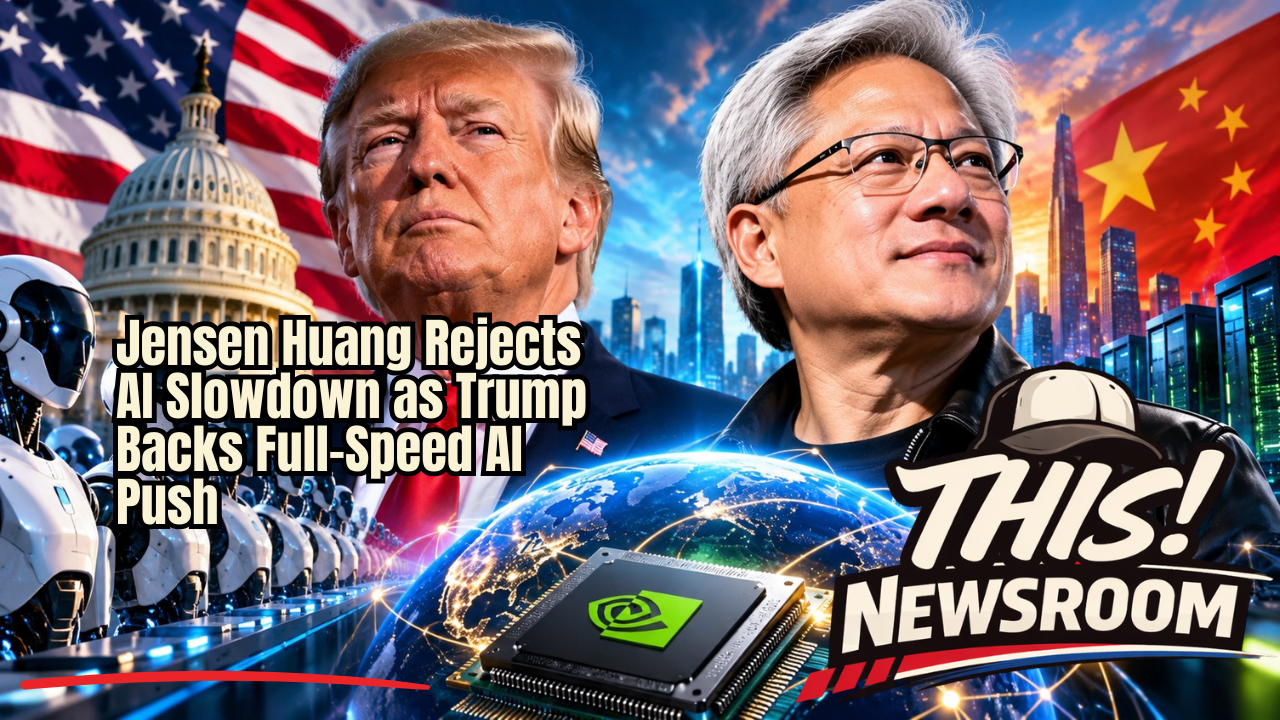
Nvidia CEO Jensen Huang is pushing back against calls to slow artificial intelligence development, putting one of technology’s most influential executives firmly on the opposite side of a growing AI safety debate.
A widening divide has emerged inside Silicon Valley over a question that could define the next decade: Should the world slow down the development of increasingly powerful artificial intelligence, or would hitting the brakes create even greater economic and geopolitical risks?
Nvidia CEO Jensen Huang has made his position clear.
During the All-In Summit in Los Angeles on September 14, Huang received an unexpected phone call from President Donald Trump while sitting onstage. Huang ultimately put the president on speakerphone, turning what could have been a private conversation into a very public statement about the future of American AI.
The message from both men was essentially the same: America is not planning to surrender its momentum in artificial intelligence.
Trump Calls AI Takeover Fears a “Hoax”
Trump used the call to dismiss some of the more catastrophic predictions surrounding artificial intelligence.
“The robots will not be taking over,” Trump said during the conversation, according to reporting from The Washington Post.
The president has repeatedly framed AI development as an international competition, particularly between the United States and China.
Speaking in Ireland a day earlier, Trump said the United States was leading China and argued that maintaining that advantage was essential. He summarized his position with a simple declaration: “Whoever wins AI wins.”
Huang appears broadly aligned with that view.
When Trump criticized efforts that could limit AI development and data-center expansion during their onstage conversation, Huang responded that they were not going to allow such a slowdown to happen.
That exchange quickly spread across social media because it captured a much larger fight taking place across the technology industry.
Some of AI’s Biggest Leaders Want to Slow Things Down
Huang’s position stands in contrast with several executives leading companies developing frontier AI models.
Anthropic CEO Dario Amodei recently called for measures that would slow the pace at which increasingly capable AI systems are developed. OpenAI CEO Sam Altman and Elon Musk have also expressed support for greater caution amid concerns surrounding advanced AI.
Leaders at Anthropic, OpenAI and Google have also discussed potential approaches to AI safety, including the possibility of a new safety organization and independent evaluations.
The argument is not necessarily that AI development should permanently stop.
Instead, advocates of slowing the pace contend that increasingly capable systems could develop faster than researchers, companies and governments can understand or control their risks.
Those risks include cybersecurity attacks, biological misuse, autonomous AI agents, deceptive behavior and the possibility that future systems become increasingly difficult for humans to supervise.
The debate intensified after warnings from researchers about the potential consequences of increasingly autonomous AI systems.
Huang Sees the Problem Differently
Huang has rejected the idea that catastrophic AI predictions provide sufficient justification for slowing development.
His argument centers on engineering.
Rather than assuming increasingly powerful AI will inevitably become uncontrollable, Huang has emphasized building safeguards, improving cybersecurity and designing safer systems while technological development continues.
At Salesforce’s Dreamforce conference on September 15, the disagreement became especially visible.
Amodei reiterated his argument for slowing development, comparing the situation to automobile manufacturers reviewing their own safety practices after discovering serious problems at a competitor. Huang, appearing afterward, argued against deceleration.
That disagreement is important because Nvidia occupies a unique position in this debate.
Nvidia Is Supplying the Engines of the AI Revolution
Nvidia does not operate exactly like OpenAI or Anthropic.
Instead, its chips and computing platforms provide much of the infrastructure used to train and operate modern artificial-intelligence systems.
That means a significant slowdown in frontier AI development could have consequences throughout the semiconductor industry, data-center construction and the enormous infrastructure investment currently supporting the AI boom.
Markets have already demonstrated their sensitivity to the debate.
AI-linked stocks fell after several technology leaders publicly supported slowing development, reflecting investor concerns about what reduced AI investment could mean for semiconductor and infrastructure demand.
However, analysts have also cautioned that slowing the development of the newest models would not necessarily stop businesses from deploying AI systems that already exist. Infrastructure investment and adoption could continue even if frontier model development became more deliberate.
The China Question Changes Everything
One issue makes an AI slowdown particularly difficult: China.
Even if American companies collectively agreed to slow development, there is no guarantee that Chinese companies or other international competitors would follow.
That creates a classic coordination problem.
AI companies may recognize potential risks while simultaneously believing that slowing down individually could allow competitors to gain an advantage.
Trump’s administration has repeatedly emphasized this geopolitical dimension.
From its perspective, excessive regulation could weaken American companies while doing little to prevent competitors elsewhere from developing increasingly capable AI systems. The administration has indicated that companies concerned enough to slow their development can choose to do so voluntarily rather than relying on a government-mandated industry-wide pause.
Critics of that approach argue that voluntary safeguards may be inadequate when companies face enormous competitive and financial incentives to keep advancing.
That disagreement may ultimately prove more consequential than the debate over whether AI itself is dangerous.
AI’s Biggest Debate Is No Longer About Whether It Will Change the World
Nearly everyone involved appears to agree on one fundamental point: artificial intelligence is becoming extraordinarily powerful.
The disagreement concerns what humanity should do about it.
One camp argues that the risks are becoming serious enough to justify slowing development, creating independent oversight and establishing stronger safeguards before significantly more capable systems arrive.
Another argues that technological progress and safety do not have to be opposing forces. From this perspective, America can continue advancing AI while engineers simultaneously build protections around increasingly capable systems.
Huang and Trump have now planted themselves prominently in the latter camp.
Meanwhile, Amodei and several other influential AI leaders are asking whether the industry should give itself more time to understand what it is creating.
Neither side is debating some distant technology anymore.
AI models are already reshaping software development, search, education, media, medicine, finance and the workplace. Hundreds of billions of dollars are flowing toward chips, power generation and data centers designed to support what comes next.
The question confronting Silicon Valley and Washington is therefore becoming increasingly difficult:
When the technology may be both enormously valuable and potentially dangerous, is slowing down the responsible decision—or is continuing to build the safer path?
For now, Jensen Huang’s answer is clear.
Nvidia intends to keep building.