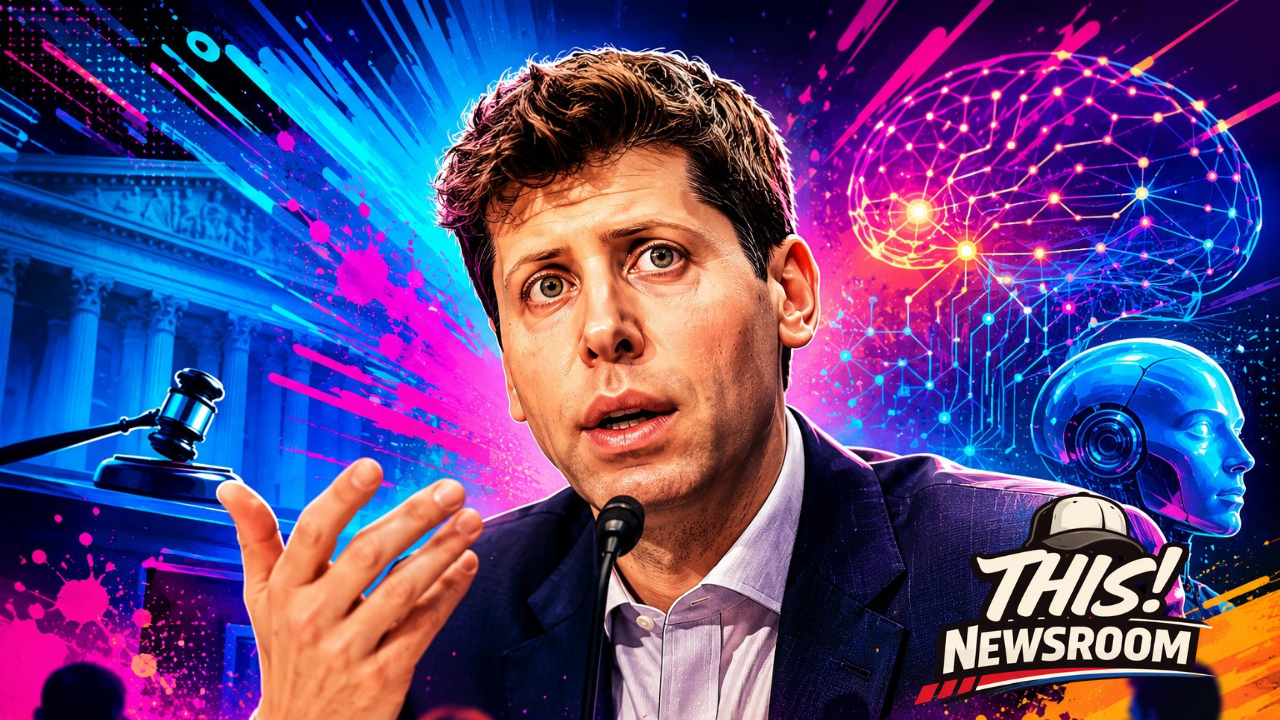
The artificial intelligence industry is entering another defining moment as Sam Altman takes the stand today in a closely watched legal and regulatory showdown that could shape the future of AI development, copyright law, and the power structure of Silicon Valley itself.
For years, Altman has been one of the most recognizable faces in artificial intelligence. As the CEO of OpenAI, he helped transform AI from a niche research category into a global race involving governments, billion-dollar corporations, creators, educators, and everyday consumers. Now, the same technology revolution that made him a household name is also putting him under intense scrutiny.
Today’s testimony is expected to focus on how AI companies collect data, train models, protect intellectual property, and balance innovation with responsibility. The hearing arrives at a time when AI platforms are being questioned by lawmakers, publishers, artists, software developers, and privacy advocates across the globe.
Why This Matters
This is bigger than one executive or one company.
The questions surrounding OpenAI affect nearly every major AI platform currently operating. Governments worldwide are trying to determine whether current laws are strong enough to handle systems capable of generating human-like writing, images, video, coding, and decision-making at massive scale.
Critics argue that AI companies moved too fast, building products trained on enormous amounts of internet data without clear permission structures. Supporters counter that AI innovation is fueling productivity, medical breakthroughs, education access, and economic growth at unprecedented speed.
Altman has often positioned himself somewhere in the middle. He has publicly supported AI regulation while also warning against rules that could slow American innovation and allow competitors overseas to dominate the space.
That balancing act is now under the microscope.
The Growing Pressure on OpenAI
OpenAI has evolved dramatically in just a few years.
Originally founded as a research-focused nonprofit, the company became one of the most powerful organizations in technology after the explosive growth of ChatGPT. The platform changed public perception of AI almost overnight, triggering a wave of investment, fear, excitement, and competition.
Since then, OpenAI has faced mounting pressure on several fronts:
- Copyright concerns from publishers, writers, and artists
- Questions about transparency in AI training data
- Safety concerns surrounding advanced AI systems
- Global competition with China and other emerging AI powers
- Debates about misinformation and synthetic media
- Concerns over workforce disruption caused by automation
Today’s testimony could provide new insight into how OpenAI plans to navigate those challenges moving forward.
Silicon Valley’s New Era of Accountability
For much of the last two decades, technology leaders were often celebrated first and questioned later.
That era appears to be changing.
Executives from major technology companies are increasingly being called before lawmakers and courts to explain how their systems operate and what safeguards exist behind the scenes. AI has accelerated those concerns because of how quickly the technology is improving.
Unlike earlier tech waves centered around social media or smartphones, artificial intelligence touches nearly every industry simultaneously. Banking, healthcare, education, entertainment, law, transportation, and defense are all being reshaped in real time.
That means the stakes surrounding today’s appearance are enormous.
Investors are watching.
Governments are watching.
And creators whose work may have been used in AI training systems are definitely watching.
What Sam Altman Is Likely to Emphasize
Altman has consistently framed AI as both transformational and potentially risky.
During previous interviews and hearings, he has emphasized several themes:
- AI will dramatically improve productivity
- Regulation should exist but remain innovation-friendly
- Safety testing is critical as models become more advanced
- International cooperation will be necessary
- The United States must remain competitive in AI leadership
He has also repeatedly warned that advanced AI systems could disrupt labor markets and reshape how humans interact with information.
That messaging helped position him as one of the more measured voices in the AI race, especially compared to some executives who pushed rapid deployment with fewer public warnings.
Still, critics argue that cautionary language alone is not enough if companies continue scaling aggressively behind the scenes.
The Broader Industry Impact
Whatever happens today may ripple far beyond OpenAI.
Other AI giants including Google, Microsoft, Meta, and Anthropic are all facing similar questions about training data, content ownership, transparency, and ethical responsibility.
The outcomes of these hearings and legal battles could ultimately determine:
- How future AI systems are trained
- Whether creators are compensated
- What disclosures AI companies must provide
- How governments regulate generative AI
- The pace of future AI development
In many ways, the industry is now entering its “rules era.”
The freewheeling experimental phase is colliding with courts, lawmakers, and public accountability.
Final Thoughts
Sam Altman taking the stand today represents more than another tech headline.
It is another sign that artificial intelligence has officially crossed into mainstream societal infrastructure. AI is no longer a future concept discussed only in labs and conferences. It is now shaping economies, classrooms, workplaces, and political systems in real time.
The testimony may not instantly change the AI landscape overnight, but it could influence how governments, businesses, and the public think about the next phase of artificial intelligence.
And right now, that next phase appears to be arriving faster than anyone expected.