
Tesla spent most of its first two decades trying to prove that electric vehicles could compete with gasoline-powered cars. By 2027, the company may look far less like a traditional automaker.
The pieces are already coming together.
Tesla is producing the Cybertruck and Cybercab, preparing the Semi for greater production, developing its long-delayed next-generation Roadster and building manufacturing capacity for Optimus. Meanwhile, the company continues expanding its Robotaxi service.
Tesla’s own Master Plan Part IV makes the shift explicit. The company describes its future around artificial intelligence, autonomy, robotics, energy and manufacturing rather than simply selling more EVs.
That could make 2027 one of the most important years in Tesla’s history.
But there is an important distinction between Tesla’s confirmed products and some of the futuristic concepts circulating online.
The Core Tesla Lineup Isn’t Going Anywhere
Tesla’s Model 3 and Model Y remain central to the company’s automotive business.
The Model 3 helped push Tesla into the mass market, while the Model Y became the company’s high-volume crossover. Tesla continues producing both vehicles across several factories worldwide.
Cybertruck adds something completely different.
Its stainless-steel body and angular design already make it one of the most recognizable vehicles on the road. Tesla lists annual installed Cybertruck manufacturing capacity in Texas at more than 125,000 vehicles, although installed capacity should not be confused with actual production volume.
Together, those vehicles form the recognizable Tesla automotive business.
The next wave looks considerably different.
Cybercab Could Change What a “Tesla” Actually Is
Cybercab represents one of Tesla’s biggest departures from conventional automobiles.
Rather than designing the vehicle around a driver, Tesla designed Cybercab around autonomy.
There is no conventional steering wheel or set of pedals in the standard vehicle. It seats two passengers and uses Tesla’s autonomous-driving technology to operate as part of its Robotaxi fleet. Tesla says the vehicle offers a center touchscreen and cargo room for items including luggage and golf clubs.
More importantly, Cybercab is no longer merely a concept.
Tesla confirmed in its second-quarter 2026 update that it had started Cybercab production. The company also began engineering test drives of production vehicles on public roads and employee rides at Gigafactory Texas.
Tesla lists installed annual Cybercab manufacturing capacity in Texas above 125,000 units. However, the company pushed its expected volume-production ramp beyond its earlier 2026 target.
Regulation remains another major variable. NHTSA recently requested additional information from Tesla concerning Cybercab’s certification, including questions related to vehicle controls.
So Cybercab is real and production has started, but the scale and timing of its broader rollout remain developing stories.
Robotaxi May Be Even Bigger Than Cybercab
The vehicle is only one piece of Tesla’s autonomy strategy.
Tesla is already operating Robotaxi rides in multiple U.S. cities. Its current Robotaxi website lists Austin, Dallas, Houston, Miami, Orlando and Tampa. The fleet includes Model Y vehicles as well as Tesla’s purpose-built Cybercab.
That matters because Tesla increasingly appears interested in selling transportation as a service alongside selling vehicles.
If autonomous fleets expand substantially, Tesla would effectively operate both sides of the equation: manufacturing the vehicles and providing the software and network through which customers use them.
That is a dramatically different business model from simply selling Model Ys.
Then There’s the Tesla Semi
Tesla’s Semi has traveled a much longer road toward mass production.
The electric Class 8 truck was originally revealed alongside the second-generation Roadster in 2017. Tesla now lists its Nevada Semi factory as being commissioned, while the company continues increasing battery-cell production to support the Semi and Cybercab ramps.
Tesla has said Semi production has started, although the company previously pushed back expectations for reaching volume production.
If Tesla successfully scales the Semi during 2027, its transportation footprint would stretch from passenger cars and pickups to autonomous taxis and commercial trucking.
The Roadster Could Finally Have Its Moment
Then comes the car enthusiasts have been waiting nearly a decade to see.
The next-generation Tesla Roadster.
Tesla originally unveiled the vehicle in 2017, but production has repeatedly slipped. The company now has another major milestone approaching: Tesla has scheduled a Roadster event for October 1, 2026.
Tesla’s current Roadster page still advertises some extraordinary targets, including a claimed 1.9-second 0-to-60 mph time, a top speed above 250 mph and 620 miles of range. Those remain Tesla’s advertised specifications rather than independently verified production-car performance figures.
The company’s latest manufacturing disclosures still categorize Roadster as being in “design development,” so an unveiling should not automatically be interpreted as immediate mass production.
Still, October could finally provide a much clearer picture of what buyers will actually get.
Optimus May Be Tesla’s Biggest Departure From Cars
Perhaps the most consequential product in Tesla’s future lineup doesn’t have wheels at all.
Optimus is Tesla’s humanoid robot.
Tesla says its goal is eventually to use Optimus for repetitive, monotonous or dangerous work. Master Plan Part IV places robotics alongside autonomy and energy as a central component of Tesla’s long-term strategy.
Tesla is constructing Optimus manufacturing operations in California and Texas. However, scaling the robot remains a major challenge. Elon Musk acknowledged during Tesla’s 2026 earnings discussion that Optimus could be the company’s hardest product ever to manufacture at scale because so many of its components are new.
That makes 2027 potentially important for determining whether Optimus can move from an impressive technology demonstration toward a meaningful commercial product.
What About the Robovan?
Tesla has also revealed Robovan, a futuristic autonomous vehicle designed around moving larger groups of people or cargo.
Unlike Cybercab, however, Tesla has not provided the same level of near-term production detail for Robovan.
Tesla currently includes Robovan in its official media gallery, confirming it as an announced Tesla vehicle, but it does not appear alongside Cybercab, Cybertruck or Semi in Tesla’s latest installed manufacturing-capacity table.
That makes Robovan part of Tesla’s future vision rather than something that should currently be treated as a confirmed 2027 mass-production vehicle.
And That Viral “Cyber SUV”? Be Careful
One of the most striking images circulating online shows what looks like a giant Cybertruck-inspired Tesla SUV.
It certainly looks believable.
But that doesn’t make it an announced Tesla product.
Tesla’s current official vehicle gallery lists Model 3, Model Y, Cybertruck, Cybercab, Robovan, Roadster and Semi among its products. It does not currently list a vehicle called “Cyber SUV.”
Likewise, Tesla’s latest manufacturing table doesn’t identify a Cyber SUV program.
For now, images depicting such a vehicle should be treated as unofficial concepts or speculative renders unless Tesla announces otherwise.
Tesla Is Becoming More Than an EV Company
That may ultimately be the biggest story heading toward 2027.
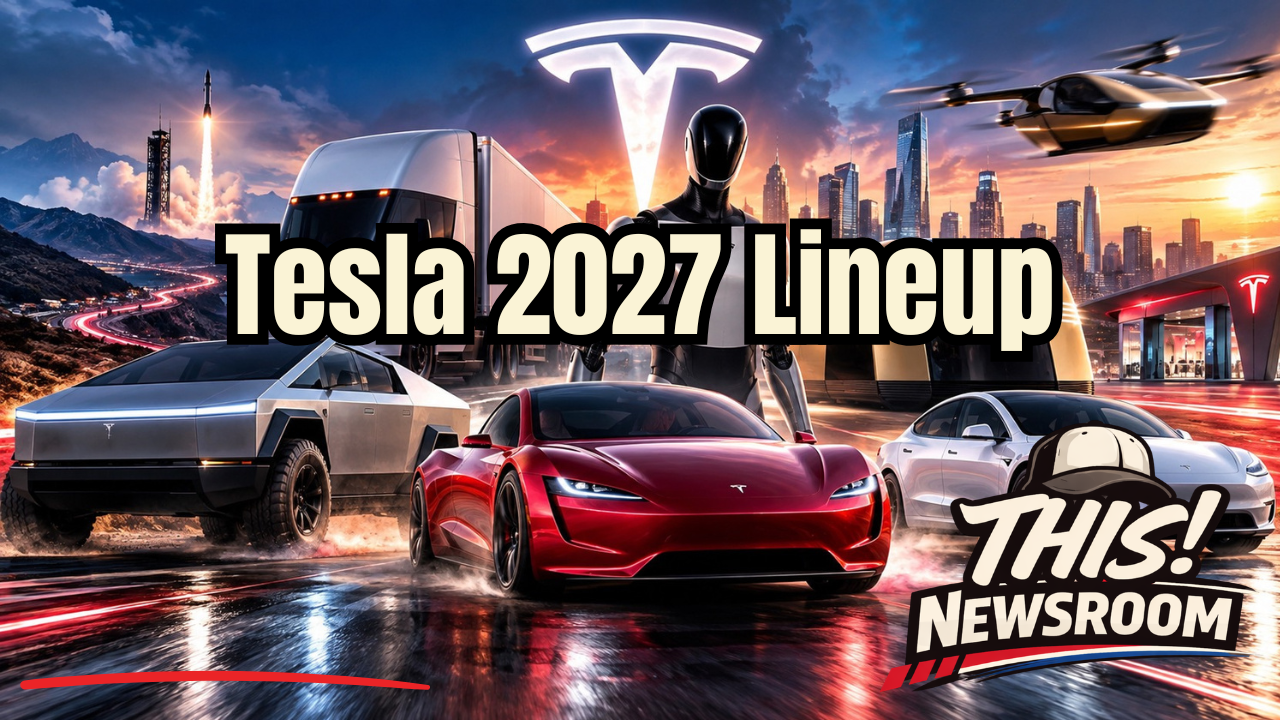
Tesla’s lineup increasingly spans several distinct categories: mass-market EVs, electric pickups, autonomous taxis, heavy trucks, high-performance sports cars and humanoid robots.
Behind all of them sits Tesla’s growing emphasis on AI.
The company describes Master Plan Part IV as an effort to bring artificial intelligence into the physical world through products including FSD, Robotaxi and Optimus.
That strategy carries substantial execution risk. Cybercab faces regulatory questions. Optimus remains difficult to manufacture at scale. Semi’s production ramp has taken longer than initially expected. Roadster has experienced years of delays.
Yet those same projects demonstrate how radically Tesla’s ambitions have expanded.
The company that once built an expensive two-seat electric sports car now wants to manufacture autonomous taxis, commercial trucks, robots and potentially entirely new forms of transportation.
Some of those products could become major businesses. Others could take years longer than expected.
But heading toward 2027, one thing is already apparent: Tesla is increasingly trying to become an AI, robotics and transportation company that also happens to build cars.
And the next 12 to 18 months could show how much of that vision is ready to move from the stage and prototype floor into the real world.