

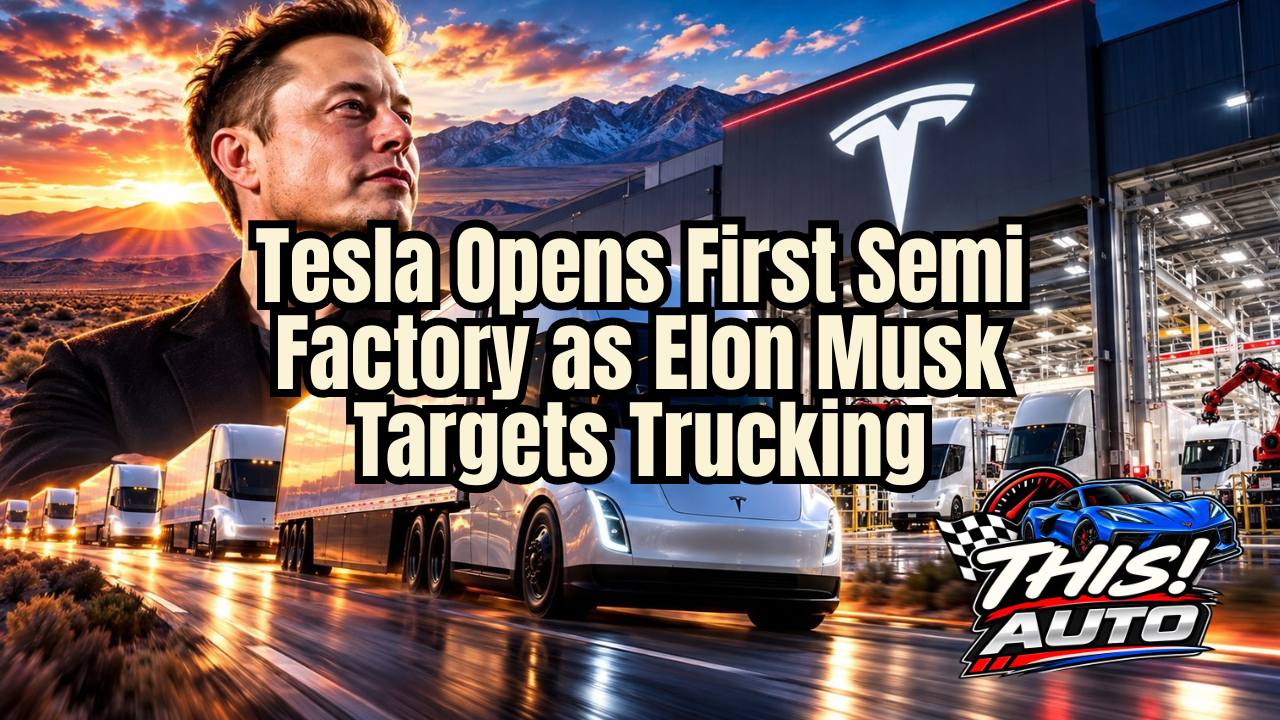
Tesla has officially entered a new phase of its electric vehicle expansion, and this time the target is much bigger than passenger cars.
On September 24, Tesla inaugurated its dedicated Tesla Semi factory in Sparks, Nevada, nearly nine years after Elon Musk first unveiled the electric Class 8 truck. Tesla says the facility is designed to eventually produce up to 50,000 Semi trucks per year, potentially giving the company a meaningful foothold in the commercial freight market.
The opening is significant because Tesla is no longer treating the Semi as a small pilot program. The company says it is beginning deliveries from its new production operation, while Musk described the program as entering “high volume production.”
For Tesla, this isn’t simply another vehicle launch. It is an attempt to bring the company’s electric-vehicle strategy into one of the most demanding segments of transportation.
Tesla’s First High-Volume Semi Factory
The new Semi facility sits alongside Tesla’s existing Gigafactory Nevada operation near Sparks.
Tesla describes the Nevada complex as a major manufacturing center for batteries, powertrains and energy-storage products. The company now identifies the expansion as home to its first high-volume Semi factory.
The dedicated Semi plant covers roughly 1.7 million square feet and was developed as part of the multibillion-dollar Nevada expansion Tesla announced in 2023. The first Semi from the new high-volume production line rolled out in April 2026.
Thursday’s inauguration therefore wasn’t the moment the first truck was physically produced. Instead, it marked Tesla’s public rollout of the factory as the company prepares to scale the program.
And the scale Tesla is targeting is substantial.
The company reiterated that the Nevada plant is designed to eventually manufacture 50,000 Semis annually, although Tesla did not announce its current production rate during the event.
Nearly Nine Years After Elon Musk Unveiled the Semi
Tesla first revealed the Semi in 2017, when Musk presented a futuristic electric truck that promised to challenge diesel-powered commercial transportation.
Getting from unveiling to mass manufacturing took considerably longer than originally planned.
Tesla initially expected production to begin in 2019. Limited deliveries eventually started in late 2022, including trucks delivered to PepsiCo. Battery constraints, production priorities and other delays repeatedly pushed the larger rollout further into the future.
Now Tesla finally has something it lacked during those early years: a dedicated factory designed specifically to manufacture the Semi at scale.
That changes the conversation from whether Tesla can build the truck to how quickly it can ramp production and how widely commercial fleets will adopt it.
PepsiCo, DHL and Other Major Fleets Are Getting Involved
Tesla is already working with recognizable names in freight and logistics.
Executives identified PepsiCo, US Foods and DHL among early Semi customers during the Nevada event. Reuters also reported that Tesla recently received an order involving 2,500 Semis from a coalition of major cargo-owning companies, while Swedish freight technology company Einride previously announced plans to add 500 Tesla Semis to its fleet.
That matters because commercial trucking buyers operate differently from typical car buyers.
Fleet operators care heavily about measurable economics: energy costs, uptime, maintenance, payload, charging infrastructure and total cost per mile.
A truck that looks impressive isn’t enough.
It has to make financial sense.
Tesla Says the Semi Can Travel Up to 500 Miles
Tesla designed the Semi for long-distance freight operations, with the U.S. version offering a claimed range of up to 500 miles.
The company is also developing high-powered charging infrastructure around the vehicle.
Tesla’s broader strategy is straightforward: replace diesel consumption with electricity while attempting to lower operating and maintenance costs for commercial fleets.
During the Nevada event, Musk argued that electricity can provide a lower cost per mile than diesel. He also said demand for the Semi had created what he described as a “pretty significant” waiting list.
Whether those economics work across a broad range of trucking routes will become clearer as more fleets put the trucks into daily service.
The Semi Could Eventually Become Autonomous
Tesla’s ambitions don’t stop with electrification.
Musk said the Semi is eventually expected to incorporate Tesla’s autonomous-driving technology.
That could make the Semi strategically important beyond vehicle sales.
Tesla has increasingly positioned itself as an AI, robotics and autonomy company in addition to being an automaker. Bringing autonomous technology into commercial trucking would put Tesla into another competitive arena involving established truck manufacturers and autonomous-driving companies.
For now, however, the immediate challenge is simpler: manufacture Semis reliably and get them into customers’ hands.
Why Electric Trucks Could Be a Bigger Deal Than Electric Cars
Passenger vehicles receive most of the attention surrounding EV adoption, but commercial trucks present a different opportunity.
Heavy trucks spend enormous amounts of time on the road. That means fuel and maintenance represent major operating expenses for fleet owners.
Even relatively small improvements in operating cost per mile can become significant when multiplied across hundreds of trucks traveling thousands of miles.
Electric trucks also offer the potential to reduce tailpipe emissions along heavily traveled freight corridors.
But electrifying trucking comes with challenges that passenger EVs don’t face at the same scale.
Charging infrastructure must accommodate enormous power demands. Fleet operators cannot afford extended downtime. Battery weight can affect payload economics. Reliability requirements are extremely high.
Tesla now has to demonstrate that the Semi can solve those problems consistently.
Tesla Is Expanding Beyond the Model 3 and Model Y Era
The Nevada opening also illustrates how much Tesla’s product strategy is expanding.
For years, the Model 3 and Model Y became the backbone of Tesla’s automotive business.
Now the company is simultaneously pursuing commercial trucks, autonomous vehicles, energy storage, robotics and other projects.
The Semi gives Tesla access to an entirely different category of transportation.
Instead of competing primarily for consumers buying cars and SUVs, Tesla can now pursue logistics companies, food distributors, retailers and some of the world’s largest freight operators.
The Real Test Starts Now
The opening of the Nevada factory is an important milestone, but Tesla’s biggest challenge comes next.
A factory designed for 50,000 trucks per year does not mean Tesla is currently producing 50,000 trucks annually. Tesla has not disclosed the current annualized production rate for the Semi line.
The coming months should reveal how quickly the company can increase production and how the trucks perform as more commercial customers deploy them.
Nearly nine years after Elon Musk first introduced the Tesla Semi, the vehicle finally has the dedicated manufacturing operation needed to pursue the scale Tesla has talked about for years.
Tesla disrupted the passenger-car market by proving electric vehicles could compete on performance, technology and desirability.
Now it is attempting something different.
It wants to prove electricity can compete with diesel where the vehicles are bigger, the mileage is higher and the economics matter on every single trip.
And with its Nevada Semi factory now officially inaugurated, that experiment is moving from promise to production.
More from This With Krish: Follow the latest developments in Tesla, electric vehicles, artificial intelligence, transportation and the technologies reshaping the future at ThisWithKrish.com.