

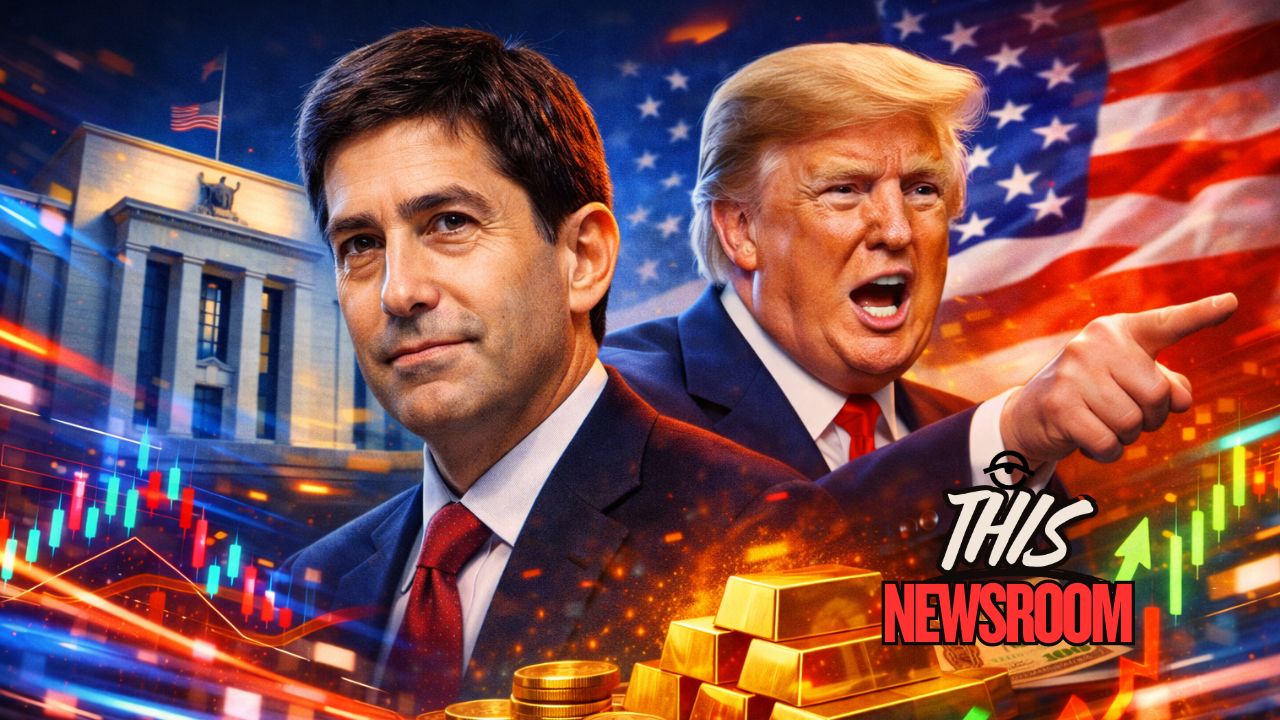
When Donald Trump posts on Truth Social, markets don’t usually move because of policy. They move because of possibility.
That’s exactly what happened when Trump publicly floated Kevin Warsh as a likely replacement for Fed Chair Jerome Powell. Within minutes, traders did what they always do best: panic politely, rebalance aggressively, and pretend later it was all “priced in.”
Stocks wobbled. Bond yields jumped. Gold caught a bid.
And suddenly, Kevin Warsh was no longer a “theoretical Fed chair.” He was a market event.
Who Is Kevin Warsh?
Kevin Warsh is not a new name in monetary policy circles. He’s a former Federal Reserve Governor who served from 2006 to 2011, including through the 2008 financial crisis. That alone gives him more real crisis experience than most of today’s central bankers combined.
But Warsh’s reputation isn’t built on survival — it’s built on dissent.
He has long argued that:
- Ultra-low interest rates distort markets
- Quantitative easing encourages reckless risk-taking
- Central banks underestimate inflation until it’s too late
In other words, Warsh has spent years warning about the very problems the Fed is now scrambling to contain.
Wall Street Roots, White House Access
Before joining the Fed, Warsh worked at Morgan Stanley, advising major corporations and governments. He wasn’t a theorist — he was in the deal flow, watching how cheap money actually changes behavior.
He later served as Special Assistant to President George W. Bush, acting as a bridge between the White House, Treasury, and the Federal Reserve. That role gave him a rare vantage point: how monetary policy looks inside government versus how it behaves in markets.
That dual credibility — Wall Street and Washington — is exactly why his name never fully disappears.
Inflation: Warsh Was Early… and Uncomfortable
Long before “transitory inflation” became the most mocked phrase in economics, Warsh was publicly skeptical.
He warned that:
- Expanding the Fed’s balance sheet at scale would be hard to unwind
- Prolonged stimulus would bleed into consumer prices
- Asset inflation and consumer inflation are cousins, not strangers
When inflation finally surged, Warsh didn’t need to rewrite history. He had receipts.
That credibility matters now — especially after years of Fed messaging that aged poorly.
Why Trump Passed Him Over in 2017
In 2017, Warsh was widely viewed as a leading contender to replace Janet Yellen as Fed Chair. Ultimately, Donald Trump chose Jerome Powell instead.
At the time, the logic was simple:
- Markets wanted continuity
- Cheap money felt good
- Warsh looked… disciplined
Trump would later spend years publicly criticizing Powell for not cutting rates fast enough. Irony has excellent timing.
Warsh wasn’t passed over because he lacked qualifications. He was passed over because he wasn’t guaranteed to accommodate political pressure.
The Truth Social Moment: Markets React in Real Time
When Trump recently suggested — openly — that Kevin Warsh could replace Powell, markets reacted immediately.
This wasn’t subtle.
- Equities pulled back, particularly rate-sensitive growth stocks, as traders priced in a tougher Fed stance
- Treasury yields jumped, signaling expectations of tighter monetary discipline and less tolerance for inflation
- Gold rose, reflecting uncertainty and renewed concern about policy transition risk
None of this required confirmation hearings or formal nominations. The idea of Warsh was enough.
That reaction tells you everything you need to know about how markets perceive him.
Warsh is viewed as:
- Less dovish than Powell
- Less tolerant of inflation
- More willing to shrink the Fed’s balance sheet
Markets don’t wait for appointments. They front-run credibility.
Political Background: Independent Enough to Be Dangerous
Warsh isn’t a populist firebrand, but he’s also not a central bank apologist.
He has criticized:
- Government overspending
- Fiscal dominance over monetary policy
- The Fed’s growing political footprint
That makes him politically inconvenient — and institutionally valuable.
In a moment when both parties are quietly worried about debt, inflation, and credibility, Warsh’s independence is suddenly an asset rather than a liability.
Family and Business Background
Warsh is married to Jane Lauder, granddaughter of Estée Lauder. Yes, that means wealth. No, it doesn’t mean dependence.
If anything, his financial independence has allowed him to be more outspoken, not less. He doesn’t need a revolving-door job. He doesn’t need political favors. That matters in a role where pressure is constant and subtle.
Why He’s Now the Leading Fed Chair Candidate
Jerome Powell stabilized markets during crisis. Kevin Warsh would be expected to restore discipline after it.
That’s the shift underway.
With inflation credibility damaged and political tolerance for endless stimulus fading, Warsh represents a reset:
- Tighter communication
- Fewer emergency tools treated as permanent
- A Fed more focused on price stability than market comfort
Markets may not love the transition — but they respect it.
Final Take: Markets Heard the Subtext
The moment Trump mentioned Kevin Warsh, markets behaved as if the Fed had already changed direction.
That’s not coincidence.
That’s credibility being repriced.
Warsh isn’t loud. He isn’t flashy. And he isn’t comforting.
Which, at this point in the economic cycle, may be exactly why his time has finally arrived.