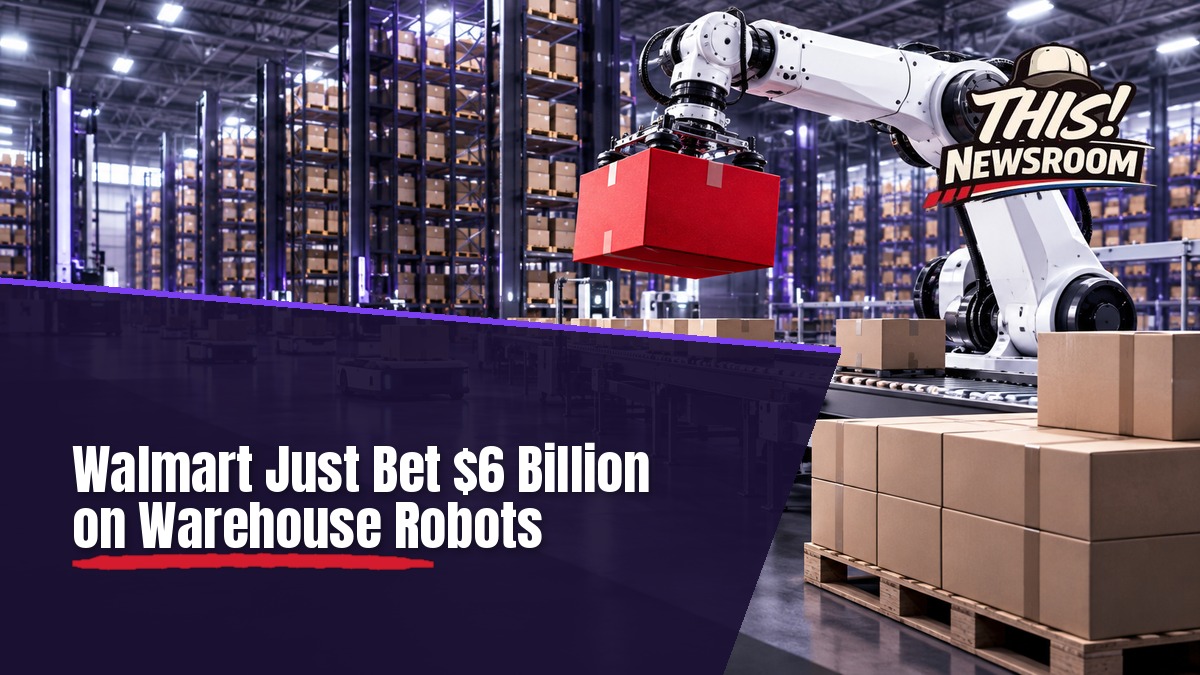
Twenty-five regional distribution centers are about to get a lot more robot, and the first bill is about $6 billion. On Oct. 29, the retail giant and warehouse-robotics company Symbotic announced an expanded Walmart Symbotic automation deal that adds Symbotic’s systems to 25 U.S. regional distribution centers.
Here’s the number that matters. The agreement “includes an initial commitment of approximately $6 billion in spend, covering work over several years across multiple locations,” according to a press release Symbotic filed with the SEC. That is a lot of conveyor belts and very few lunch breaks.
What the Walmart Symbotic automation deal actually covers
Symbotic (Nasdaq: SYM) builds AI-enabled robotics for the supply chain. Walmart (Nasdaq: WMT) is its marquee customer, and the two say they have worked together for more than a decade. This expansion also supports opportunities across Walmart’s global supply chain, according to the release.
Walmart says the added automation will support e-commerce upstream inventory management. It will also increase storage capacity and improve how products move through its network. In plain English, the stuff you order online should get from a warehouse to your door with fewer hiccups. It is the same retailer that just rolled out a new $120 membership bundle, so speed and cost are clearly on its mind.
Rob Montgomery, Walmart U.S. executive vice president of supply chain operations, said in the release: “Our work with Symbotic over the years, including this expanded agreement, helps us improve service, grow capacity, simplify work for our associates and lower costs.”
The fine print on the $6 billion Symbotic Walmart expansion
Read the number carefully. (Press releases are very careful with their nouns.) The release calls it “spend,” not a Walmart capital investment in robots.
It also says “initial,” which suggests this may not be the last check. It does not say whether the money is new or how it relates to earlier spending.
Some outlets have put a bigger figure on it. GuruFocus reports that TD Cowen analysts estimate Symbotic’s backlog could reach about $7 billion once software commitments are counted. That is an analyst estimate, not something either company has confirmed.

For context, Walmart previously paid Symbotic $520 million to outfit 400 of its Accelerated Pickup and Delivery centers, according to Control.com. This new commitment is more than ten times that.
Here’s the thing about Walmart warehouse robots and jobs
So what happens to the people who work in those buildings? The release doesn’t say. It makes no mention of workforce effects beyond Walmart’s line about simplifying work for associates.
Walmart also hasn’t published a site list or a rollout timeline. It says only that the work spans “several years across multiple locations.”
That silence is worth watching. Whenever a company says automation will “simplify work,” the follow-up question is how many positions that work still includes. The answer will show up in hiring numbers long before it shows up in a press release. Amazon’s push offers a preview of that fight, as its million robots and the worker debate show.
For shoppers, the pitch is faster service and lower costs. For warehouse workers and the towns that depend on those jobs, the pitch is still missing. Expect the next chapter to appear in Symbotic’s earnings and Walmart’s quarterly reports, though neither company has said when that detail arrives.
The robots have a contract. When do the people who work alongside them get some answers?