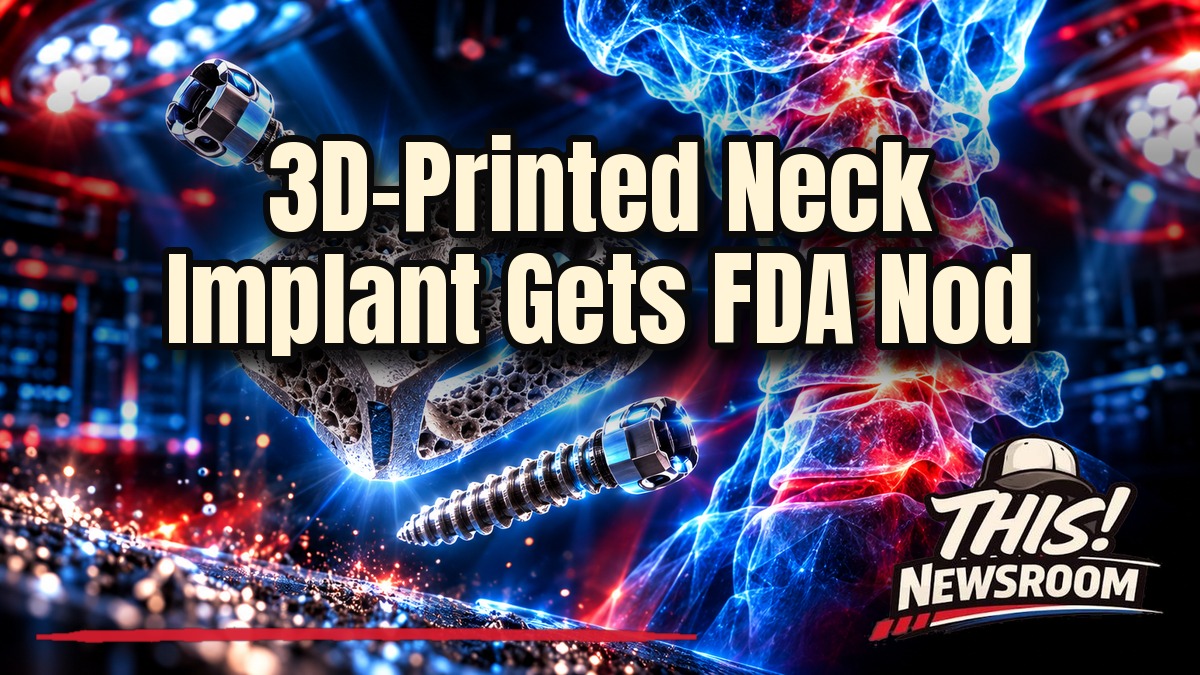
Picture a titanium implant built to look like the spongy inside of a bone. That is the pitch behind the FDA’s 510(k) clearance for the CORUS PCSS 3D-T spinal device, which Providence Medical Technology announced on Oct. 13. The lattice is designed to act like real bone.
First, a correction to the buzz. Some headlines say the FDA “approved” this device. It did not. It cleared it through the 510(k) pathway, which is a different and lighter bar than full premarket approval. Because the distinction matters, we will keep using the right word. This FDA clearance spinal implant news is a regulatory step, not a verdict on results. We’ve covered the same gap before, as when the FDA cleared a lung-clot removal system.
What the FDA-cleared neck implant actually is
According to a company press release on PR Newswire, the device is a 3D-manufactured spinal implant with integrated screw fixation. Surgeons use it to stabilize spinal segments as an add-on to posterior cervical fusion. The company meant it for patients with cervical degenerative disc disease, the age-related wear that breaks down the cushions in the neck.
The new part is the material. The implant uses a porous titanium lattice designed to mimic cancellous bone, the spongy inner kind. The idea, as Orthopedic Design & Technology reports, is to support bone growing into the implant and fusing. Surgeons place it on both sides through the back of the neck, and it comes in a sterile, single-use instrument set.
Same design, new surface on a cervical fusion implant
Here is the thing that keeps this from being a brand-new surgery. The 3D-T keeps the core design, indications and surgical technique of the earlier CORUS PCSS. So surgeons do not have to learn a new procedure. Instead, they get a different, more bone-like surface on a familiar tool.
So where does the evidence come from? A randomized trial, registered as NCT04229017, backs the older CORUS PCSS. When combined with multilevel anterior fusion, it showed higher fusion rates at 12 and 24 months than anterior fusion alone, plus a substantially lower two-year revision rate, per the company. The journal Spine published interim results in May 2025.
That is a strong track record for the first-generation cervical fusion implant. But it is not data on this one.
The caveat on spinal device clearance nobody should skip
The sources do not say the 3D-T has its own clinical outcome data. Instead, the company describes the benefit of the porous titanium, better bone ingrowth, as what the design is “designed to” or “intended to” do. Clearance says a device is substantially equivalent to one already on the market. It does not say it works better.
Also worth knowing: nearly all coverage so far traces back to the company’s own release. We found no independent FDA statement or outside comment. That gap between clearance and proof shows up elsewhere too, as in the Keytruda biosimilar review, where regulatory steps carry very different weight.
Why the company is excited
CEO Lane Major called the clearance “an important milestone for Providence and for the surgeons who rely on our platform.” He added that it is “the next step in our commitment to Total Segmental Fusion and to helping surgeons deliver predictable fusion with fewer revision surgeries for their patients.”
Total Segmental Fusion is Providence’s term for pairing its posterior technology with anterior fusion approaches. The FDA cleared the original CORUS PCSS in July 2024 for up to three-level cervical degenerative disc disease, based on the FUSE study of 227 patients at 18 US sites.
What to watch after this 510(k) clearance for the spine
Providence has shared no launch date, pricing or rollout plan. Meanwhile, the company is lining up a trial of a related device, CORUS PCSS 3D, in two-level disease. That study was listed as not yet recruiting as of July.
For patients facing neck fusion, the practical takeaway is simple. Ask your surgeon which implant they use and what evidence supports it.
A cool material is a good start. Proof that it means fewer repeat surgeries is the real finish line.