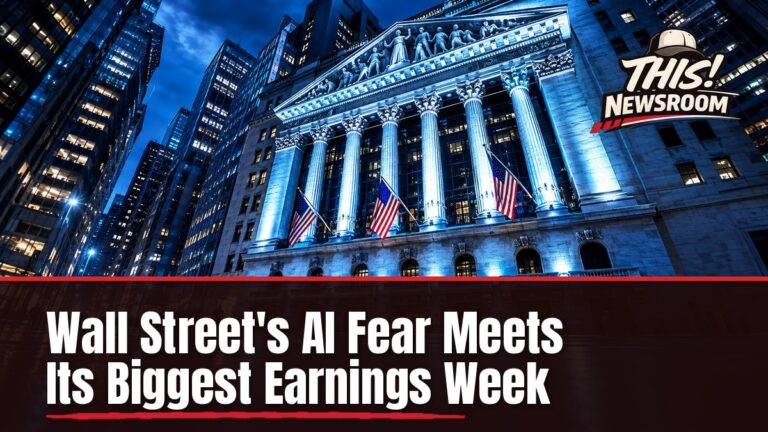
Hot inflation, pricier borrowing and cracks in the AI trade all showed up at the same party, and nobody brought good news. Nasdaq stocks tumbling is the story of the week, with the tech-heavy index down about 1.2% shortly after Thursday’s open, following its worst day since July.
It’s the second straight ugly session for the stocks that rode the AI boom. Here’s what’s driving it, and what it could mean for your 401(k).
What happened to the Nasdaq this week
On Wednesday, the Nasdaq Composite dropped 1.88% and the S&P 500 fell 1.11%, according to CNN. Both were their worst days since July. Thursday opened lower again, with the S&P 500 down about 0.4% early on. That is quite a reversal for an index that sat just shy of a record only days ago.

The pain was sharpest in AI names. CoreWeave sank 15.5% Wednesday, then fell another 7% Thursday. Dell dropped 11% Wednesday and about 8% Thursday. Nvidia slid 3% Thursday, which puts it roughly 10% below the record high it hit earlier this month, per CNN’s report on the global sell-off.
Not a great week to check your balance.
The chip sector is hurting too. A closely watched semiconductor index fell more than 3% Thursday. It now sits 23% below its June peak, and that tech stock slide shows no sign of easing.
Why Nasdaq stocks are tumbling: inflation and interest rates
The first culprit is inflation. A hotter-than-expected September CPI report fed bets that the Federal Reserve will raise rates again. Then Thursday brought another jolt: wholesale prices rose 1.3% in September and 6.3% from a year earlier, CNN reported. That is the hottest wholesale inflation in more than four years. Economists had expected 5.5%.
Why does that hit tech so hard? Because AI companies borrow enormous sums (think of a mortgage the size of a small country’s budget). Higher rates make that debt more expensive, and they make future profits worth less today. The 10-year Treasury yield topped 5.32% during Wednesday’s session, Quartz reported.
“The selloff in Asia looks less like a sudden deterioration in technology fundamentals and more like a repricing of the cost of capital,” Charu Chanana of Saxo Bank said.
The AI trade behind the Nasdaq drop
Inflation alone doesn’t explain the carnage. The AI buildout itself is under the microscope, and it is a major reason for the Nasdaq drop.
CoreWeave, a so-called neocloud that rents out computing power, carries tens of billions of dollars in debt. Its shares are down 66% from their post-IPO peak. On Wednesday, research firm Gartner forecast that over 80% of neocloud providers will cease operations by 2030. That soured the mood fast.
Credit markets are flashing a warning too. Default insurance on Oracle, SoftBank and CoreWeave debt widened, in some cases to records, Reuters reported. Oracle fell about 9% Wednesday.
Competition adds to the worry. Chinese chipmaker CXMT announced progress on advanced memory chips, which raised doubts about profits at US and South Korean rivals. And TSMC’s CEO said rising component prices and macro uncertainty are challenging demand in some segments. TSMC still fell 2% despite record profits.
“Worries about the AI buildout, bubbly valuations, lower-than-expected earnings growth at leading US frontier labs, Chinese competition, inflation and rates sent investors running for the covers,” Saxo strategist Neil Wilson wrote.
The Nasdaq sell-off went global
Asia took the worst of it. South Korea’s Kospi closed down 7.6%, so steep that a circuit breaker briefly halted trading. SK Hynix fell 11% and Samsung 9.5%. Japan’s Nikkei dropped 4.9%.
Europe followed the same script. The region’s tech index fell about 3% in the afternoon, and ASML slid nearly 5%. Meanwhile, investors ran to safety: Treasuries rallied and yields eased Thursday. With Nasdaq stocks tumbling at home and abroad, even the long-promised push toward 23-hour trading won’t give nervous investors a place to hide.
Here’s the thing: why the tech stock slide matters to your wallet
If you own an index fund, you own a lot of this. Big tech and AI names make up a huge slice of the S&P 500, so a sell-off here shows up in your retirement account even if you’ve never bought a single chip stock.
The bigger fear is economic. Jefferies economist Mohit Kumar warned that “a slowdown in the AI infrastructure build out would imply a sharp slowdown in US growth expectations.” The US now spends more on AI each year, as a share of GDP, than it did building railways in the 1800s. So when that spending wobbles, everybody feels it.
Is this a bubble popping?
Not necessarily. CNN notes that fears of a sudden bubble burst have tended to be overblown, and Kumar still expects earnings season to show that demand remains robust. That said, even he would “take some chips off the table” before the midterms, since a Democratic win in Congress could be negative for the sector.
One caution: the Thursday numbers above are early-trading moves, not closing prices. They could change by the final bell. For more on how AI’s long-term promise is being weighed, see our coverage of Anthropic’s financials.
So the question for the weeks ahead is simple. Can AI earnings outrun the cost of money?
Until the rest of earnings season answers, expect Nasdaq stocks tumbling to stay the headline, and the index to keep swinging. Your 401(k) has a front-row seat whether it wanted one or not.