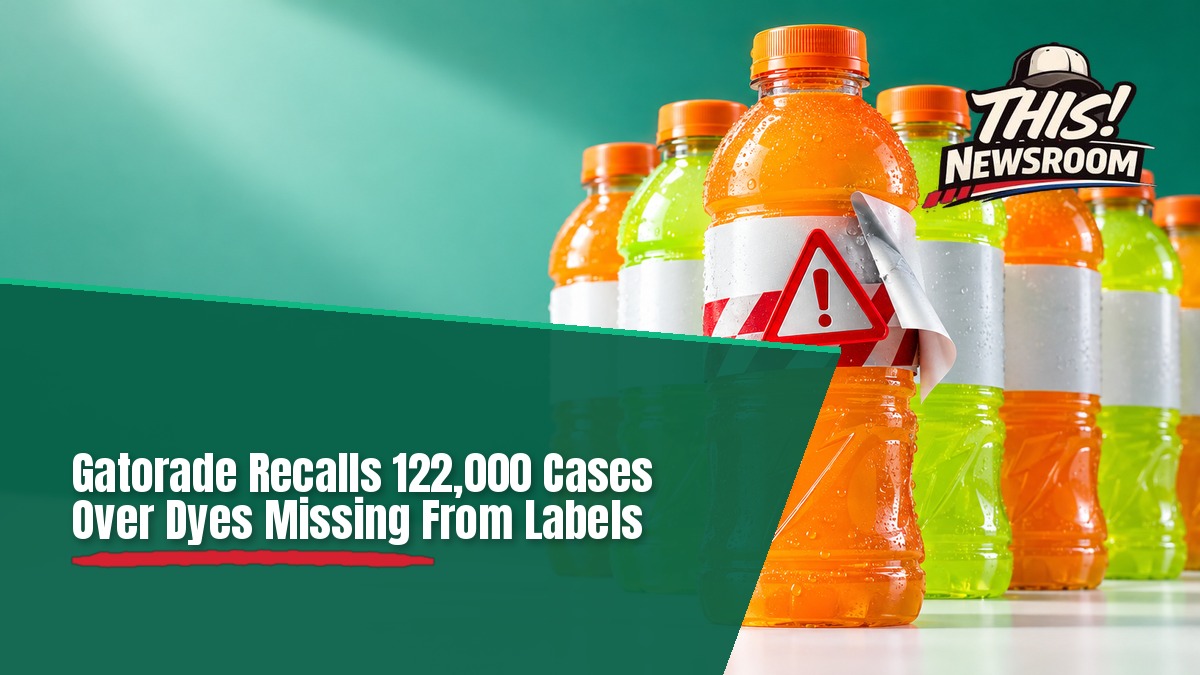
Think you know what’s in the bottle in your fridge? If it’s lemon-lime or orange Gatorade, check the label, because the Gatorade recall covers 122,021 cases of 28-ounce bottles that contain food dyes the packaging never disclosed, according to ABC7 New York’s report on the FDA notice.
The dyes are Yellow No. 5 and/or Yellow No. 6. Both are legal in food. Companies just have to list them, and here PepsiCo didn’t.

What the Gatorade recall covers
PepsiCo, which owns Gatorade, voluntarily started the recall on Sept. 25. The FDA then classified it on Oct. 2 as Class II, and the action is still ongoing.
The recall hits four 28-ounce flavors: Lemon Lime, Lemon Lime Zero, Orange and Orange Zero. NBC News reports that the lemon-lime labels left off Yellow No. 5, while the orange labels left off Yellow No. 6. Other outlets describe it more loosely as “and/or,” so the exact flavor-to-dye match isn’t firmly pinned down.
The bottles went to 37 states, including New York, New Jersey, Pennsylvania, Florida, Texas, North Carolina and California. Affected bottles carry lot dates from April 2027 to June 2027. Altogether, the recalled Gatorade spans 15 lot codes. Local10 lists several of them, including 091026 DL (JUN 07 27) and 072226 DT (APR 18 27). The FDA’s enforcement report (recall number H-0009-2027) has the full list.
Should you worry about the Gatorade undeclared dyes?
For most people, no. Still, that’s not really the point of a label.
Here’s the thing: some people react to these dyes, and they can only avoid them if the label tells them what’s inside. A label is basically a promise, and this one skipped a line.
The FDA says reactions can include a mild rash or allergic-type asthma. They’re uncommon and show up more often in people with aspirin hypersensitivity. Registered dietitian Toby Amidor told Food Network that “a tiny amount of the population” may be allergic, which is exactly why the FDA requires disclosure. That’s also why the Gatorade dye recall matters even without a single reported illness.
Class II is the middle tier of the FDA’s recall system. It applies when a product “may cause temporary or medically reversible adverse health consequences or where the probability of serious adverse health consequences is remote,” the agency’s own definition, as quoted by ABC News. As of Oct. 4, no one had reported illnesses or reactions tied to these bottles.
The awkward timing behind the Gatorade dye recall
Here’s the part that stings. PepsiCo said in April 2025 that it would move away from synthetic dyes toward natural ones. Around the same time, federal health officials announced a plan to work with industry to phase out certified color additives, including Yellow 5 and Yellow 6. We covered that shift in our look at how the U.S. is phasing out artificial food dyes, and it won’t happen overnight.
So the dyes were the very ingredients everyone was already trying to phase out. Leaving them off the label is the kind of slip that tends to draw extra attention right now. It’s also another headline for PepsiCo, as we noted in our piece on Coca-Cola’s media review and the Publicis win.
What to do if you have a recalled Gatorade bottle
Check the lot code and date printed on the bottle against the FDA’s list. If you or someone in your house has a dye sensitivity, or reacts to aspirin, skip it until you’ve confirmed the bottle is clear.
Refund guidance is still murky. PepsiCo hadn’t answered CBS about refunds, and NBC notes that neither the FDA nor Gatorade has issued consumer instructions. In the meantime, keep the receipt and the bottle until that changes.
The recall is still listed as ongoing, so watch the FDA enforcement report for updates. Until PepsiCo says more, the safest move is the simplest one: read the code before you take a sip.