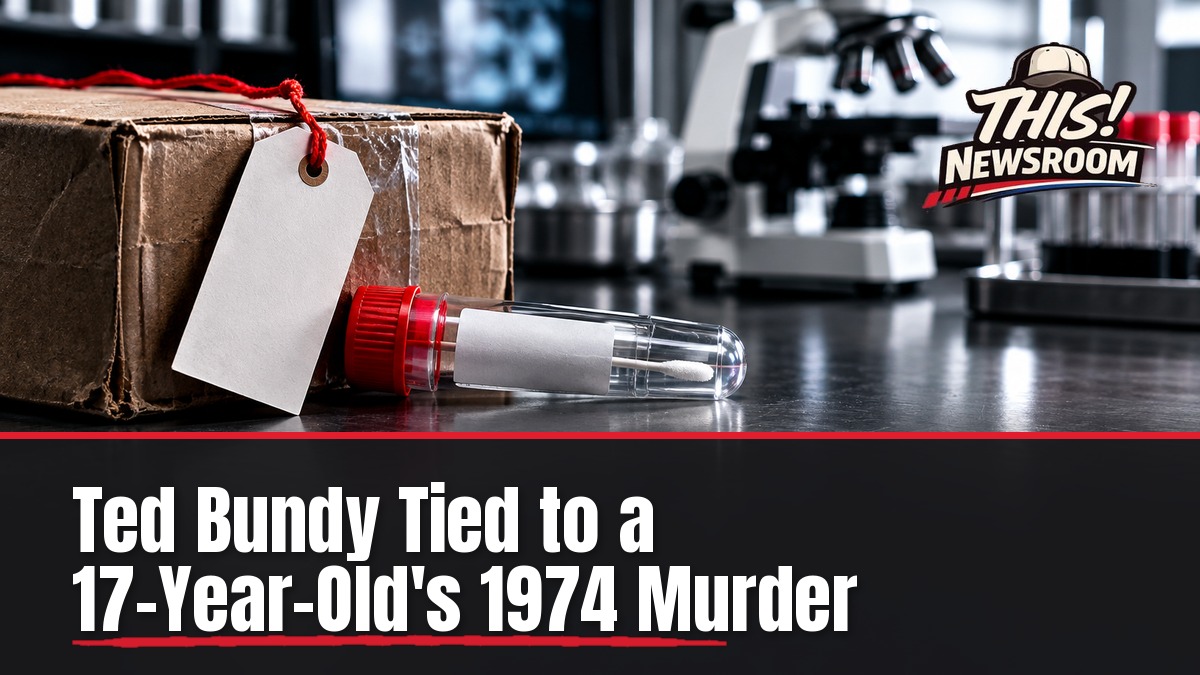
Melissa Ann Smith was 17 when she vanished in 1974. On Tuesday, Utah investigators announced that DNA evidence ties serial killer Ted Bundy to her murder, closing a Ted Bundy cold case that sat open for 52 years.
The news arrived on the exact anniversary of the day hunters found her body.
Summit County’s sheriff and county attorney made the announcement at a joint press conference in Park City, ABC4 Utah reports. Salt Lake County Sheriff Rosie Rivera, Utah County Sheriff Mike Smith and Utah State Crime Lab analysts stood alongside them. The Bundy murder case is not a story of one lab result. It rests on decades of kept evidence.
The Melissa Smith murder: what happened in 1974
Smith, of Midvale, vanished after leaving a pizza restaurant where she had gone to see a friend. Her family reported her missing Oct. 18, 1974. She was the daughter of then-Midvale Police Chief Louis Smith, according to KPCW.
Hunters found her body on Oct. 27, 1974, near Toll Canyon in Summit Park. The case then stayed open for decades. “Although there was much speculation about a suspect at the time, a suspect was never named and the case was never officially closed,” Summit County Sheriff Kacey Bates said, per the Deseret News.
The Bundy DNA match: how investigators did it
The break came from Y-chromosome (Y-STR) DNA taken from Smith’s body. Investigators compared it with the profile developed in the Laura Ann Aime case. Because April testing had definitively linked Aime to Bundy, the profiles could be checked against each other, and they matched, NewsNation reports.
Here’s the part worth understanding. Y-STR DNA traces a paternal line, not one individual, and it isn’t cataloged in a national database. So the DNA alone doesn’t carry the case. Officials say it was the DNA plus evidence of “pattern, motive, means and opportunity.” As Summit County Attorney Margaret Olson put it, that combination “establishes that Ted Bundy was responsible for Melissa Ann Smith’s murder.”
No source has published a statistical figure for the match. Reports also differ on when investigators first saw it: the Salt Lake Tribune points to July 14, while AP reporting says Utah County presented the evidence to Summit County on Oct. 7. They may describe different steps, and no one has reconciled the dates yet.
Why this Ted Bundy cold case matters for other unsolved crimes
Florida executed Bundy in 1989, and he confessed to about 30 murders. Courts convicted him of only three. Before his death, someone asked him about Smith and Aime, and he said he did not recall meeting either woman. Nobody should read this as a confession, and nobody can charge him, because Bundy is dead.
Here’s the thing: this is a template, and it matters to any family still waiting on an answer. The Utah State Crime Lab picked up newer DNA genotyping in 2023, a method that can rebuild fuller profiles from degraded or mixed samples. Evidence kept for half a century, a better lab technique and counties sharing profiles produced two closures in one year.
Sheriff Rivera put the lesson plainly: “This case demonstrates the importance of preserving evidence.”
That should get the attention of every agency sitting on unsolved cases from the 1970s and 80s. Science keeps moving, too, much like the way newer research keeps overturning recovery habits people swore by. It’s also the quiet argument for never throwing out the old evidence box.
What happens next after the 1974 cold case solved
Smith’s next of kin received notice but no longer live in Utah and declined to attend. Utah investigators say they are still working to link the disappearance of Nancy Wilcox, 16, of Holladay, to Bundy, and are pursuing leads on other possible Bundy homicides. Officials gave no dates. Salt Lake County Detective Ben Pender said closing this case “does not close the book on Ted Bundy.”
The next question is whether other states where Bundy operated, including Washington, Colorado, Idaho and Florida, ask for his newly developed DNA profile. If they do, more families could get answers after decades of waiting. Public attention can be fickle, though, and funding fights over public money often decide which old cases get lab time.
Which family will be the next to hear that their wait is over?