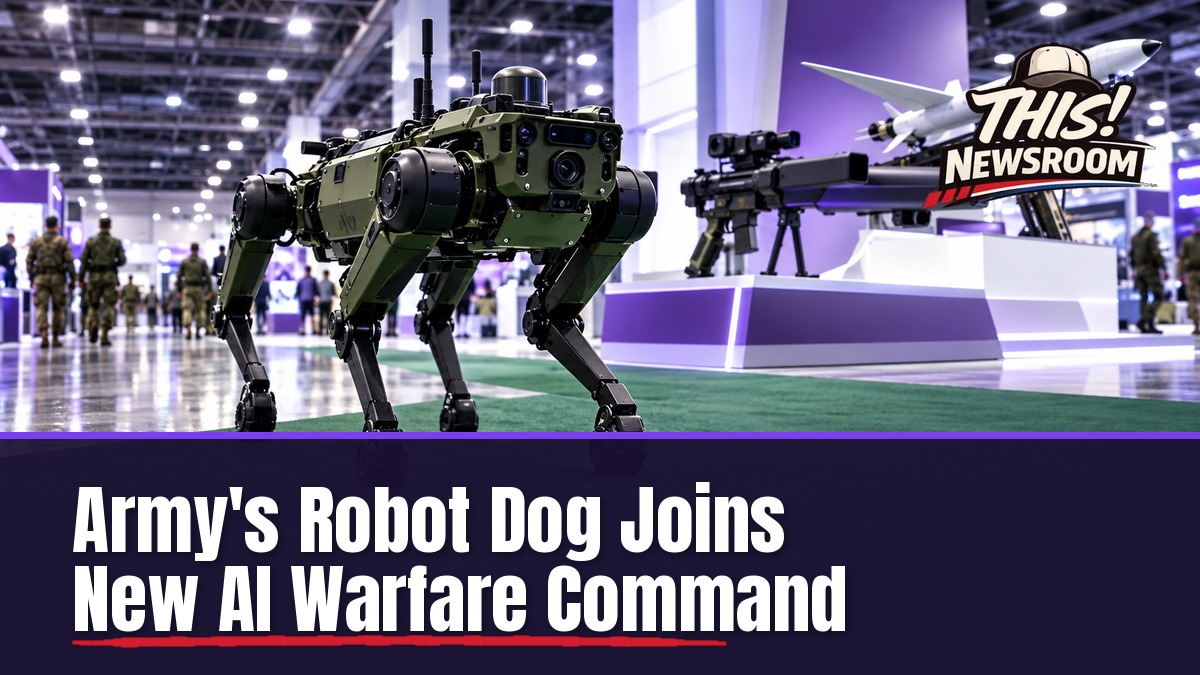
The Pentagon is racing toward autonomous warfare, and the money is already moving. At the Army’s biggest annual conference this week, War Secretary Pete Hegseth pushed a planned four-star Autonomous Warfare Command, while a $982 million Army contract for lethal unmanned systems kept defense vendors busy. The Army robot dog, according to Fox News, strolled the AUSA floor beside a small armory of drone-stoppers.
The machine drew the crowds. The command, the contracts and the manufacturing race behind them are the bigger story.
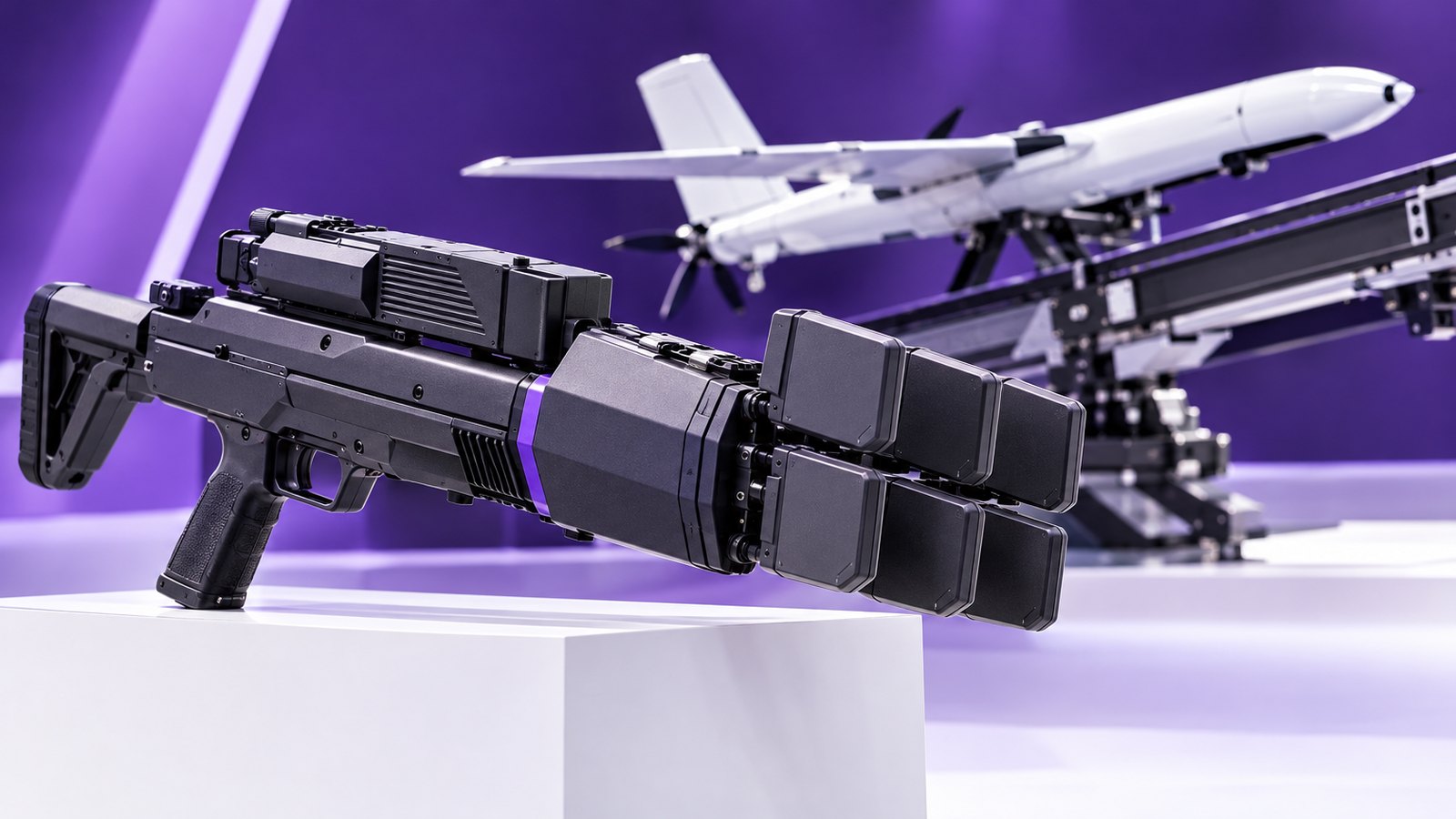
The Drone-Stoppers Parked Beside the Army Robot Dog
The gear sitting near the military robot dog came from Ondas, whose CEO, Eric Brock, spoke with Fox at the event. It includes the Dronebuster, a handheld device that jams or spoofs a drone’s communication and navigation links without firing a shot. A longer-range version is under contract for delivery to the Office of Naval Research for testing and evaluation, though no date has been given.
The other system is IonStrike, which physically intercepts incoming drones, including Shahed-class one-way attack drones. Its onboard guidance lets operators launch it in numbers against several drones at once.
Drone defense is a hot market. For example, Raytheon’s $729 million counter-drone deal shows how much cash is flowing toward swatting away cheap drones. That matters because the drones cost far less than the missiles once used to stop them.
The Money Behind the Four-Legged Military Robot
This isn’t a science fair. Ondas’ Mistral subsidiary holds more than $240 million in orders under the Army’s $982 million Lethal Unmanned Systems contract. That $240 million sits inside the $982 million contract. It does not add to it. The total includes an extra order worth more than $50 million announced in August.
Ondas also bought DZYNE Technologies this summer in a deal valued at roughly $875 million. That purchase is how it picked up both IonStrike and the Dronebuster.
The result: one company now sells a drone jammer, a drone killer and a growing slice of the Army’s unmanned shopping list. That is one-stop shopping, Pentagon edition.
Fox’s subhead says the expo showcased the Pentagon’s push to field counter-drone systems shaped by lessons from Ukraine and the Middle East. In other words, the people designing these systems have watched cheap drones reshape real battlefields.
Here’s the Thing: Robot Dog Soldiers Are a Manufacturing Race
Brock told Fox the real challenge is building autonomous weapons and defenses at massive scale. That makes sense, because a clever prototype wins a trade-show crowd. A factory that can turn out thousands wins a war.
Meanwhile, the threat keeps changing. “It’s always a cat and mouse game,” Brock said, “and we do have to be looking down the field.”
The Pentagon is reorganizing around that idea. According to Fox, Hegseth said at AUSA this week that the department is working toward a four-star-led Autonomous Warfare Command. The Army also has a new autonomous systems command of its own. Other outlets use “Secretary of Defense” for Hegseth’s title.
Hegseth first announced the new command on Sept. 30 as a four-star combatant command with service-like authorities. He said then: “Today at my direction, we are announcing the creation of Autonomous Warfare Command,” Stars and Stripes reported. He also faced protesters at the panel where leaders discussed it.
What This Means for You
You don’t have to wear a uniform to feel this. Speed is the whole contest. A country that can build cheap autonomous systems by the thousand holds an edge, and one that can’t is exposed. That puts a spotlight on the industrial base: the factories, suppliers and engineers who turn prototypes into mass production. Any weak link there becomes a national vulnerability.
The technology also doesn’t stay on the battlefield. Counter-drone tools, robotics and autonomy research feed commercial markets, from logistics to infrastructure security. The tech competition over who builds them first shapes jobs, supply chains and prices at home.
The Catch: The Command Doesn’t Exist Yet
Here is the catch. Standing up the command by Oct. 1, 2027, requires the Pentagon to work with Congress on legislation. Until lawmakers act, “Autonomous Warfare Command” is a plan with a deadline and a lot of contractors lining up. The Navy is moving too, as a crewless ship joining a carrier’s escort makes clear.
So the Army robot dog may be the cute headline, but the money, the contracts and the legislation are the real news. The question now is who builds the next thousand of them, and whether Congress keeps pace.