
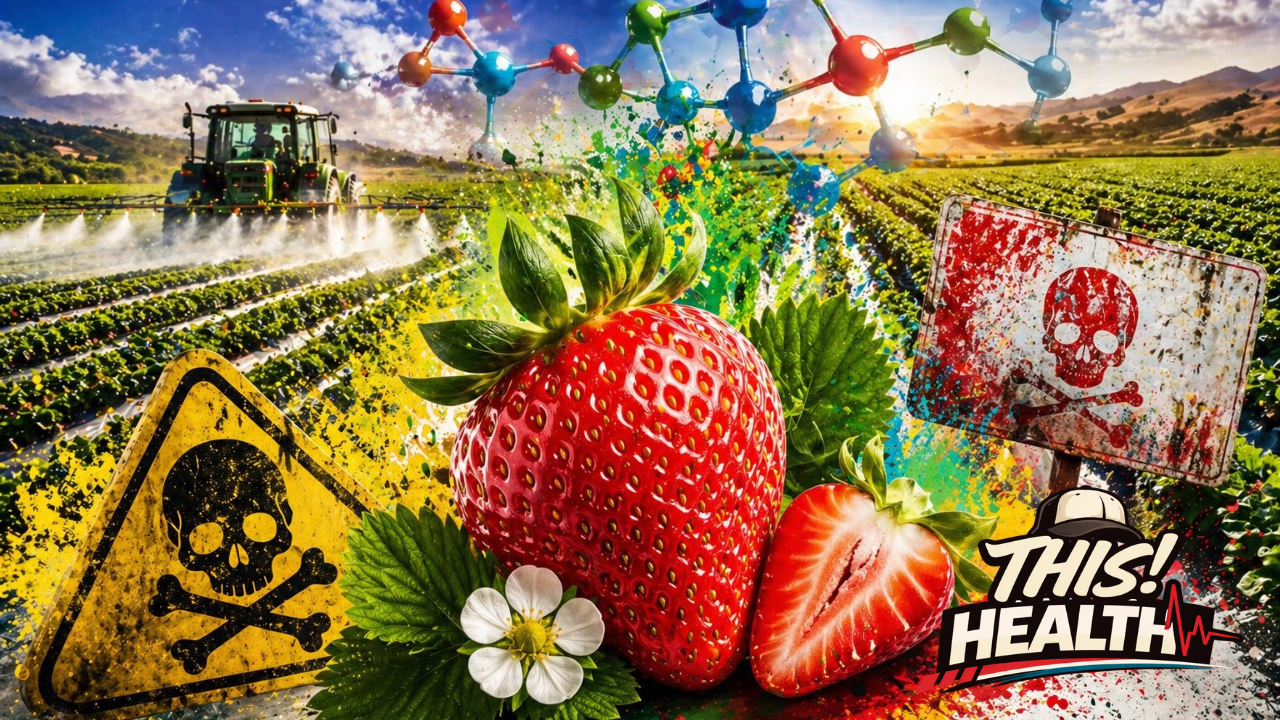

A viral social media post is making a serious claim: that communities near major strawberry farms in California—particularly those tied to Driscoll’s—are experiencing 38% higher rates of childhood cancer.
It’s alarming. It’s emotional. And it deserves a closer, fact-based look.
Let’s break down what’s real, what’s unclear, and what actually matters.
The Claim: 38% Higher Childhood Cancer Rates
The post points to Santa Cruz County, home to parts of the Pajaro Valley, a major agricultural hub that produces a significant portion of California’s strawberries.
- It claims childhood cancer rates are 38% higher than the state average
- It links that increase to pesticide exposure
- It highlights proximity of farms to schools and residential areas
There is some truth behind pieces of this—but the conclusion being drawn is far less certain.
What the Data Actually Shows
Public health data from California has indicated that:
- Certain regions, including parts of Santa Cruz County, have reported higher-than-average pediatric cancer rates during specific time periods (like 2017–2021)
- The Pajaro Valley is indeed one of the most intensively farmed agricultural regions in the U.S.
- Pesticides are widely used in commercial farming, including strawberry production
But here’s the key distinction:
Correlation does NOT equal causation.
There is no definitive scientific consensus that pesticide exposure from strawberry farming is directly causing increased childhood cancer rates in these communities.
The Pesticide Question


This is where things get complicated—and worth paying attention to.
- California has some of the strictest pesticide regulations in the U.S.
- Farmers must follow rules on when, where, and how chemicals are applied
- Buffer zones exist between farms and schools in many cases
However:
- Advocacy groups argue that long-term, low-level exposure may still pose risks
- Some pesticides historically used in agriculture have been linked to cancer in lab or occupational studies
- Communities near agricultural zones often raise concerns about air drift and groundwater contamination
So while direct proof is limited, the concern itself isn’t baseless—it’s an ongoing area of research and public debate.
Why Strawberries Are Under the Microscope
Strawberries are one of the most chemically treated crops in large-scale farming.
Reasons include:
- They’re highly susceptible to pests and mold
- They’re grown close to the ground (increasing exposure risk)
- Consumers demand perfect, year-round produce
This has landed strawberries on lists like the “Dirty Dozen” (produce with higher pesticide residues), though it’s important to note:
- Residues found on store-bought fruit are typically within federally approved safety limits
- Washing produce can reduce surface residue, but not eliminate all exposure
What About Driscoll’s?
Driscoll’s is one of the largest distributors of berries globally, but it’s important to understand:
- They don’t own most of the farms
- They work with a network of independent growers
- Farming practices vary by region and grower
So attributing regional health outcomes directly to a single brand oversimplifies a much broader system.
The Bigger Picture: Environmental Health vs. Food Supply

This story sits at the intersection of two big realities:
1. Feeding Millions
California produces nearly 90% of the strawberries in the U.S., supplying year-round demand nationwide.
2. Protecting Communities
Communities near agricultural zones—especially lower-income and farmworker populations—often face higher environmental exposure risks.
Both can be true at the same time.
So… Should You Be Concerned?
Here’s the grounded takeaway:
- There is evidence of elevated cancer rates in certain areas
- There is known pesticide use in those same areas
- But there is no proven direct causal link tying the two together
That doesn’t mean ignore it—it means:
- Stay informed
- Support continued research
- Advocate for transparency and safety in agriculture
And at a practical level:
- Wash produce thoroughly
- Consider organic options when possible
- Stay aware, not alarmed
Final Thought
The viral post taps into something real: concern for children’s health and environmental safety.
But turning complex public health data into a single cause-and-effect narrative? That’s where things get misleading.
This isn’t a simple story of “berries causing cancer.”
It’s a much bigger conversation about agriculture, regulation, science, and long-term health—and it’s still unfolding.