
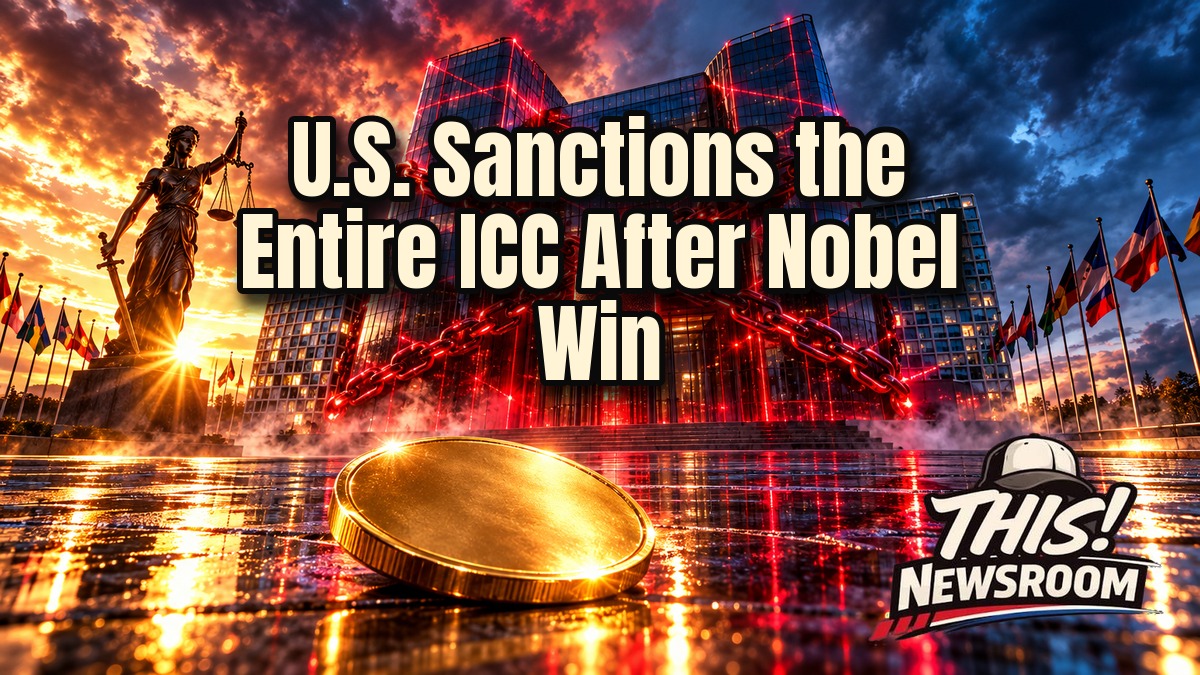
The Trump administration just put ICC sanctions on the International Criminal Court itself, the first time Washington has gone after the institution instead of individual officials. The timing is hard to ignore. It came hours after former ICC judge Navi Pillay won the 2026 Nobel Peace Prize.
The State Department announced the designation on Oct. 9 under Executive Order 14203. Seventeen people have now been sanctioned under that order. Until today, none of them was the court. It is the latest in a run of executive actions, much like the executive order targeting financial services for undocumented immigrants.
What the new ICC sanctions actually do
The measures freeze ICC assets under U.S. jurisdiction. They also generally bar Americans, U.S. businesses and banks from transacting with the court, according to Fox News. The ICC’s IT agreements with U.S. companies are caught up in it as well.
There is a cushion, though. U.S. companies and individuals get a 180-day wind-down period, Fortune reports. Firms that keep doing business with the court after that could face U.S. punishment.
Here is where it gets murky. Treasury also issued four licenses that allow substantial activity to continue, plus exceptions for certain pension transactions and detainee welfare, per Military.com. So the headline says total freeze, while the fine print says not quite. The real-world scope is not yet clear.
Rubio’s message: end the threats or end the court
Secretary of State Marco Rubio did not soften it. “President Trump will never allow the International Criminal Court to prosecute Americans,” he said. He added that the U.S. will “ban transactions with this rogue court, cutting off their resources and crippling its ability to operate against us.”
He also laid down an ultimatum. “Either the ICC will end its threats, or we will end the ICC,” Rubio said, according to The National.
The backstory is not new. Trump signed the order in February 2025 after the court issued arrest warrants for Israeli Prime Minister Benjamin Netanyahu, which he called baseless. Four judges were sanctioned that year. ICC President Tomoko Akane and senior trial lawyer Abdoulaye Seye followed in August. This latest ICC designation simply widens the net to the whole institution.
The Nobel angle behind the sanctions on the ICC
Navi Pillay is 85, South African, and a former ICC judge who later served as the UN’s top human rights official. The Nobel committee honored her “for her efforts to promote peace and international law,” and noted that international law is “under tremendous pressure” and its institutions “under attack.”
Pillay also chaired the UN commission that found Israel’s actions in Gaza amounted to genocide. Israel rejects that finding, and its Foreign Ministry condemned the award, CBS News reports.
So did the Nobel cause the sanctions? No outlet says so. Reports of sweeping ICC sanctions surfaced in September, weeks before the prize. It is a coincidence of timing, but a loud one.
Here’s the thing: U.S. sanctions on the court hit the paperwork, not just the politics
Strip away the diplomacy and sanctions are plumbing. The ICC has warned that institution-wide measures could disrupt its IT systems, insurance, investigator hiring and routine payments, including salaries for American employees. Banks also tend to over-comply with U.S. sanctions because they depend on the dollar system, so even licensed activity could dry up. U.S. sanctions on the court will be felt first in payroll and software, not in courtrooms.
The ICC called the move an assault on the rule of law. It also made a direct appeal. “The Court cannot stand alone,” it said. “Its fate now rests also in the hands of the states that created it.”
Allies push back on International Criminal Court sanctions
Canada, Denmark, Germany, France, Italy, Japan, the Netherlands and the UK issued a joint statement expressing strong disagreement. The EU called the move “deeply regrettable” and said it will work with the ICC so it can keep operating. International Criminal Court sanctions have rarely united so many allies against Washington at once.
One wrinkle matters here. Neither the U.S. nor Israel is an ICC member. The court says it can still reach nationals of non-member states for qualifying crimes committed on a member state’s territory. That is the exact dispute at the heart of this fight. Washington has used similar pressure elsewhere, as in Venezuela after Maduro.
What to watch next
The clock is running on the ICC sanctions. Counting 180 days from Oct. 9 lands in early April 2027, though that date is our math, not an official one. Fox News also reports the sanctions take effect in 180 days if the two sides cannot reach an agreement.
Before then comes the Nobel ceremony in Oslo on Dec. 10. Pillay will be on stage. And the question hanging over the room is simple: will ICC member states do more than issue statements?