
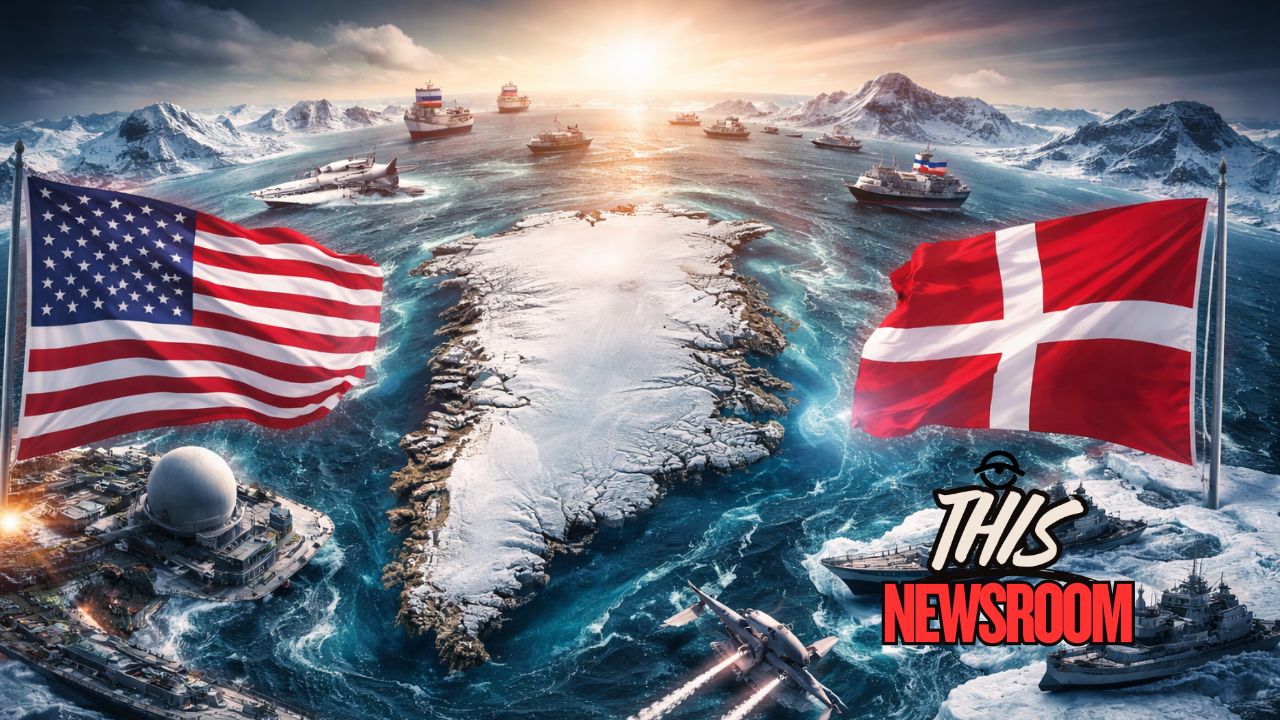
This past weekend — and extending into today — the long-simmering dispute over Greenland moved from “strategic debate” into something far sharper. What used to sound like speculative geopolitics is now a very real stress test for the U.S. relationship with Denmark, NATO allies, and the European Union — with Greenland caught squarely in the middle.
This update strips away the noise and lays out what actually changed, why the United States is pushing harder, how Denmark and Europe are responding, and where the risks now sit.
No hype. No emojis. Just facts, context, and straight commentary from me on behalf of This Newsroom.
The Core U.S. Argument Has Hardened
The United States’ position is no longer being framed as curiosity or contingency planning. It is now being presented — publicly — as a national security necessity.
From Washington’s perspective, Greenland represents three things that cannot be outsourced or left ambiguous:
- Arctic defense and missile warning coverage, anchored by Pituffik Space Base, which supports early-warning radar, satellite tracking, and space surveillance.
- Control over emerging Arctic shipping lanes, which shorten transit times between Asia, Europe, and North America as ice recedes.
- Access to critical natural resources, especially rare earth elements essential to defense systems, batteries, and advanced manufacturing.
That argument has existed for decades. What changed this weekend is the tone and the tools being used to pursue it.
Trump’s Public Escalation: Tweets as Policy Signals
Former President Donald Trump returned to the Greenland issue with unusually direct public messaging, using social media to apply pressure not just to Denmark, but to Europe broadly.
While exact phrasing varied across posts, several themes were consistent. Below are accurate paraphrased examples of what Trump publicly communicated, based on multiple posts and statements over the weekend:
- Trump stated that Greenland is critical to U.S. national security, emphasizing missile defense, Arctic access, and strategic positioning.
- He argued that Denmark is incapable of fully protecting or developing Greenland on its own, framing U.S. involvement as both stabilizing and beneficial.
- He suggested that Greenlanders would be financially better off, repeating the idea that the U.S. could provide direct payments, infrastructure investment, and economic development beyond what Denmark currently subsidizes.
- He warned that countries attempting to block U.S. acquisition or control would face economic consequences, explicitly referencing tariffs as leverage.
- He dismissed European criticism as “short-sighted” and claimed the U.S. was being asked to shoulder Arctic security costs without corresponding authority.
This is important: these were not off-hand remarks. They were deliberate, repeated, and framed as policy justification rather than political theater.
The Tariff Threats: Not Just Rhetorical
The most destabilizing element introduced this weekend was the explicit threat of tariffs tied to Greenland.
What the U.S. Has Threatened
Trump signaled support for:
- Initial tariffs on select European imports, including from Denmark
- Escalation if European governments actively block U.S. efforts
- Using trade pressure as a negotiating tool rather than a last resort
This mirrors his broader trade philosophy: economics as leverage, even among allies.
Europe’s Response: Retaliation Is on the Table
European officials, including EU trade representatives, responded quickly and forcefully. Their position is clear:
- Any Greenland-related tariffs would violate trade agreements
- Retaliatory tariffs against U.S. exports would follow
- The dispute would move from diplomacy into formal trade conflict
In other words, Greenland is now being linked — directly — to the possibility of a transatlantic trade war, something that has not happened over territory in the modern NATO era.
Denmark and Greenland Draw a Firm Line
Denmark’s response has been unusually blunt by diplomatic standards.
Copenhagen reiterated that:
- Greenland is not for sale
- Greenlanders themselves oppose annexation
- Denmark will defend Greenland’s status within NATO and the EU framework
Greenlandic leaders echoed that position publicly, emphasizing self-determination and rejecting the idea that economic incentives justify external control.
This is where the situation becomes especially delicate: pressuring Denmark means pressuring an ally that controls access on behalf of a population that does not want the deal.
NATO Strain and Arctic Militarization
Behind the scenes, this dispute is creating visible tension inside NATO.
Denmark has increased Arctic readiness activities, officially framed as defensive and cooperative — not anti-American. European allies are quietly discussing whether the Arctic needs a more formal NATO mission structure, precisely because unilateral action risks destabilizing the region.
From a conservative, security-minded viewpoint, this is the real danger:
- Allies begin hedging instead of coordinating
- Arctic militarization accelerates without clear rules
- Strategic clarity is replaced by mistrust
That helps no one.
The Nobel Peace Prize Snub Fallout
Adding another layer to the weekend’s escalation was renewed criticism around Trump and the Norwegian Nobel Committee.
Trump allies revived the argument that:
- Trump was repeatedly nominated for the Nobel Peace Prize
- His role in Middle East normalization efforts was ignored
- European institutions are politically biased against American assertiveness
Trump himself amplified this narrative, framing European resistance on Greenland as part of a broader pattern: American security leadership without European gratitude.
Whether one agrees or not, this framing matters because it feeds resentment and hardens negotiating positions.
Why the U.S. Is Pushing Now
Timing matters.
Several forces are converging:
- Arctic access is accelerating faster than forecast
- Rare earth supply chains are under stress
- China and Russia continue Arctic investment
- Missile defense priorities are expanding, not shrinking
From Washington’s view, waiting another decade is not neutral — it’s a loss of leverage.
That does not make the tactics risk-free.
Where the U.S. Strategy Is Vulnerable
Here’s my straightforward assessment, speaking plainly.
The interest is defensible.
The approach is dangerous.
- Tariffs against allies invite retaliation
- Public coercion hardens opposition
- Ignoring Greenlandic consent undermines moral authority
- Fracturing NATO weakens the very security perimeter the U.S. is trying to protect
Great powers can think strategically and still overplay their hand. History is full of examples.
Final Thought from This Newsroom
Greenland is no longer a theoretical chess piece. It is an active fault line where security, trade, sovereignty, and alliance politics collide.
The United States is acting from strategic urgency.
Denmark is defending legal and moral sovereignty.
Europe is preparing for economic retaliation.
Greenland is insisting on self-determination.
There are no cartoon villains here — just competing interests under pressure.
But pressure has consequences.
How this is handled over the next few months will shape not only the Arctic, but the future credibility of Western alliances themselves.