

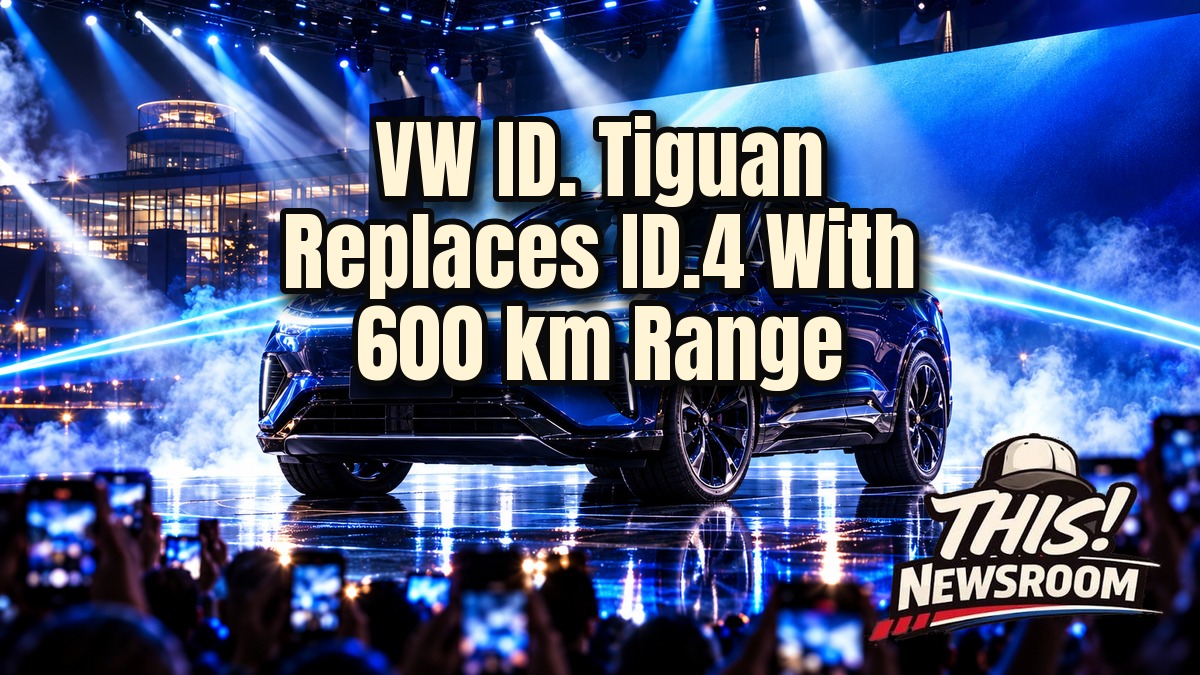
Same famous badge, new plug. The Volkswagen ID. Tiguan made its world debut on October 9 in Wolfsburg, and the VW ID. Tiguan has a big job: replace the ID.4 and ID.5. Europe gets it in early 2027.
Here is the part worth your attention. VW is putting its most famous SUV name on an EV, and it is hoping the badge does what the ID.4 name never quite managed.
What VW actually announced about the ID.4 replacement
The new ID. Tiguan is a mid-size electric SUV that succeeds both the ID.4 and the ID.5, according to Volkswagen’s world premiere release. Emden, Germany, builds it on the upgraded MEB+ platform. The gas-powered Tiguan stays in production in Wolfsburg and keeps selling alongside it.
Volkswagen says it has built more than 950,000 ID.4 and ID.5 units. “The ID. Tiguan brings these two success stories together,” said Thomas Schäfer, CEO of the Volkswagen brand.
Three powertrains, up to 600 km of range for the VW ID. Tiguan
Buyers get three setups, and the two bigger ones share a 77 kWh battery:
- Rear-wheel drive, 140 kW (190 PS), 58 kWh battery
- Rear-wheel drive, 210 kW (286 PS), 77 kWh battery
- 4MOTION all-wheel drive, 220 kW (299 PS), 77 kWh battery
VW quotes a range of up to 600 km, which Carscoops converts to up to 373 miles. Towing tops out at 2,000 kg.
Now read that range number with a squint. It uses the European WLTP cycle, and Drive Tesla Canada notes that Canadian ratings will likely come in lower. American EPA numbers usually run lower too.
Range also matters only if charging keeps pace, and EV charging is quietly getting better, even as sales slump.
Inside the electric Tiguan: more screens, and real buttons
For the first time, VW offers an optional passenger display on this model. Drive Tesla Canada reports a 10-inch driver display, a 15-inch central touchscreen and an optional 12-inch screen for the co-pilot. It also says physical buttons return to the steering wheel. Cargo space is 534 litres in the back, plus a 32-litre frunk.
Auto123 adds a detail North American buyers will notice. Mechanical pull-type handles replace the ID.4’s electronic door handles, which were tied to recalls and sales halts over water intrusion and unlatching risks.
In other words, VW fixed the thing that annoyed people. Good.
Here’s the thing: the name is the strategy
Tiguan has sold more than 8.3 million copies. ID.4 has been, to put it kindly, a mixed bag. Auto123 calls it only “middlingly successful” in Canada.
So if you are shopping for an electric SUV, the pitch is simple: a name you already trust, with VW hoping some of that trust carries over to its new VW electric SUV.
It is also following a playbook. The Tiguan name is the third major nameplate VW has moved into its electric lineup, after the ID. Polo and ID. Cross. Meanwhile, VW is also reshaping its portfolio at the top, as the Bugatti sale shows.
What we still don’t know about the new ID. Tiguan
Here is where it gets fuzzy for American readers. Volkswagen’s release speaks only of a European launch in early 2027. Drive Tesla Canada says Canada follows later in 2027, while Carscoops says a North American launch is coming but the timing is unconfirmed. Auto123 headlines it as a 2028 model.
Nobody has announced US pricing, US powertrains or a model year for the VW ID. Tiguan.
There is no pricing for any market yet. Whether Chattanooga, where workers assembled the ID.4, plays any role is also unknown, since Emden is the only plant named.
So the electric Tiguan is real, it looks good on paper, and it is coming to Europe first. The question everyone in the US will be asking is simple: when do we get it, and what will it cost?