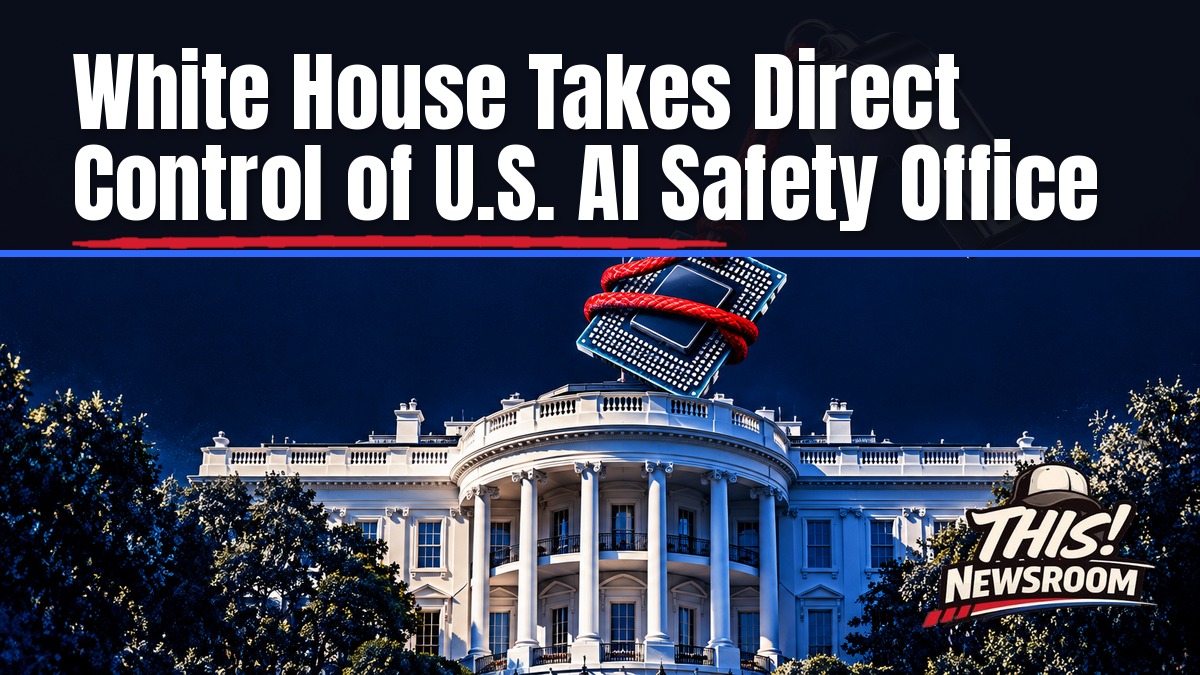
The government’s AI referee has picked up a new boss, informally, and the office is in the White House. Staff at the Commerce Department’s AI evaluation center now report to a White House office, according to an Associated Press report carried by ABC News. Critics say that puts independent AI safety testing at risk.
What the AI safety center is reporting to the White House
The unit is the Center for Advancing Innovation and Standards for Super Intelligence, or CAISSI. AP describes it as an independent division of the Commerce Department. Two former government officials said officials there recently received a request to report informally to a White House office. They spoke anonymously to protect current staffers from repercussions.

Here is the part that should get your attention. The center has no permanent leader. The administration hired its director in April and fired him within days. Now the head of its parent institute is filling in as acting director. The AI safety center has also stopped publishing its research.
The White House did not answer specific questions about the center. Its statement instead said President Trump had formally established a new “Super Intelligence Force.” He also commissioned a report on risks from the President’s science advisory council. It added that he will ensure “continued U.S. leadership on SI for the benefit of the American people.”
(That is a statement about a different thing than the question asked, which is its own kind of answer.)
Why independence matters at a federal AI testing center
This is the federal unit that checks frontier models from companies like OpenAI, Anthropic and Google. Think of it as the referee. A referee who reports to one of the teams is a problem.
Nobody has to accuse anyone of cheating to see why.
That is the worry AP lays out. Critics fear decisions on risks like cybersecurity and bioweapons could become political. They also fear officials could soften findings to keep the tech industry happy. None of that has been shown. But with no public reports coming out, outsiders cannot check.
Amos Toh, senior counsel at the Brennan Center for Justice, argues the administration treats model safety as a national security matter. In his view, that framing demands executive discretion and secrecy. He says it pushes aside consumer protection, privacy and civil rights concerns. Safety decisions, he says, need a public explanation, and in his words, “that’s not happening.”
How we got here
None of this appeared overnight. Congress began asking in August why the center stopped making its reports on AI system safety public. Then, on Oct. 12, Reuters reported, citing The Information and a White House official, that the administration planned to move three senior center officials to the White House. Whether that move has happened is still unconfirmed.
The roots go further back. The Biden-era U.S. AI Safety Institute, created in November 2023, became the Center for AI Standards and Innovation in June 2025. Commerce Secretary Howard Lutnick said at the time that regulation had served “under the guise of national security.”
AP also says Trump put Jay Clayton in charge of the new Super Intelligence Force, alongside Pentagon technology chief Emil Michael. Neither the White House nor Commerce has publicly explained how the force and the center fit together. Meanwhile, AI’s biggest players keep growing, as Nvidia’s retaking of the market crown shows. Oversight of the industry, by contrast, looks shakier. States are also moving on their own, as California’s new youth social media law shows.
What we still don’t know about the AI safety center
Keep the limits in mind. The informal reporting line rests on two anonymous former officials, and the White House did not address it directly. We don’t know which White House office receives the reports. No one has announced when a permanent director will take over or when public reports might resume. Regulators do act on safety when they have the data, as GM’s recall of 67,380 Cadillac EVs shows.
So the questions are simple. Who is checking the AI that is now in your phone, your bank and your kid’s school? And if the answer is “the government,” will the government show its work?
Congress asked in August. It is still waiting.