
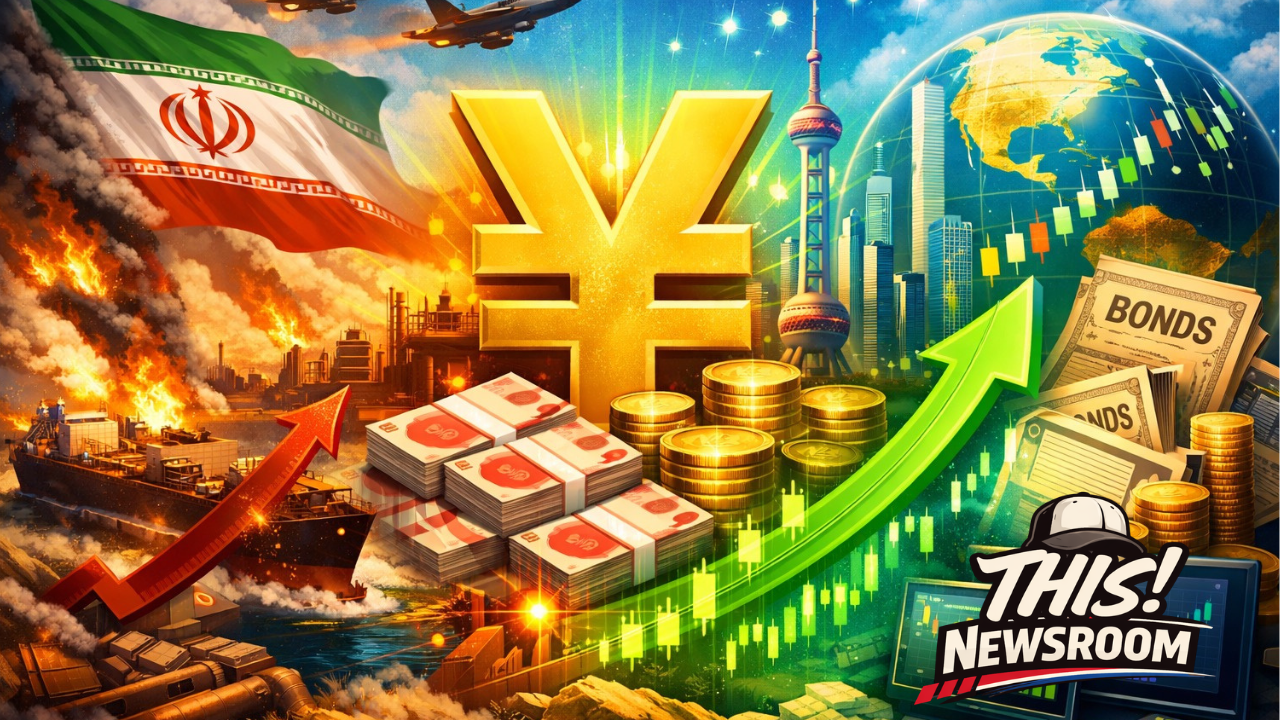

As geopolitical tensions escalate with the war involving Iran, global markets are behaving in ways few expected. Traditionally, investors run to U.S. Treasuries or gold during conflict. However, this time, something very different is happening—China’s enormous domestic savings and financial structure are quietly reshaping the rules of the game.
At the center of it all is a staggering figure: roughly $51 trillion in Chinese household and institutional savings, a financial cushion that is helping China’s bond market outperform—even during wartime volatility.
A New Safe Haven Emerges
For decades, U.S. Treasuries dominated as the world’s go-to safe haven. Yet amid the Iran conflict, investors are increasingly turning to Chinese bonds instead.
Why?
Because China’s economic environment looks fundamentally different from the West right now:
- Lower inflation pressures
- More controlled interest rates
- Strong domestic liquidity
- Less exposure to Middle East energy shocks (relatively speaking)
As a result, China’s bond market has attracted billions in foreign inflows, even as other emerging markets see capital flight.
Short- and mid-term Chinese government bonds, in particular, are outperforming due to stability and predictable policy support.
The $51 Trillion Advantage
China’s massive savings pool is not just a statistic—it’s a strategic weapon.
Unlike Western economies that rely heavily on foreign capital, China is largely funded from within. That creates three major advantages during times of war:
1. Internal Demand for Bonds
Chinese investors—households, banks, and institutions—have deep reserves of capital. That means consistent demand for government bonds, even when global markets wobble.
2. Lower Volatility
Because the investor base is more domestic, China’s bond market is less sensitive to global panic selling.
3. Policy Control
The People’s Bank of China can maintain a dovish stance, keeping borrowing costs stable while Western central banks deal with inflation shocks.
War Is Hurting the West—But Not in the Same Way
The Iran conflict has triggered a massive energy shock:
- Oil prices have surged sharply
- Supply chains have been disrupted
- Inflation fears are rising globally
In fact, about 20% of the world’s oil flows through the Strait of Hormuz, making the conflict highly disruptive.
For Western economies, this typically means:
- Rising inflation
- Higher interest rates
- Falling bond prices
But China’s diversified energy strategy—coal, renewables, and stockpiled reserves—has softened the blow.
Bonds vs. Stocks: China’s Quiet Outperformance
While global equities struggle, Chinese financial assets are showing resilience:
- Chinese stocks have fallen less than regional peers
- Bond yields remain stable or declining
- Capital inflows continue
Even during the early weeks of the war, Chinese markets held up significantly better than markets in Japan, South Korea, and Europe.
At the same time, U.S. corporate bonds have remained stable—but not dominant—thanks to strong fundamentals rather than safe-haven demand.
The Catch: China Isn’t Immune
Despite the bond market strength, China faces real risks:
- Heavy reliance on imported oil (including Iranian supply)
- Export slowdown due to weakening global demand
- Rising geopolitical tensions with the U.S.
Exports have already begun slowing as war-related uncertainty spreads across global trade.
And if energy disruptions worsen, China’s economic stability could be tested.
What This Means for Investors
This shift signals something bigger than just short-term market movement.
We are potentially witnessing a reordering of global safe-haven assets:
Old Playbook:
- War → Buy U.S. Treasuries
- Inflation → Buy gold
New Reality:
- War + inflation → Look to China’s bonds
China’s combination of massive savings, policy control, and relative insulation from global shocks is creating a new category of defensive investing.
The Bottom Line
The war with Iran is exposing cracks in traditional financial assumptions. While Western markets grapple with inflation and volatility, China’s $51 trillion savings engine is quietly stabilizing its bond market—and attracting global capital.
Whether this trend continues will depend on how long the conflict lasts and how deeply it disrupts global energy and trade.
But one thing is clear:
In today’s geopolitical climate, the definition of a “safe haven” is changing—and China is positioning itself right at the center of it.