
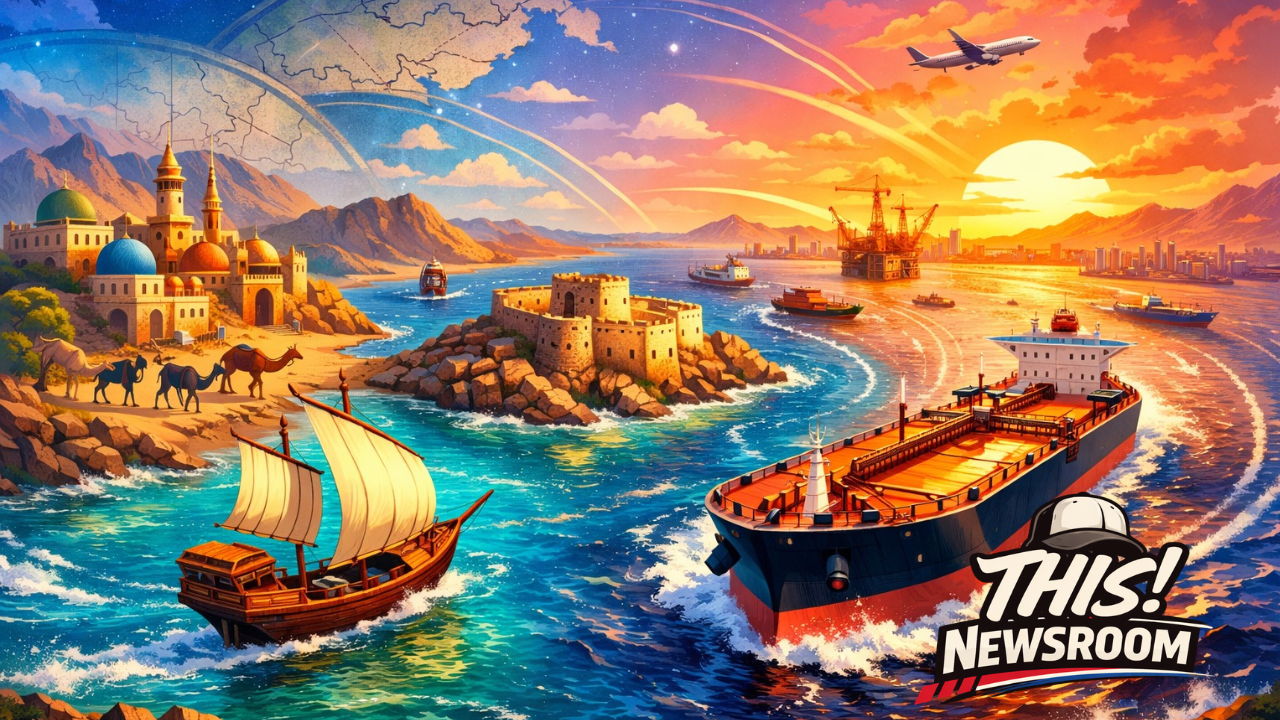


Few places on Earth carry as much historical weight and modern relevance as the Strait of Hormuz. This narrow waterway—just about 21 miles wide at its tightest point—connects the Persian Gulf to the Gulf of Oman and, ultimately, the open ocean.
But long before oil tankers and global trade routes, the Strait of Hormuz was already one of the most strategically significant corridors in human history.
Ancient Origins: Trade, Empire, and Early Navigation
The importance of the Strait of Hormuz dates back thousands of years. As early as 3000 BCE, civilizations in Mesopotamia relied on maritime trade routes that passed through this channel.
- The Mesopotamia civilizations traded goods like textiles, metals, and spices.
- The nearby island of Hormuz Island became a key trading hub.
- Maritime routes connected the ancient world—from the Indus Valley to the Arabian Peninsula and East Africa.
By the time of the Achaemenid Empire (c. 550–330 BCE), Persian rulers understood the value of controlling this chokepoint. They used it to monitor trade and project influence across the region.
The Medieval Era: The Rise of Hormuz as a Trade Power


9
Between the 10th and 16th centuries, the Strait reached new heights of importance under the powerful Kingdom of Hormuz.
This kingdom controlled trade flowing between:
- India and Southeast Asia
- The Middle East
- East Africa
- Europe (via overland routes)
Hormuz became one of the wealthiest trading centers in the world, known for:
- Pearls and precious stones
- Spices and textiles
- Strategic taxation of passing ships
The city itself was described by travelers as incredibly rich—so much so that it became a target for global powers.
European Arrival: Portuguese Control and Global Competition
In the early 16th century, European empires began aggressively expanding into global trade routes.
In 1507, the Portuguese Empire, led by Afonso de Albuquerque, captured Hormuz and built a fortress to dominate the strait.
This marked a major turning point:
- Control of Hormuz meant control of East-West trade
- Portugal taxed ships and enforced military presence
- The strait became part of Europe’s early global trade network
However, Portuguese dominance didn’t last forever. In 1622, a joint force of the Safavid Empire and the British East India Company expelled the Portuguese, shifting control back to regional powers.
Early Modern to 19th Century: Regional Control and British Influence
After the fall of Portuguese rule, the Strait of Hormuz remained vital—but less dominated by a single global empire.
Instead:
- Regional Persian and Arab powers controlled surrounding territories
- Trade continued steadily, especially in pearls and regional goods
- European powers, particularly Britain, increased influence without direct control
By the 19th century, the British Empire had established a strong naval presence in the Persian Gulf to protect trade routes to India.
The Strait of Hormuz became part of a broader system of imperial maritime security.
The Oil Era: A Strategic Transformation


7
Everything changed in the 20th century with the discovery of oil in the Middle East.
Countries surrounding the Persian Gulf—like Saudi Arabia, Iran, Iraq, and Kuwait—became major energy producers.
The Strait of Hormuz quickly evolved into:
- The primary export route for global oil supply
- A critical artery for liquefied natural gas (LNG)
- One of the most monitored shipping lanes in the world
Today, roughly 20% of the world’s oil supply passes through this narrow channel.
Geography: Why the Strait Matters So Much
The Strait’s importance is rooted in simple geography:
- It is extremely narrow (21 miles at its tightest)
- Shipping lanes are only about 2 miles wide in each direction
- It is the only sea passage from the Persian Gulf to the open ocean
This makes it a classic “chokepoint”—a location where global trade can be easily monitored, controlled, or disrupted.
There are few viable alternatives:
- Pipelines exist but cannot fully replace maritime transport
- Rerouting ships adds significant time and cost
Modern Role: The Lifeline of Global Energy
Today, the Strait of Hormuz is essential to:
- Global energy markets
- International shipping logistics
- Economic stability worldwide
Massive oil tankers and cargo vessels pass through it daily, linking Middle Eastern energy supplies to:
- Asia (China, India, Japan)
- Europe
- North America
Its role has only grown as global energy demand has increased.
Why the Strait of Hormuz Still Matters
The Strait of Hormuz isn’t just a narrow stretch of water—it’s a living timeline of global trade.
From ancient merchants and medieval kingdoms to modern supertankers, it has remained:
- A gateway between regions
- A driver of economic power
- A strategic maritime chokepoint
What makes it remarkable is consistency. Across thousands of years, despite changing empires, technologies, and economies, one thing hasn’t changed:
If goods are moving between the Persian Gulf and the rest of the world—they pass through the Strait of Hormuz.
Final Take
Understanding the Strait of Hormuz is understanding global trade itself.
It’s where geography meets economics, history meets modern industry, and ancient trade routes evolve into the backbone of today’s energy system.
And in a world that still runs on movement—of goods, fuel, and resources—this narrow passage remains one of the most important places on Earth.