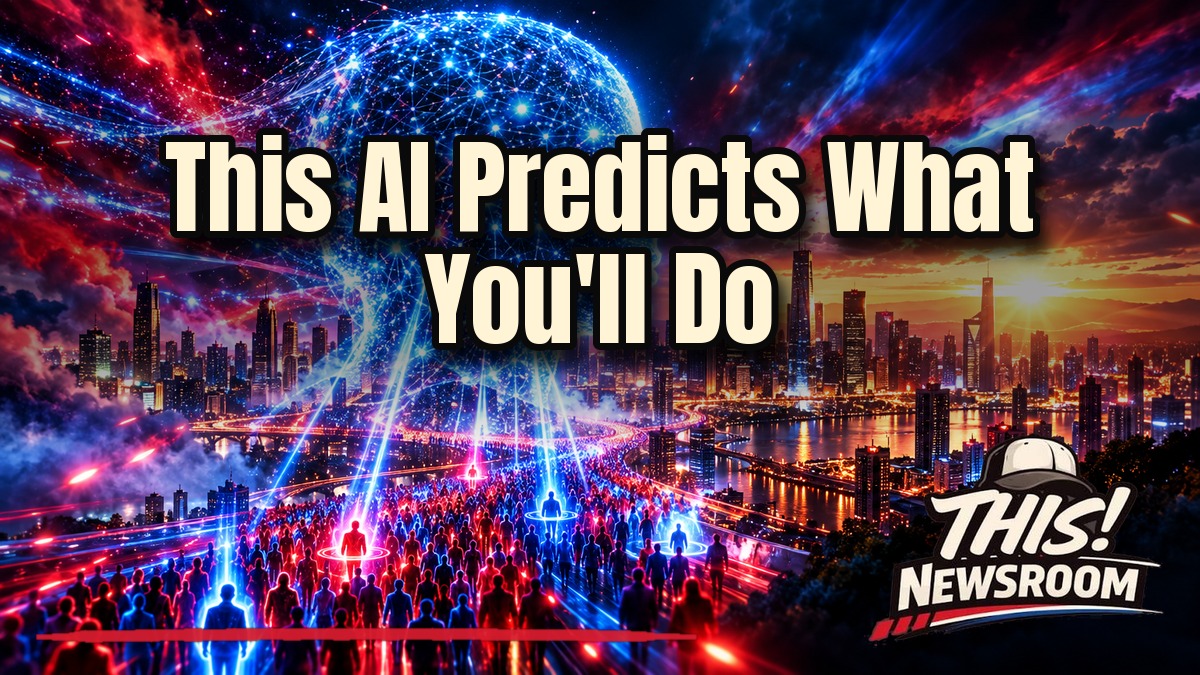
What if a company could ask thousands of people a question without asking a single real person? That is the pitch behind Aaru, an AI startup that just landed on TIME’s Best Inventions of 2026 list. It is also the latest sign of AI human behavior modeling moving from the lab into the boardroom.
TIME released its 300-item list on Thursday, according to NASA, whose Nancy Grace Roman Space Telescope also made the cut. Aaru sits in the AI category, labeled an “AI human behavior predictor.” This is the kind of AI human behavior tool that has quietly gone from lab curiosity to corporate budget line. For the full range of winners, see our rundown of TIME’s 300 best inventions.
What this human behavior simulation actually does
Here is how TIME describes it. Aaru’s multi-agent simulation software uses modeling and joint statistical distributions to predict how people behave. It then turns those predictions into simulated consumer surveys for corporate buyers.

In plain English, it builds digital stand-ins for a population and asks them questions. (They never ignore the call or hang up, which is a selling point.)
TIME says the company has forecasted elections and stress-tested disaster plans for high-profile clients. It also says Aaru helped EY finish a six-month Global Wealth Study in under a day, with 90% accuracy. That last number comes from TIME’s brief blurb, and I found no independent audit of it.
“If you can understand what people will do, you can shape it,” founder Ned Koh told TIME.
Read that one twice. It is either the best sales line in tech or a slightly unsettling mission statement, depending on your mood.
The kids who built a behavior-predicting AI
The origin story is half the appeal. Aaru was cofounded in March 2024 by Ned Koh (then 19), Cameron Fink (then 18) and John Kessler (then 15), according to Fortune. One of them started the company before he could legally drive.
Fortune reports that Aaru’s simulation of New York’s mayoral primary landed within 2,000 votes of the final count. It also says the company’s sales pitch to clients is, and I am not making this up, “do not trust us.”
Ask us to prove it, in other words. That is a refreshing line in an industry that usually promises the moon. Few behavior-predicting AI startups open with that kind of honesty.
Here’s the thing: why synthetic survey AI matters to you
Surveys decide what companies sell you and what they charge you. They also shape the wording of the ad you see tonight. They are slow and expensive, and people do not always answer honestly.
Synthetic survey AI could make that process far faster and cheaper, and that changes who gets to run the numbers.
Aaru also claims its simulations rank brand pairs correctly 92.4% of the time. Traditional surveys manage 77.8%, per its own published research. Notice who is grading the homework. Those figures come from Aaru, not an outside lab.
The money story is a bit murkier. Reports say Redpoint Ventures led the startup’s Series A at a headline valuation of $1 billion. Those details rest on anonymous sourcing, however, and suggest the blended valuation was lower.
Reported annual recurring revenue was under $10 million. Accenture and EY are among reported partners. Competitors in what the industry calls synthetic research include Simile, Keplar and Outset.
The race is also heating up at the model level, as Anthropic and OpenAI trade blows over the next generation of AI.
The fine print on any AI behavior predictor
A viral Instagram graphic shows an Aaru-style survey on hurricane alerts. It claims specific time-and-route wording reached 36%, versus 19% for standard “mandatory evacuation” language.
I could not find that statistic in TIME’s write-up or any independent source. Treat it as a product demo, not a finding.
That caution applies to the whole story. A TIME honor is a nice trophy, not a peer review. The accuracy claims are real claims, made by interested parties. Any AI behavior predictor deserves the same scrutiny we now give AI that prescribes medication.
So the question for the next few months is simple. When a simulated crowd and a real crowd disagree, who wins the argument?
Somebody is about to find out.