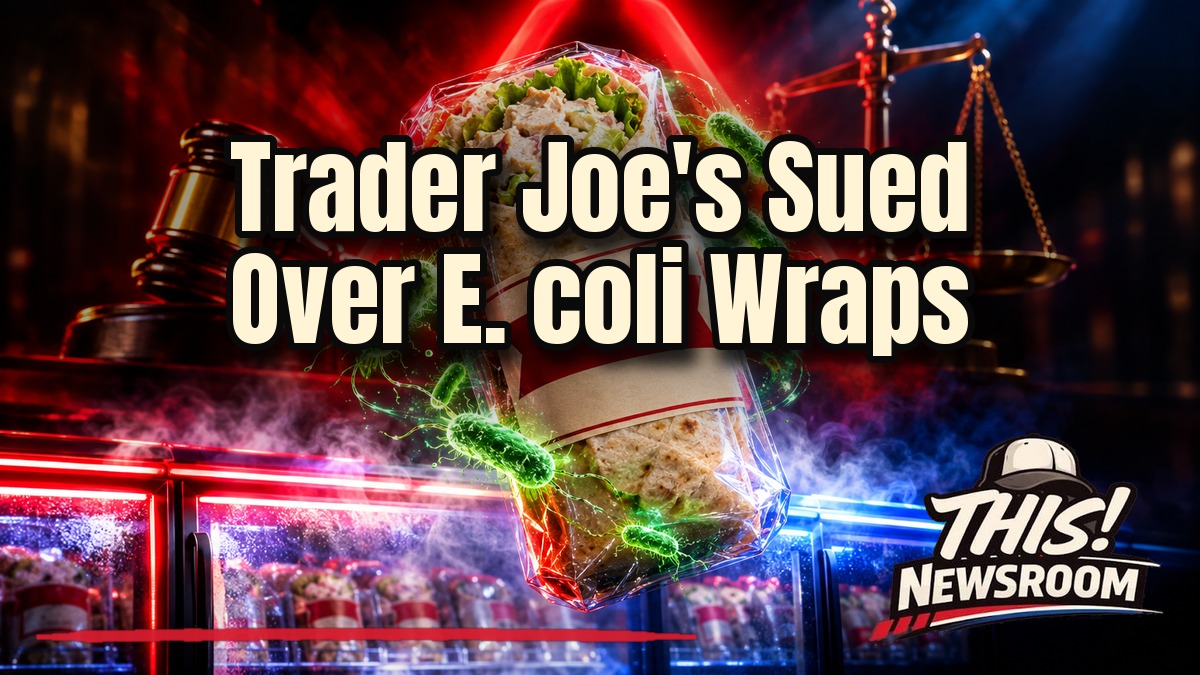
Two women ended up in the hospital after eating chicken wraps, and now they want answers in court. The plaintiffs’ law firm Marler Clark issued a press release on PR Newswire. It says two women hospitalized with E. coli O157:H7 have sued Trader Joe’s over its Tarragon Chicken Salad Wraps. Trader Joe’s has not publicly responded. No court has tested any claim in the Trader Joe’s E. coli lawsuit.
What the Trader Joe’s E. coli lawsuit alleges
The plaintiffs filed the complaint in federal court in the Central District of California. They are Gayle Gottlieb of Pembroke, North Carolina, and Meaghan Egan Bright of Somerville, Massachusetts. Per the release, they bought the wraps a day apart in late August. The stores were in Myrtle Beach, South Carolina, and Allston, Massachusetts.
The release says lab-confirmed infections put both women in the hospital. Both say their local health departments told them they are part of a multistate outbreak. That is the plaintiffs’ account, relayed by their lawyers. Nobody published the underlying health records.
The suit pleads strict product liability, negligence, negligence per se and breach of implied warranty. It asks for a jury trial. Marler Clark says it will provide copies of the complaint on request, but we found no public docket entry to check.
What the government says about the E. coli chicken wraps
The outbreak itself is real, and the official picture is oddly incomplete. The FDA’s outbreak table lists an active E. coli O157:H7 investigation tied to a “multi-ingredient wrap with chicken.” It puts the case count at 50. That is up from 25 when the file opened on September 23, and from 38 on October 7.
What the agencies have not said matters just as much. According to Food Safety News, neither FDA nor USDA has named a brand, a manufacturer, a retailer or the states where people got sick. There is no recall and no public health alert. The FDA says the wraps are no longer for sale and are past their shelf life. It also says they came off shelves before the outbreak link was confirmed.
So the claim that these are Trader Joe’s wraps rests, for now, on one source: lawyers who profit if the suit succeeds. That does not make it false. It does mean you should read it as an allegation.
Here’s the thing: Trader Joe’s food poisoning and your kitchen
If you bought a ready-to-eat chicken wrap in late August or September and then had diarrhea, especially bloody diarrhea, call a doctor and ask for a stool test. The release also warns that antibiotics and anti-diarrheal medicine can raise the risk of hemolytic uremic syndrome in O157:H7 infections. HUS is the kidney-failure complication doctors watch for, so please do not self-treat with whatever is in the medicine cabinet.
The wraps are reportedly gone from shelves, so there is nothing to throw out. The risk now falls on people who may have eaten one weeks ago. They are only now getting sick or sorting out why. The same grocery-aisle caution applies to the way shoppers fill their carts generally: know what you bought and when.
A familiar fight over a Trader Joe’s wraps outbreak
This is not Marler Clark’s first run at the grocer. In 2013, E. coli O157:H7 in salads and wraps made by Glass Onion Catering and sold at Trader Joe’s sickened 33 people in four states. Plaintiffs later sued the retailer over that outbreak. Back then, the maker and the store were named while the outbreak was still being counted. William Marler, the firm’s managing partner, argues that the agencies now hold the same kind of information. He says they are keeping it quiet.
“It could name these wraps today,” Marler said of the FDA in the release. He says he has drafted two citizen petitions. They ask the agency to publish the implicated firm, the suspect food and the states during open investigations. They also ask it to publish the stores that received recalled products. The petitions are drafts, circulating for comment. Nobody has filed them.
What to watch next in the Trader Joe’s lawsuit
Three things will tell us whether this holds up. First, whether Trader Joe’s answers the complaint. Second, whether the FDA or USDA names a product or issues an alert. Third, where the case count lands, since it has gone from 25 to 38 to 50 in about three weeks. More cases, and more lawsuits, would not be a shock. Regulators face scrutiny on several fronts right now, as in this week’s storm coverage, but this one is quieter and slower.
For now, the public record has a pathogen, a rising number and a category of food. A name, so far, only has a lawsuit behind it. Will the agencies fill in the rest themselves, or will a courtroom get there first?