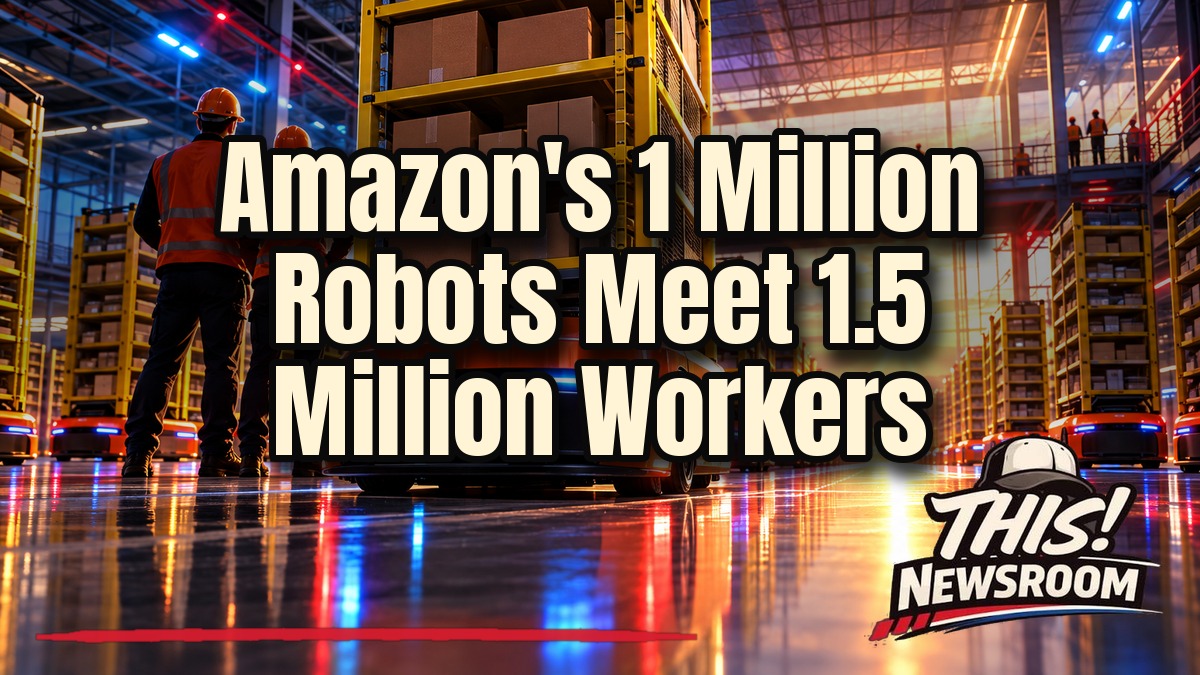
Somewhere, a “JUST IN” banner is announcing news that has been sitting around for over a year. Amazon’s million-robot milestone is making the rounds again this week, with headlines saying the company has “now deployed” more than 1 million warehouse robots. That is true. It is also more than a year old.
Amazon announced its 1 millionth robot on July 1, 2025. What changed this week is the conversation around it, not the count. For the full backstory on why the first passing of the mark mattered, start there.
Where the Amazon 1 million robots count really stands
The fresh wave of attention traces to a Futurism report that pairs the robot fleet with roughly 1.5 million human workers and calls it bad news for the people. Meanwhile, a viral “JUST IN” post on X pushed the same line on Oct. 17, 2026.
Here is the catch. “Over 1 million” is still the only official number Amazon has published. Nobody outside the company can say how far past it the fleet has grown.
A “now deployed” headline implies a new announcement. As far as the public record shows, there isn’t one.
The workforce number is rounded too. The 1.5 million figure comes from Amazon’s annual report, per a syndicated copy of an Ars Technica piece, and it counts full- and part-time workers.
What the million-robot milestone looked like in 2025
The July 2025 announcement came with a software launch. Amazon introduced DeepFleet, a generative AI model it says improves travel efficiency across the Amazon robot fleet by 10%. Scott Dresser, Amazon’s VP of Robotics, described it as “an intelligent traffic management system for a city filled with cars moving through congested streets.”
The robots sit in a network of more than 300 facilities, CNBC reported at the time. The roots go back to 2012, when Amazon bought Kiva Systems for $775 million.
Here’s the thing about Amazon warehouse robots and workers
So why does an old milestone suddenly feel new? Because the argument underneath it is still live, and it reaches anyone who works in or depends on those buildings.
George Mason University business professor Brad Greenwood told Ars Technica that warehouse robots change the job in two ways. They are physically close to workers, and the robot “has the ability to dictate the pace of work.” That is the heart of the worker-safety worry. In short, the robots aren’t just replacing tasks. They set the tempo for the people still there.
Amazon makes the opposite case. The company says robotics cut its global recordable-injury rate by more than 43% and its lost-time-injury rate by more than 70% over the six years before Aug. 19, 2026, according to a report on that announcement.
Both claims come with a caveat. Futurism’s “bad news for workers” angle is its own interpretation, and Amazon’s safety numbers are Amazon’s own.
Jobs are the bigger question
The longer-running fear is about hiring. The New York Times reported in October 2025, from internal documents, that Amazon could avoid hiring about 600,000 workers by 2033 through automation. Amazon said those documents reflected one group’s view, not company strategy.
What we can say is what’s on the calendar. CFO Brian Olsavsky has said Amazon expects its robotic-arm fleet to more than double in 2026, though the company hasn’t said how many arms it runs today. In August, Amazon announced a multibillion-dollar robotics manufacturing facility in Austin, Texas, expected to create 300 to 500 manufacturing and engineering jobs.
That is a Texas jobs story hiding inside a robot story. Elsewhere in the sector, the money is flowing too, as a Rivian-linked robotics startup’s $3.4 billion valuation shows.
What to watch after Amazon’s 1 million robots
Amazon’s third-quarter earnings call is the next moment to get real numbers on automation and spending. Until then, treat Amazon 1 million robots as a July 2025 fact that keeps getting a fresh coat of paint.
The better question isn’t how many robots Amazon has. It’s who is setting the pace, and for how many people.