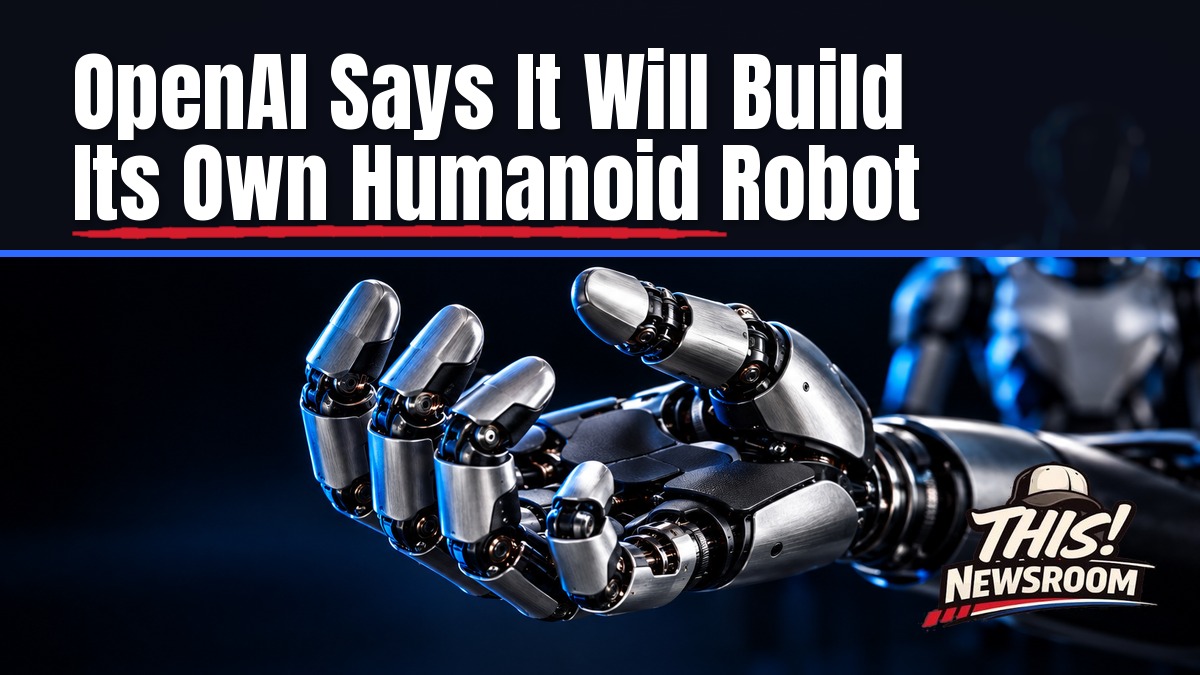
Sam Altman expects “a cool demo in 2027” of an OpenAI humanoid robot, and he says the metal body is the easy part. The company best known for chatbots now wants to give its software legs.
Altman made the pledge on the Sources podcast in early September, and Engadget’s recap has put it back in front of readers this week. Asked whether the company’s robotics push meant a humanoid or a data-center machine, he answered “Both.” Then he got specific. “We will definitely do a humanoid. We will do other form factors as well,” he said, according to Forbes. One outlet dates the episode to September 2.
That is about six weeks old, so think of this as a recap, not breaking news. It still matters, because no one outside the company has seen what OpenAI is actually building.
Why build an OpenAI humanoid robot at all?
Altman’s reasoning is practical. Doors, keyboards, stairs and tools were all built for human bodies. “The world is very much designed for people,” he said, and “matching that form factor seems good,” per Engadget’s write-up.
It is a fair point. A robot shaped like you can use a world shaped for you (no one has ever redesigned a staircase for a toaster on wheels). That is also why so many companies are chasing the same design. Rivian’s founder, for one, has bet big on the same race, as his robotics startup’s $3.4 billion valuation shows.
The Altman humanoid robot’s real challenge isn’t the body
Here is the part that gives the story its title. Altman said the hardware details matter less than “really figuring out like the brain that makes the robot work,” according to Forbes’ version of the quote. Engadget’s version trims it with an ellipsis, so the wording differs slightly between outlets.
That fits OpenAI’s strength. It already builds some of the world’s best-known AI models. A robot is a way to put that software into a body that can lift, carry and open the fridge.
So who gets hurt if it works? Forbes frames it as vertical integration. Robot makers that depend on someone else’s AI model could suddenly be competing with the company supplying it. In other words, the supplier could become the rival.
What it means for you
For most people, nothing changes soon. Altman himself does not “think there will be robots walking the streets for a few years longer.” Even so, the direction is clear.
A general-purpose robot is built to do the physical tasks people get paid for, such as moving boxes, stocking shelves and running a line. If the AI brain gets good enough, that could mean cheaper labor for companies and real pressure on warehouse and factory jobs. It could also mean new products, from home helpers to machines for dangerous work. Nobody can say which comes first, and OpenAI has not said what its robot will do.
What the job listings say about the OpenAI robotics push
OpenAI has said little publicly, but its hiring page says plenty. Engadget counts 27 robotics openings, up from 19 roles reported about six weeks earlier by Robots Beat. That is eight new roles in roughly six weeks.
The openings cover custom actuators (the motors, transmissions, sensing and cooling that move a robot’s joints), manufacturing, supply chain, motion control and machine-learning infrastructure for what the industry calls physical AI. That is a company planning to build real hardware, not just write software for someone else’s.
What we don’t know
A lot. OpenAI has not said what the humanoid will look like or what it will do. It has not said when anyone outside the company will see one, beyond Altman’s own 2027 demo target.
Humanoid.guide notes the statement is not yet a product announcement. The interview set no release date and no shipping product. Home deployment, meanwhile, is not the first priority, per The Robotics Media.
This is not OpenAI’s first brush with humanoids. It backed Figure AI’s $675 million round in 2024. Figure ended that collaboration in February 2025 to build its AI in-house. Now OpenAI wants a robot of its own.
Competitors are not standing still, either. China’s machines are already setting records on the race course, which shows how fast the hardware side is moving.
Here’s the thing: a demo in 2027 is a long way off, and a robot in your kitchen is further still. But OpenAI added eight robotics roles in about six weeks. If that pace holds, the company will have a hardware team of real size well before Altman’s demo date, and the brain he says is the hard part will be the only thing left to prove.