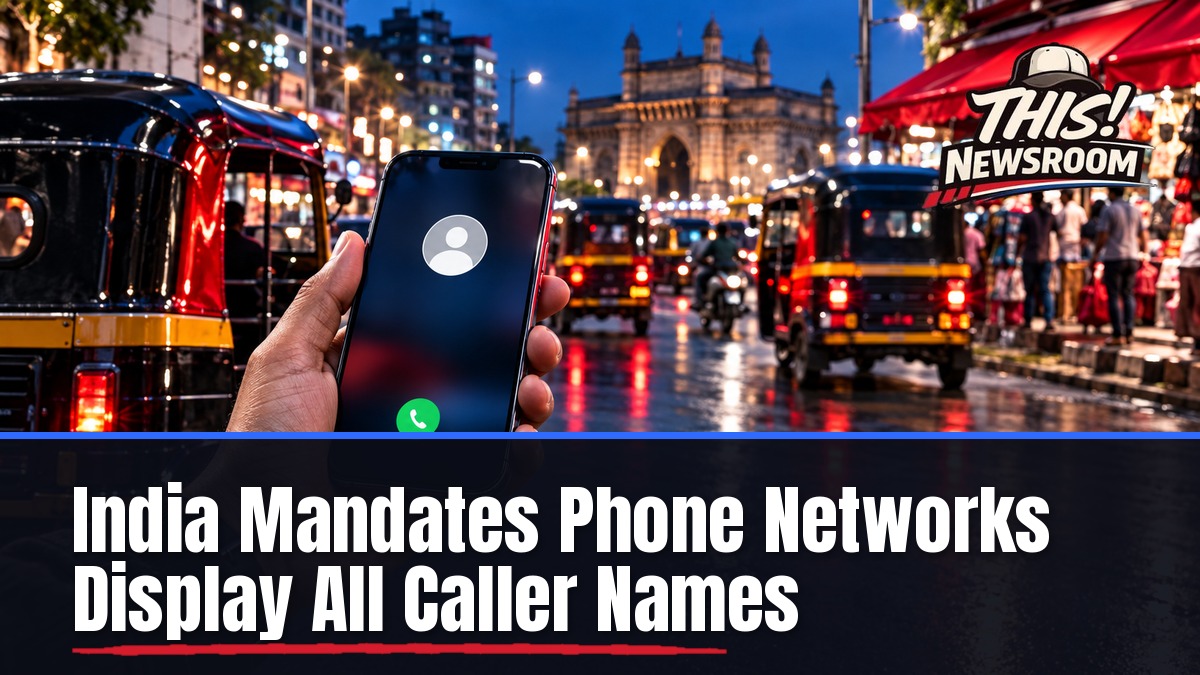
Your phone is about to start telling you who is actually calling. India’s caller name display is coming on November 1, and the unknown number is about to lose its best hiding spot.
Telecom operators must now show the name of whoever is calling, right on your screen. The order comes from India’s Department of Telecommunications. According to Inc42, a circular dated October 13 tells operators to roll out Calling Name Presentation, or CNAP, across their service areas starting November 1. That covers Airtel, Jio, Vodafone Idea and BSNL.
Scan by User:Mattes (Public domain, via Wikimedia Commons)
How CNAP shows the caller’s name
Here is the part I like: you do not have to do anything. Operators switch CNAP on by default on 4G and newer networks. There is no opt-in, no app, and no settings menu to hunt through (a small miracle in modern tech).
The name you see depends on who is calling. If you saved the number in your contacts, you see the name you saved. If you did not, domestic calls show the name in the caller’s operator records, as Outlook Money reports. Unsaved international calls simply show “International Call.”
That name comes from SIM registration data. So it works without third-party apps like Truecaller.
What the caller name display does not do
Before anyone cheers too loudly: this is not a universal unmasking. People who have turned on Calling Line Identification Restriction, known as CLIR, are exempt. Their names stay hidden.
The rollout also targets 4G and higher networks for now. Coverage varies on the wording, with some outlets saying “4G and 5G.” The department will examine 2G, 3G and landline networks separately, according to Deccan Herald. So far, it has not given a date for that.
Businesses get a special lane. Companies on business and bulk connections may show a preferred name, but only if it is a registered trademark or a trade name on the GST portal. Operators must verify the paperwork, and existing business customers must apply, per The Statesman.
Why this caller ID change matters, even in the U.S.
The idea is simple: fewer scam calls. Regulators first floated the feature in 2024 and later backed making it the default. Early coverage framed it as a weapon against fraud calls and “digital arrest” scams. Scam fights are heating up elsewhere too, much like the court fight over forced-labor tariffs now putting trade rules under a microscope.
Here’s the thing: why should a reader in Texas care? Because millions of Indian-American families call home all the time. Plenty of U.S. companies also dial India, from call centers to customer support lines. If your call lands on an Indian phone after November 1, the person on the other end may see a name instead of a mystery number.
There is a business angle too. Truecaller says it has more than 500 million users, about 350 million of them in India, and India brings in roughly 75% of its revenue. A built-in, free, default caller name feature is not exactly a gift to that model.
Operators have already trialled CNAP on 4G and newer wireless networks. Authorities have also told them to follow a security-by-design approach to protect privacy and network security. For a very different kind of disruption, see how looters hit luxury stores in France.
The big test starts November 1. Will a name on the screen be enough to make people pick up, or will the scammers just find a new name to hide behind?