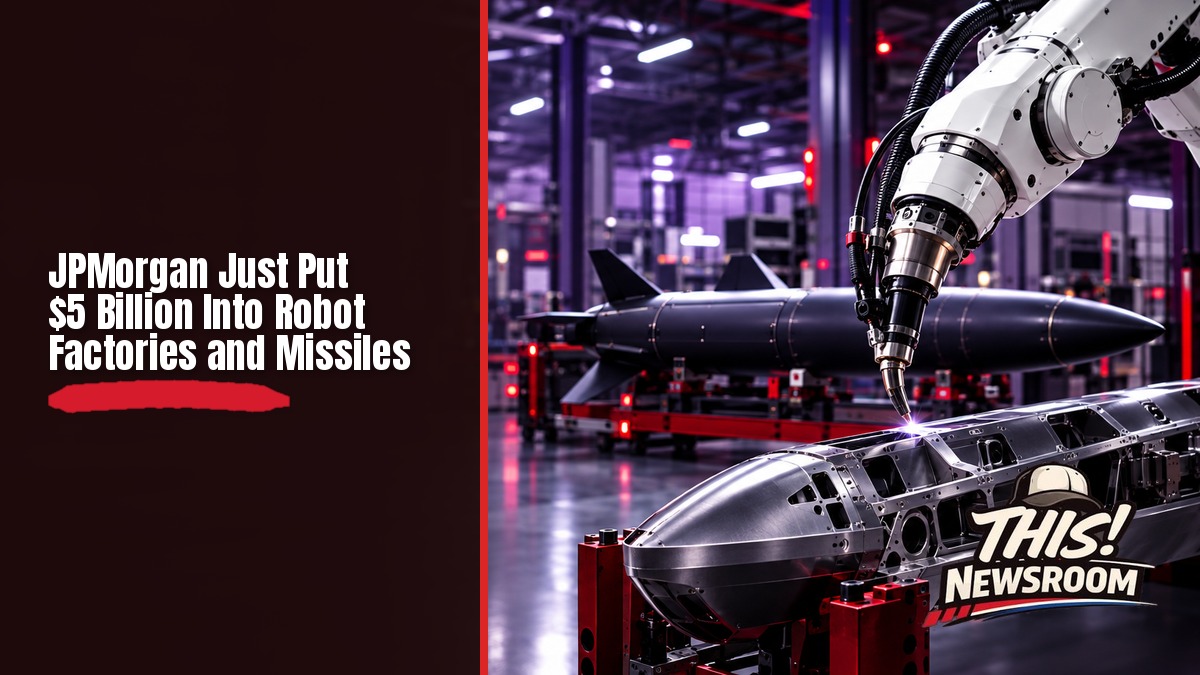
Most banks stop at checking accounts and credit cards. JPMorgan Chase is now one of the biggest venture backers of American defense tech, and JPMorgan defense investments have barely started.
The bank says it has put $5 billion of equity into startups in the first year of its Security and Resiliency Initiative, according to CNBC. That is half of the initial $10 billion the bank set aside for direct investments.
Where the JPMorgan Defense Investments Went
So far, the bank has not disclosed most of the stakes. Only two are known: Hadrian and Castelion.
Hadrian builds automated factories for aerospace and defense companies. In August, for example, JPMorgan helped lead a $1.4 billion funding round in the company, per CNBC. Castelion, meanwhile, is developing low-cost hypersonic missiles.
Robot factories and hypersonic missiles. That is not a typo, and it is not a movie pitch.
The money is spread across venture, growth and later-stage companies, according to wire copy of the announcement. Areas include next-generation defense technology, distributed battery storage, automated manufacturing and other frontier technologies. These JPMorgan defense tech bets span a wide range of company stages.
The JPMorgan Security Initiative Behind the Bet
The $5 billion is only a small slice of a much larger promise. JPMorgan launched the initiative in October 2025 as a $1.5 trillion, 10-year effort. It also includes up to $10 billion in direct equity and venture investments.
In its anniversary press release, the bank says it has also financed and facilitated more than $230 billion over the first year. Read that wording slowly: “financed and facilitated” is not the same as the bank investing its own cash. That is a lot of lending and deal-making, not a lot of checks written from the bank’s own pocket.
The initiative covers four areas: supply chains and advanced manufacturing, defense and aerospace, energy independence and resilience, and frontier technologies. For a sense of how the bank is performing elsewhere, see our look at its first-quarter 2026 earnings.
Why Jamie Dimon Wanted This
CNBC reports that CEO Jamie Dimon started the effort because wars in Ukraine and the Middle East, plus trade disputes with China, threatened the flow of energy and key components. In plain terms, he saw supply chains getting fragile and decided the bank should help rebuild them. That logic drives JPMorgan defense spending today.
Doug Petno, a JPMorgan co-president, runs the overall investment project. CNBC notes that many people see him as one of two key possible successors to Dimon. Running a $10 billion bet is one way to audition.
Petno told CNBC the bank may beat its own target. “There’s a lot of really interesting companies that have been working to solve some of these problems,” he said.
Here’s the Thing: Why This Matters Beyond Wall Street
When the country’s largest bank starts funding factories and missile makers, it changes who gets capital and how fast. Startups that once struggled to find money for hardware, which is slow and expensive, now have a very large new backer. In that sense, JPMorgan defense investments reach well beyond the bank’s own balance sheet.
It also raises a fair question: does a bank that decides which industries count as “critical” start steering national priorities? Nobody has voted on that list. For now, the answer is a mix of business logic and patriotism, and the bank is not shy about either. Even so, the bank’s earnings story is more mixed, as we noted when Goldman beat forecasts while JPMorgan missed.
What Comes Next for JPMorgan Defense Investments
The bank has yet to deploy the other $5 billion of the initial allocation. Jay Horine, who heads the initiative, said the next phase will focus on “expanding industrial capacity, strengthen supply chains and support the industries that will shape long-term economic resilience and national security.”
Per the release, nearly one-third of related activity was outside the U.S., and the program has expanded into Europe and Canada. Year two is about acting on what the bank learned in year one.
The first $5 billion was the warm-up. The question now is whether the second half buys more robot factories, or something even harder to explain at a dinner party.