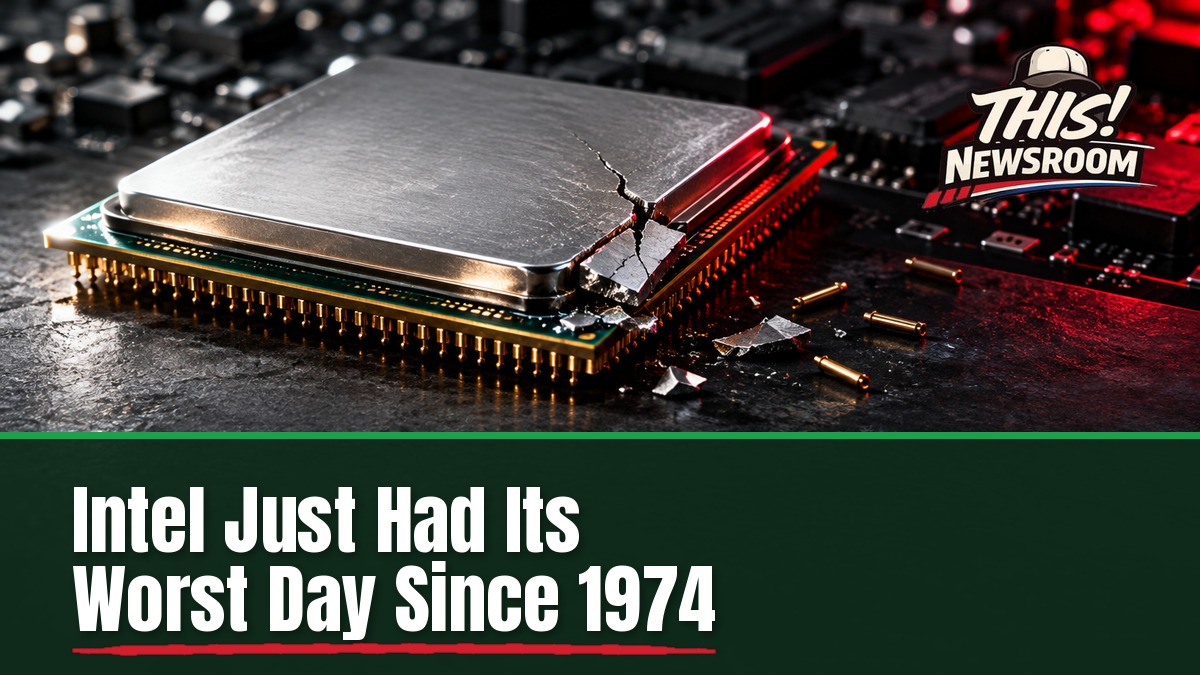
Intel stock fell about 29% on Friday, October 30, one of the worst single-day crashes in the company’s history, after a weak fourth-quarter forecast blamed a PC slump. If you own a chip fund, a 401(k) or a stock-picking uncle, that sound you heard was a lot of money leaving the building.
The pitch behind the sell-off is simple. Intel’s own CFO said it plainly in the earnings release, as CNBC reported: “We see the PC slowdown continuing at least through the first half of next year.” Investors heard that and hit the sell button. Big Tech followed Intel down, but one viral number about the damage doesn’t hold up.

Intel stock: the numbers that broke it
Intel guided fourth-quarter revenue to between $15 billion and $16 billion, with adjusted earnings of 25 cents a share. Analysts were expecting roughly $17.05 billion and 43 to 44 cents, according to TheStreet. That is not a miss. That is a swing and a whiff.
Here’s the funny part: the quarter Intel just reported was actually good. Revenue hit $16.5 billion and adjusted earnings came in at 52 cents, both ahead of the company’s own guidance. Data center and AI revenue jumped about 78% from a year ago to $7.3 billion.
Wall Street looked at all of that and said, “Cute. What about next quarter?”
How bad was the Intel plunge, really?
Yahoo Finance ran the numbers using closing prices going back to May 1973. Its analysis puts the previous worst day at July 5, 1974, when Intel fell nearly 30%. Friday’s intraday low of 30.5% was deeper than that. CNBC called it the stock’s worst day since the 1970s.
One caution before anyone writes “worst ever” on a mug. Most reports were written while the market was still open, and the exact closing percentage was still being confirmed as this was published. If the final number lands near 29%, it would be roughly tied with, or just short of, the 1974 plunge.
Either way, the 26% drop in August 2024 is now only the third-biggest. That’s a podium nobody wants.
The damage was big in dollars, too. Estimates of lost market value range from about $138 billion to nearly $150 billion, depending on the outlet. Uncle Sam felt it as well: the U.S. government bought a roughly 10% stake in Intel in August 2025 at $20.47 a share, and Friday’s drop trimmed about $12 billion from that stake’s value, per CNBC.
Here’s the thing: the Intel share price story isn’t simple
Here’s the thing: if you hold Intel through a fund or a retirement account, Friday landed in your balance, not just on a trading screen. But zoom out and the picture gets stranger. Intel entered Friday up about 150% for the year, and it was still up more than 70% for 2026 after the crash.
The stock had also hit a record high on June 22 and has since given back about half of that peak. So this is a crash, but also a hangover from one heck of a party.
The PC problem is real, though. Global PC shipments fell 4% in the second quarter from a year earlier, according to Counterpoint Research. The cause was soaring memory and component costs. Intel’s PC chip revenue slid 9% from the prior quarter to $8.1 billion. When your biggest customers can’t sell laptops, you can’t sell them chips.
Then there’s the bad luck. Intel says an explosion at one of its fabs in Israel will cut revenue by about $600 million over two quarters, with roughly $300 million of that landing in the fourth quarter. And it called 2027 an “investment year,” with spending rising “up strongly” and no positive free cash flow.
Translation: don’t expect the checkbook to relax anytime soon.
Wall Street’s reaction was not subtle
The analyst notes read like a pile-on. Bank of America downgraded Intel to Neutral and cut its price target to $100 from $145. Roth also moved to Neutral with a $70 target. Cantor trimmed its target to $90, Bernstein to $75, and D.A. Davidson downgraded the stock too.
Bernstein’s Stacy Rasgon summed up the outlook in one word: “(in a word) terrible.” D.A. Davidson’s note was titled “Not fixed yet.” (Subtle, these folks are not.)
Intel wasn’t alone. Dell, HP, AMD and Micron all fell. Benzinga reported that chip stocks as a group lost about $1 trillion in value as the Nasdaq 100 sank. Michael Dell’s own holdings took a hit too, as we covered when Dell’s stock fell after Intel’s warning. Amazon and Alphabet also sold off this week after their earnings, on worries about AI spending, per Forbes.
What comes next for Intel shares
Intel says it will add server capacity in 2027 to close the supply gap with demand. That is the bright spot, because the AI and data center business is growing fast. But JPMorgan estimates Intel’s share of server CPU revenue has already slid from 77% to 53% since late 2022. Growth alone won’t fix everything.
The CFO says the PC slump lasts at least through mid-2027. More analyst cuts are likely, and the ripple effects reach your 401(k).
So every Intel shareholder is asking the same question this weekend. Was this the bottom, or just the first big bounce on the way down?