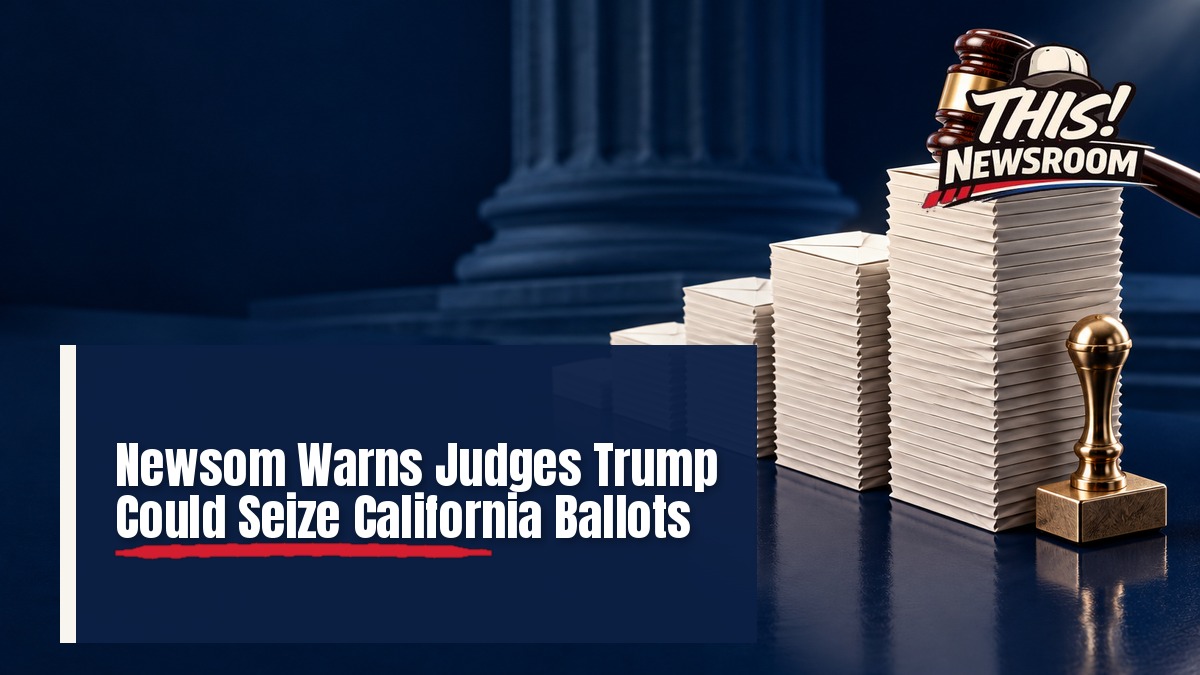
A federal appeals court on Friday blocked an effort to force California to immediately set aside the ballots of about 20,000 voters the Justice Department calls “likely noncitizens.” The ruling is the backdrop for a letter Gov. Gavin Newsom sent Saturday to California’s federal judges. He warned that the Trump administration may now try the next move: asking a judge for a warrant to seize ballots before the state certifies its midterm results. That is the Newsom federal election warrants fight in a nutshell, and it is landing just days before Election Day, Tuesday, Nov. 3.
A ballot seizure warrant is a court order letting federal agents physically take ballots, election records or vote-counting equipment as evidence. A judge has to approve it first. That approval step is exactly where Newsom wants California’s judges to push back.
The letter went to the chief judges of California’s four federal district courts, according to the SF Standard. Newsom asked them to closely scrutinize any request for ballots, election records or vote-counting equipment. The governor’s office also published the letter on its website.
Be clear on what this is: a warning, not a report of something that happened. Newsom himself wrote that he is “unaware that there are any such matters at this time.” No outlet reports that the Justice Department has applied for a ballot-seizure warrant in California, and no court has issued one.
Still, he is not hiding his worry. “Given the United States Department of Justice’s persistence in advancing this baseless theory of criminal liability, I have grave concerns federal agents will seek search warrants to seize ballots and ballot materials before the election results are certified,” he wrote, per Reuters. He also said “there is no legitimate law enforcement reason to seize ballots, ballot materials, and equipment needed to process and tabulate ballots.”
The letter also encloses a September guide from the UC Berkeley Edley Center on Law & Democracy. Its title is “Questions for Assessing A Search Warrant for Election Materials,” and the authors wrote it for magistrate and district judges.
Why the governor fears ballot seizure warrants now
Newsom did not pull this out of thin air. He pointed to Justice Department threats of prosecution against election officials. He also cited federal grand jury subpoenas sent to Los Angeles County election workers, San Jose Inside reports.
The subpoenas carry an Oct. 24 date. They went to three employees of the LA County Registrar-Recorder, who must appear Nov. 4, the day after the election, according to the AP via CapRadio. They seek records on federal letters alleging noncitizens on the voter rolls. They also ask how the county prevents noncitizen voting. Orange County got a subpoena too, reportedly seeking unredacted records on about 60 people.
The Justice Department claims roughly 20,000 “likely noncitizen” voters are on California’s rolls. State officials deny it. In a Saturday filing, UCLA data scientists said the federal list has many errors. They cited apparent citizens and thousands of names not found in state records.
The political temperature was already high before any of this. Newsom’s own fraud-crackdown credit fight has added fresh risk for him this fall.
The courts have not been friendly to the DOJ so far
The timing matters because the administration has been losing in court. Reuters says Friday’s 9th Circuit ruling could set up a Supreme Court showdown. Besides blocking the immediate set-aside of the 20,000 voters’ ballots, the court set a schedule for more fact-finding after polls close.
Earlier this week, a federal judge ordered the DOJ to stop threatening to prosecute California election officials. “These threats must stop,” he wrote, per NPR. California Attorney General Rob Bonta also issued a legal advisory. It guides judges and election officials on handling warrants for election materials, a sign that California election warrants are now a live legal question.
What this means for California voters
The disputed 20,000 voters are a sliver of California’s roughly 23 million, and nothing in the reporting says your ballot is at risk today. If you voted by mail, your ballot is already in the system. The count will run for weeks, and the state’s certification deadline is Dec. 11. That long window between Election Day and the final number is exactly what Newsom is trying to protect.
The stakes reach every race on the ballot, from the contests in our Primary Day 2026 race guide to the governor’s race, where markets favor Becerra over Hilton. All of it depends on a count nobody disputes.
What happens next with the Newsom judges letter
Election Day is Tuesday, Nov. 3. The next day, the LA County employees are due before the grand jury. Fact-finding in the 20,000-ballot case continues once polls close, and a Supreme Court appeal is possible. The reporting so far shows no response from the Justice Department or the White House to the letter, only these court dates.
So watch three things. First, whether any federal agent actually applies for a warrant at a county elections office. Second, which judge gets that request and what they say. Third, whether the Nov. 4 grand jury appearances and the post-election fact-finding turn the 20,000-voter dispute into a Supreme Court case before Dec. 11 certification. Until one of those moves, the warning remains just that.