
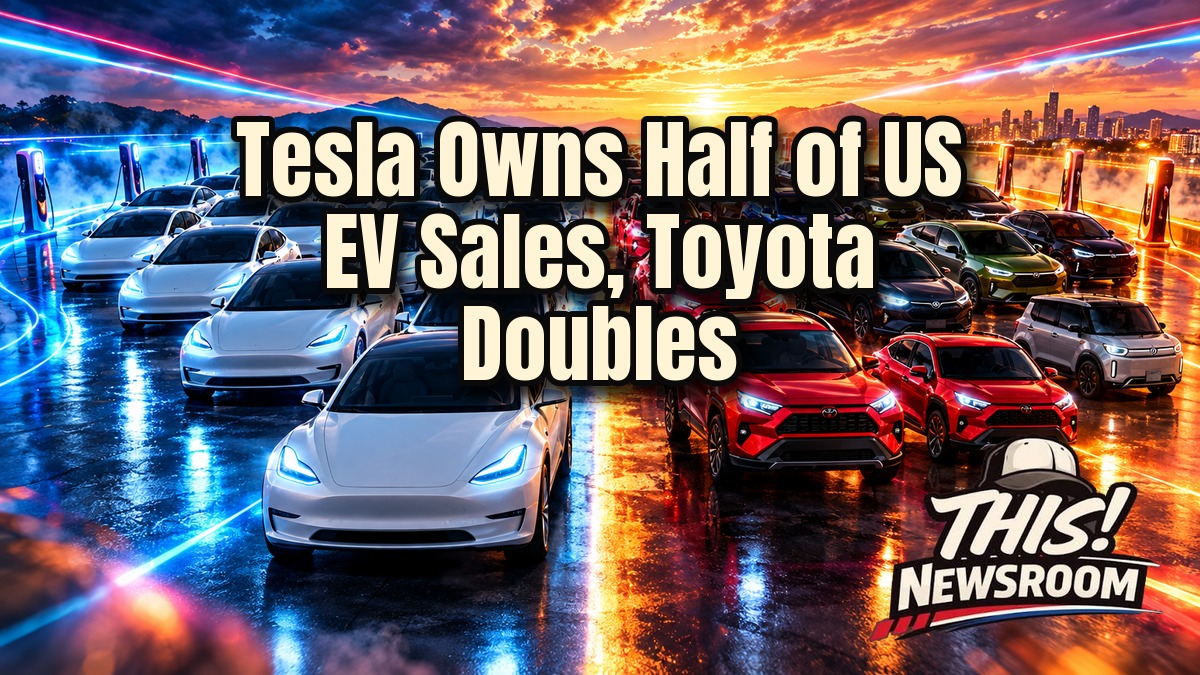
Same name on top, new face in fourth. The best-selling EVs in the US through the third quarter are led once again by the Tesla Model Y and Model 3, according to a ranking published by Electrek using Kelley Blue Book data. Together they account for roughly half of every EV sold in America this year.
That is the headline everyone expected. The more interesting story is underneath it.
Tesla Still Owns the Top-Selling Electric Vehicles
The Model Y sold 262,491 units from January through September, good for a 36.0% share of the segment. The Model 3 added 106,962 more, or 14.7%. Add them up and Tesla’s two workhorses take about 50.7% of the whole EV pie. No other EV sales ranking comes close to that concentration.
Still, the Model 3 is down 31.1% from a year ago, and the Model Y slipped 1.0%. Tesla is winning the race, but it is running slower than last year.
Everyone is, and there is a good reason why.
The Tax Credit Hangover
Remember the stampede before the $7,500 federal credit expired at the end of Q3 2025? Buyers rushed in, and that quarter became a record. Naturally, this year’s comparison looks ugly. KBB estimates Q3 EV sales at 266,630, which is down 38.6% from last year’s peak. For the full fallout, see our look at who won and lost a year after the EV tax credit died.
However, that number is up 7.7% from Q2 and is the best quarter since the credit went away. EVs also grabbed 6.5% of new-car sales, up from 5.8% in the prior quarter.
Cox Automotive’s Stephanie Valdez Streaty described the post-credit period as a “reset phase” that is largely behind us. That sounds optimistic (it is also the kind of phrase that sounds great in a press release). The sales chart suggests a market that has stopped falling, not one that has taken off. Even the most popular EVs are feeling the hangover.
Toyota Crashes the Bestselling EVs Party
Here is the plot twist. The Toyota bZ landed at number four with 24,944 sales, a jump of 103.4% from last year. The updated 2026 model only went on sale late last year, so it is fresh. Toyota’s EV sales rose 328% in Q3 alone, and Lexus climbed 442%, according to Electrek’s report.
Meanwhile, the Hyundai Ioniq 5 stays the best-selling non-Tesla EV at 31,112 sales, though it is down 24.3%.
Notice a pattern? The Ioniq 5, the bZ and the Chevy Equinox EV all start around $35,000. In a market short on incentives, cheaper cars are winning.
Chevy’s Rough Quarter
Speaking of the Equinox EV, ouch. It ranks fifth with 18,154 sales this year, but only 1,905 of those came in Q3. That is a 92% plunge from more than 25,000 a year earlier. Year to date it is down 65.6%. Few EVs have fallen so hard, so fast.
Honda’s Prologue, a close cousin, fell 63.6%, and the Ford Mustang Mach-E dropped 59.0%. In fact, the rest of the top 10 is a parade of red numbers. Rivian is a bright spot: its R1S held up at 17,259 units, and the brand’s Q3 sales rose 46%.
One caution before you quote that top 10 at the next barbecue. The table includes the Rivian EDV500/700, a commercial delivery van, at number eight. It sold 15,685 units, up 130.4%. So the list is not purely a ranking of cars you can park in your driveway.
What the Best-Selling EVs in the US Mean for Your Wallet
Here’s the thing: the EV market is no longer a one-brand show, but it is still close. Tesla sets the pace, and everyone else fights over the remaining half. For shoppers, that fight means more competitive pricing near the $35,000 mark, where the strongest challengers are camped. Used buyers are shopping too, as demand for the used Ford F-150 Lightning shows.
It also helps explain why automakers keep leaning on hybrids. America’s appetite for electrification is real, but it is picky about price. The best-selling EVs in the US are the ones that keep sticker prices sane.
Next, watch whether Toyota’s momentum holds and whether Chevy can turn its Bolt and Cadillac lineup into something resembling a comeback. Tesla will not be sweating, but for the first time in a while, the chasing pack has a pulse.