
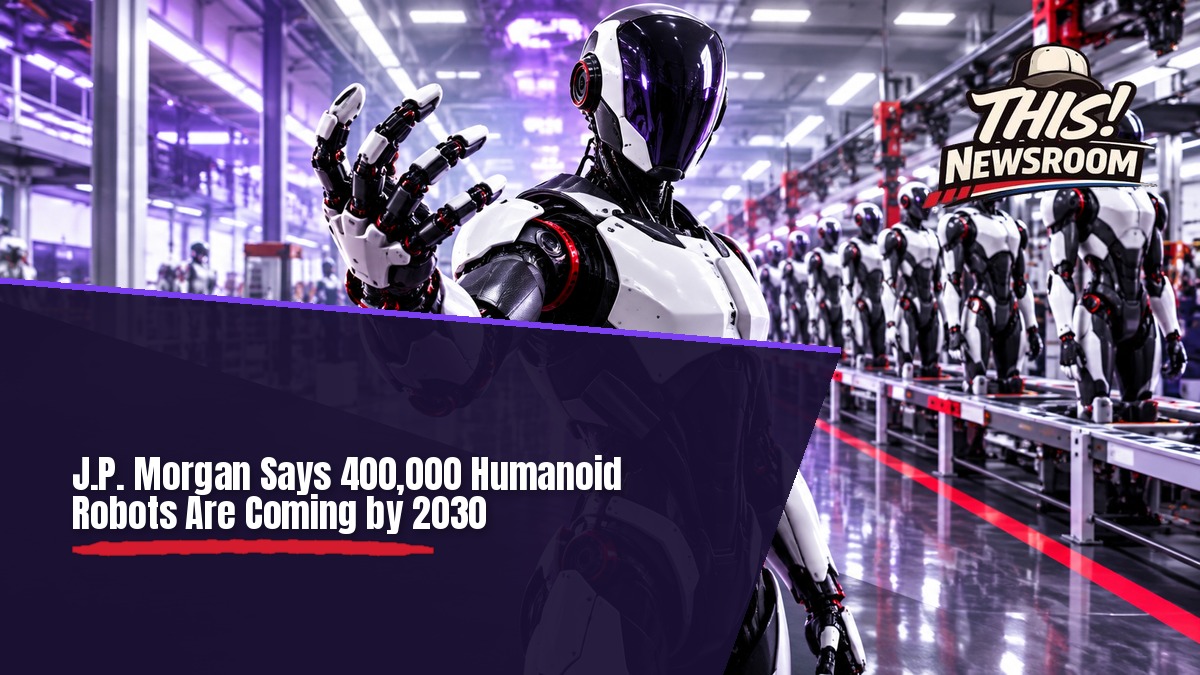
America could be building up to 400,000 humanoid robots by 2030, J.P. Morgan said on Thursday, according to a Reuters report. Humanoid robot production in the US could reach 300,000 to 400,000 units by 2030, and about 1.5 million by 2035.
That is a long way from the showroom display model you walk past at the mall. Today, most US makers other than Tesla are aiming for just 10,000 to 30,000 units a year, according to Reuters via TimesLIVE. So the bank is forecasting a jump that would make a factory manager blink twice.
Why 530,000 open jobs could drive humanoid robot production
The shortage is the real hook. According to Cailian Press via Futu News, US manufacturers have about 530,000 open jobs, and warehousing and logistics have another 90,000. Employers can’t fill those positions, which is why a machine that never calls in sick starts to look interesting.
Better economics and growing factory capacity add to the push. The first jobs will be in manufacturing, logistics and warehousing.
Tesla is already thinking along these lines. Its 2027 lineup of cars, robotaxis, semis and humanoid robots shows how seriously one carmaker takes the bet.
Here’s the thing: the money for building humanoid robots is starting to add up
J.P. Morgan estimates that humanoid costs are nearing parity with labor costs. It says multi-shift deployment could save a customer about $100,000 a year. For a company running a warehouse around the clock, that is the number that gets a purchase order signed.
Even so, don’t expect your next coworker to be made of titanium. Early deployments are limited to defined tasks in controlled environments, so the savings are not guaranteed, eWeek reports. J.P. Morgan itself says near-term progress is still “supply constrained,” with a few binding bottlenecks: “hands, actuators, the brain, and production capacity.”
In other words, robots can’t yet do it all, and the industry can’t yet build enough of them. Hands are hard. Brains are harder.
Meanwhile, the market is starting to reward the bet. Agility Robotics is going public.
The Washington angle on humanoid robot manufacturing
Policy may also help speed things along. The Trump administration has found that imported robotics and industrial machinery pose national security risks. According to FOX 26 Houston, J.P. Morgan says that finding could lead to tariffs or other measures meant to boost domestic production. However, no date has been set for any such action.
The same report names Tesla’s Optimus, Agility Robotics’ Digit, Boston Dynamics’ Atlas, Figure AI’s robots and Apptronik’s Apollo as leading US platforms.
One catch for humanoid robot output
There is a catch worth knowing. Reporting so far does not make clear whether the 2030 and 2035 figures describe annual humanoid robot output or a running total. Some outlets call them annual, but the wire reports do not say. We have asked for clarity and will update as we get it.
Also note that this is a bank’s forecast, not a guarantee. A survey of US executives found that 61% expect a lack of societal acceptance to be a critical obstacle to adoption.
So will robots really be on every factory floor by 2030? The bank’s spreadsheet says yes. The 530,000 empty jobs say the demand is already there. The only open question is whether we’re ready to share the break room with a machine that never takes one.