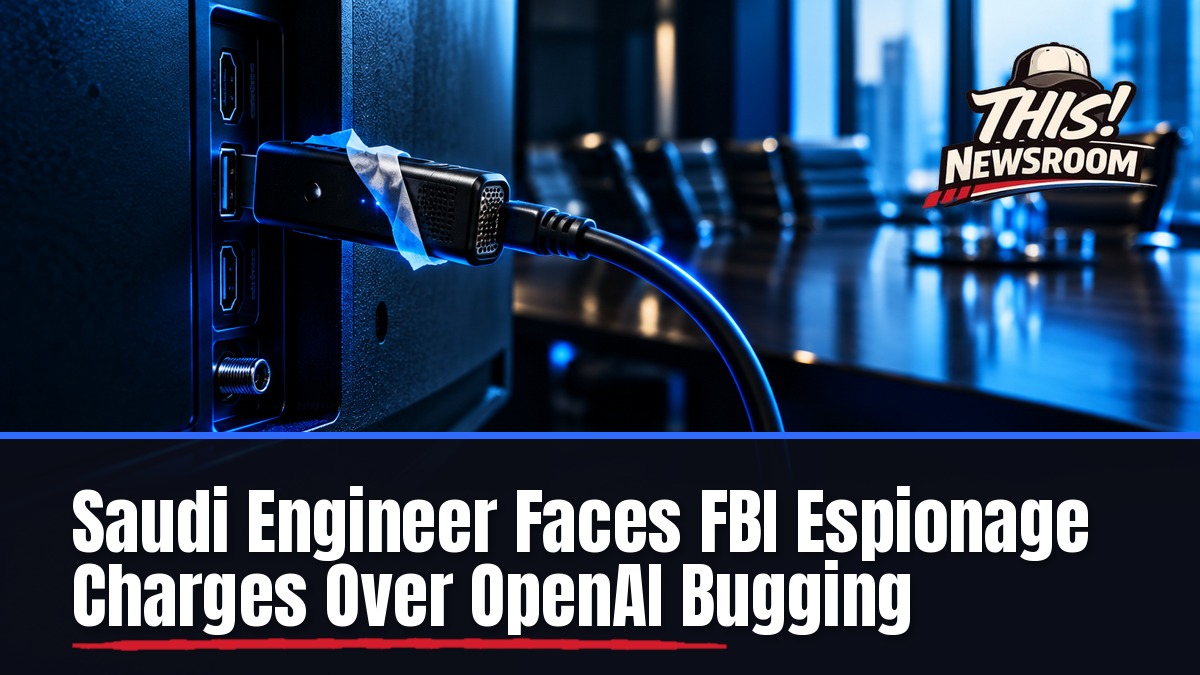
35-year-old Saudi engineer Abdulrahman Alfozan faces one federal charge, and the FBI is exploring whether to build an OpenAI espionage case on top of it, according to a Wall Street Journal report. The former OpenAI engineer is accused of planting a hidden recording device in an executive conference room. Prosecutors have filed nothing beyond that single count.
The Journal says investigators are examining whether they can also pursue Alfozan for espionage, per a German summary of the story. We could not independently confirm it. Neither the Justice Department nor the FBI has publicly backed the claim, so treat it as a reported possibility, not a decision.
Today, Alfozan faces one charge: using a device to intercept oral communications. That is a wiretapping-style offense. Al Jazeera reports the maximum penalty is five years in prison and a $250,000 fine. Prosecutors have not filed any espionage or trade-secret counts.
What prosecutors say happened in the OpenAI bugging case
Alfozan, 35, is a Saudi national who joined OpenAI as an engineer in July 2025. The Justice Department said agents arrested him Oct. 9. According to the FBI complaint, he installed a thumb-sized device on or about Sept. 28. It had a microphone and could connect to a camera. Reuters reported that he concealed it in toilet paper. Our earlier report on the arrest and the hidden mic has the full timeline.
OpenAI found the device on Sept. 30, plugged into a USB port behind a TV in a San Francisco executive conference room. A camera the company had placed in the room reportedly caught Alfozan checking behind the television. Investigators also found a second, similar recorder in a bag of his.
The complaint says the stored data was encrypted and inaccessible. As a result, it is unclear what, if anything, the device actually captured.
The Saudi connection in the OpenAI spy case
This is where the story gets sharper. Prosecutors say Alfozan was in frequent WhatsApp contact with a member of the Saudi royal family throughout 2025 and 2026. They also say he booked one-way tickets to Saudi Arabia, via Istanbul, for Oct. 12. His wife and a third family member were on the booking, CNBC reported. He is also a venture partner at Saudi-based Raed Ventures.
Then came the bail hearing. On Oct. 19, Judge Alex Tse ordered Alfozan held without bail, citing a significant flight risk. The Saudi consulate in Los Angeles had offered to pay his full bail. The judge called that offer “problematic,” per CNBC.
Nobody has established a motive or any Saudi government role. No court has tested the claims, and Alfozan is presumed innocent.
Here’s the thing: why the OpenAI espionage case matters
Espionage is a different animal than wiretapping. It would signal that investigators believe a foreign state was behind the effort. One outside expert told AZ Family that prosecutors could bring economic-espionage charges if someone took trade secrets to benefit a foreign government. That is speculation, not an FBI statement.
The stakes are concrete. The charge on file carries up to five years and a $250,000 fine. An espionage count would raise the penalty and turn a workplace bugging into a national security prosecution.
OpenAI says it found no sign that Alfozan accessed or took model weights, source code or customer data. The company fired him. Still, officials are treating the case as a national security matter. FBI Director Kash Patel said he “allegedly concealed a covert recording device inside his employer’s executive conference room to secretly capture sensitive communications about the company’s super intelligence technology.”
The timing is awkward, too. Earlier this year, OpenAI held talks with Saudi Arabia’s Public Investment Fund about investing in the company. The people building the most valuable technology on earth now have to ask who is sitting in the room, and who is plugged in behind the TV. Governments are asking similar questions: Sweden has blocked ChatGPT and Claude on government work PCs.
What happens next in the OpenAI espionage probe
Alfozan stays in custody for now. Prosecutors could seek an indictment or add counts, but no date is public, and the court has not announced the next hearing. We have asked the Justice Department, the FBI and OpenAI for comment, and we will update this story if they respond.
One charge stands, and the device was encrypted. Whether it ever recorded a word that mattered is the one thing nobody can say yet.