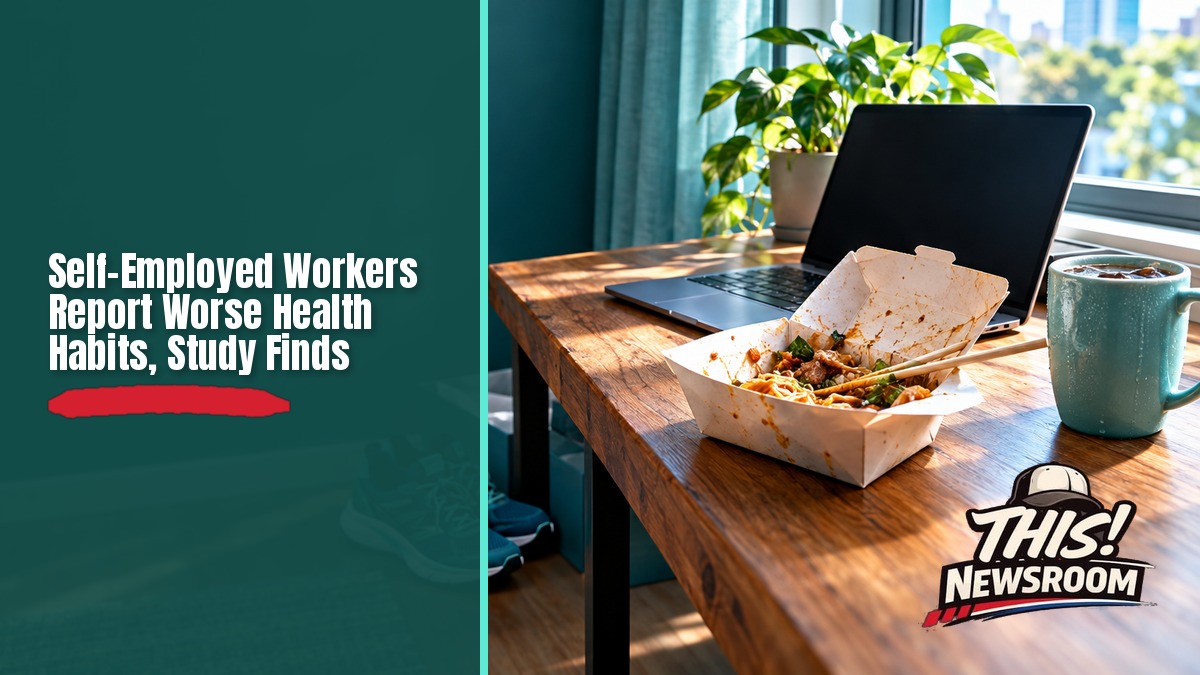
Being your own boss sounds like freedom, until the bill shows up. A new study of more than 5,000 working adults suggests the self-employed health gap is real: self-employed workers reported poorer health and shakier habits than people with traditional jobs, according to research published in Frontiers in Nutrition.
One catch before anyone panics: the adults in this study live in Thailand, not the United States. That matters, and we’ll get to why.
What the self-employed health gap study found
The researchers pulled data from the Thailand Health and Welfare Survey, covering working-age adults. They looked at self-rated health, diet variety, physical activity, smoking and alcohol use, as Mindbodygreen reported.
Then they compared traditional employees with the self-employed. They also split the self-employed into two groups: those who have employees and those who work solo.
The self-employed reported less varied diets and lower physical activity. They were also somewhat more likely to smoke or drink alcohol. A composite measure of illness was significantly linked to self-employment too, which backed up the findings based on self-rated health. Put simply, freelancer health looked shakier on almost every measure.
Solo worker health risks: going it alone widened the gap
Here’s the part that stands out. Solo workers did worse than self-employed people who employ others. They had less varied diets and poorer overall health indicators.
In other words, the gap isn’t simply employee versus entrepreneur. Running a business with a team behind you looked healthier than running it alone.
The paper’s authors point to several possible pathways, including unstable schedules, economic uncertainty, stress and delayed health care. Those may lead to irregular eating, less exercise and fewer checkups. That is the authors’ theory, though, not something the data proved.
Why this study has limits
So, does this mean your side hustle is making you sick? Not so fast.
The study is cross-sectional, which means it is a snapshot in time. It shows an association, not a cause. Healthier people might simply be more likely to land traditional jobs. Or something else, like income, could be driving both. That uncertainty is a good reminder to read any claim about the self-employment health gap with care. We took the same careful approach when we looked at a sauna study that got oversold as proof.
The sample is also Thai. Self-employment looks different in Bangkok than in Boise, and the researchers themselves say its health effects remain unclear in developing economies. We don’t know yet whether the same pattern holds for freelancers, contractors and small-business owners in the U.S.
Entrepreneur health: what self-employed Americans can take from it
Here’s the thing: the findings still ring true for a lot of people who work for themselves. No HR department schedules your lunch. No boss tells you to log off. And no employer plan nudges you toward a yearly physical.
Self-employed Americans often buy their own health insurance, which adds another reason to skip a checkup. That is separate from this study, but the logic isn’t hard to follow. Many of these workers are also building an audience online, and platforms like LinkedIn, which now courts business creators, only add to the pressure to stay constantly on.
If you work for yourself, treat your own wellbeing like a client who never cancels. Block time for real meals, put a workout on the calendar, and book the checkup you keep pushing back. The boss is nicer when she’s rested.
The next step belongs to researchers. Someone needs to run the same question on American workers, and see whether the freedom of self-employment comes with a hidden cost here, too.