

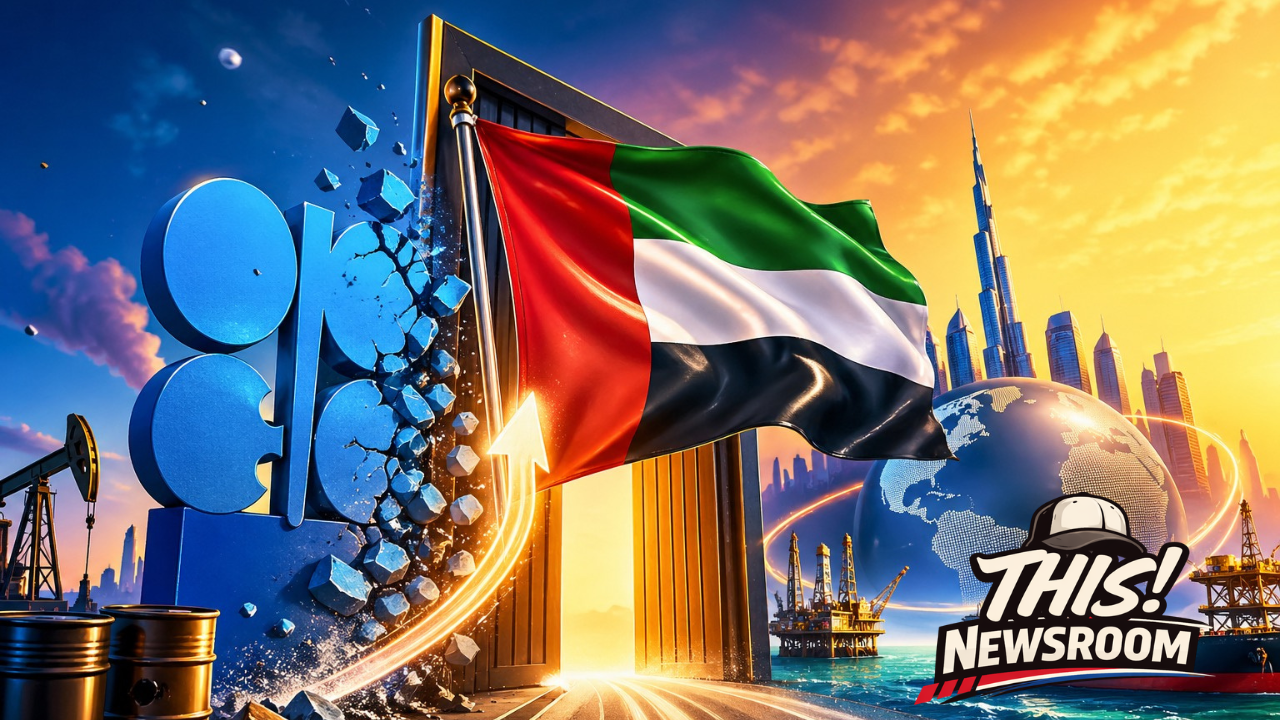

After nearly six decades as a core member of the Organization of the Petroleum Exporting Countries, the United Arab Emirates is officially stepping away on May 1st—a move that signals far more than a simple policy change. It marks a structural shift in how global energy power is distributed, controlled, and ultimately monetized.
This is not just an exit. It’s a message.
Why This Matters: The Cracks in OPEC Are No Longer Hidden
For years, OPEC has operated as the world’s most powerful oil alliance—coordinating production levels to stabilize (and often elevate) global oil prices. Countries like Saudi Arabia have historically led the charge, with members agreeing to production quotas in exchange for price control.
But here’s the reality: that control is slipping.
The UAE’s exit underscores a growing frustration among member nations that feel constrained by OPEC quotas—especially those capable of producing more oil at lower cost. The UAE has heavily invested in expanding its production capacity and now wants the freedom to fully capitalize on it.
In simple terms:
Why limit output when you can dominate market share?
Why Now? Timing Is Everything
The timing isn’t random—it’s strategic.
Global energy markets are undergoing rapid transformation:
- Demand remains volatile post-pandemic
- Geopolitical tensions continue to disrupt supply chains
- Renewable energy is gaining traction but not fast enough to replace oil
The UAE sees an opportunity.
By exiting OPEC now, the country can:
- Increase production without quota restrictions
- Capture additional global market share
- Strengthen its long-term economic diversification strategy
More importantly, the UAE is positioning itself not just as an oil producer—but as a global energy powerhouse with autonomy.
Who Else Has Left OPEC?
The UAE isn’t the first to walk away. Several countries have already exited OPEC, often citing similar frustrations.
Notable OPEC Departures:
- Qatar (2019) – Shifted focus toward natural gas dominance
- Indonesia (Suspended membership multiple times, last in 2016) – Became a net oil importer
- Ecuador (2020) – Needed fiscal flexibility
- Angola (2023) – Disagreements over production quotas
Each departure chipped away at OPEC’s cohesion. The UAE, however, represents something different—it’s not a struggling producer leaving.
It’s a top-tier, financially strong, high-capacity exporter choosing independence.
What This Means for OPEC: Beginning of the End?
Let’s be direct: this is a serious blow.
OPEC’s power has always depended on unity. The more members align on production limits, the more influence the group has over global oil prices.
But that unity is unraveling.
When a heavyweight like the UAE exits:
- It weakens collective bargaining power
- It encourages other nations to reconsider membership
- It accelerates fragmentation within the alliance
Could OPEC fail entirely?
“Fail” might be too simplistic—but irrelevance is a real risk.
The rise of non-OPEC producers (like the United States), combined with internal disagreements and now high-profile exits, means OPEC’s grip on the market is loosening.
The Bigger Picture: A New Energy Order
This move isn’t just about oil—it’s about control in a changing world.
The UAE is betting on:
- Flexibility over coordination
- Market share over price control
- Independence over alliance
And that strategy may resonate.
If more countries follow, OPEC could shift from a dominant force to just another voice in a crowded energy landscape.
Final Take
After 59 years, the UAE’s exit marks the end of an era—and possibly the beginning of a new one.
The message is clear:
The future of energy may no longer be controlled by alliances—but by ambition.
And right now, the UAE is choosing to lead on its own terms.