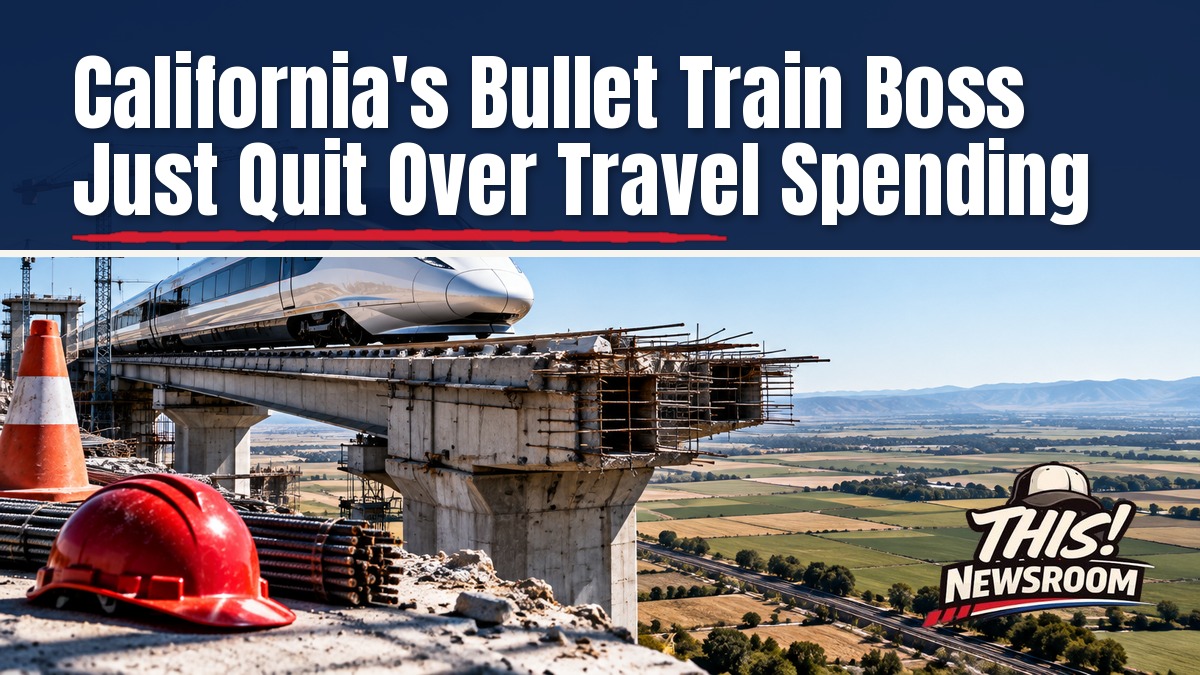
Nothing says “public works project” like an escape room on the expense report. California high-speed rail CEO Ian Choudri resigned late Wednesday, days after an inspector general flagged questionable travel spending by the consultants the state pays to build the $126 billion-plus bullet train.
Taxpayers still don’t have a train to ride.
According to CalMatters, which obtained his email, Choudri cited “important personal and family priorities.” The resignation took effect immediately, board Chair Steve Kawa said. Then, on Thursday, the board named state Finance Director Joe Stephenshaw as interim president, CBS News Sacramento reports.
What the inspector general found about the consultants’ travel
Inspector General Ben Belnap reviewed about $2 million in travel expenses from four firms: KPMG, SYSTRA TYPSA, Nossaman LLP and AECOM-Fluor. Roughly $800,000 had not been approved in advance, according to Yahoo News coverage of the report. Another $81,000 was flagged as not allowed, including trips tied to a gym, an escape room and a nightclub.
Other reported outings included a tiki bar and a cigar lounge. Some travel also involved Folsom, where Choudri has a home, per SFist. Escape rooms are fun. They are not usually a line item on a public rail project.
Here’s where the numbers get messy. CalMatters puts the questionable spending at about $600,000, while the SF Standard says $592,000. CBS, meanwhile, cites an inspector general finding that 60 percent of reviewed travel, or $680,500, did not comply with state rules. Each outlet is describing a slightly different slice, so treat the exact figure with care.
Why the rail authority head’s exit matters to your wallet
Here’s the thing: this isn’t only a story about a CEO and some bar tabs. Gov. Gavin Newsom has committed $1 billion a year from the state’s climate fund to the project through 2045, according to CalMatters. That is real money from a state where residents already feel the squeeze, and it fits a wider pattern of scrutiny over how California spends public dollars, as in this California fraud crackdown and the political risks it created for Newsom.
The latest business plan estimates the full project will cost between $126 billion and $231 billion, per KFOX. Only the 171-mile Merced-to-Bakersfield stretch is under construction. Meanwhile, the Trump administration pulled $4 billion in federal funding in 2025, the SF Standard notes, and California dropped its lawsuit over it in December and turned to private investors.
So who’s paying for all this? Mostly Californians, and the oversight questions just got louder.
Pressure on the high-speed rail chief was building
Earlier this month the board limited Choudri’s contracting authority. It now requires in-house legal counsel to sign off on contracts under $25 million, according to San Jose Inside. An anonymous source told CalMatters the board had been weighing further discipline for weeks, including possible termination. The board was also set to decide whether he qualified for a $25,000 bonus. His 2026 pay tops $534,000.
Republican Assemblymember Alexandra Macedo had written to the board demanding his removal. Democratic gubernatorial candidate Xavier Becerra told KCRA that if elected in November he would likely replace Choudri. That race is one of many shaping the state’s direction, as our look at the key races that could shape the political landscape shows. Whether any of that triggered the exit is unclear, and Choudri’s own stated reason is personal and family priorities. In his email he called the job “one of the most meaningful and rewarding chapters” of his professional life.
Newsom’s office said it “welcomes today’s announcements as an important step in that direction,” toward accountability and a stronger project.
What happens next after the California high-speed rail CEO’s resignation
The board’s meeting continues Thursday, and it was scheduled to consider environmental clearance for the final 33-mile Anaheim-to-Los Angeles leg. Still unanswered: whether the board will run a permanent CEO search, how long Stephenshaw will serve, whether he keeps his Finance post, and whether Choudri walks away with any bonus or severance. Critics are also pushing to recover taxpayer money from the four consulting firms.
Choudri took the job in August 2024. He lasted about two years. The train, as of today, still hasn’t left the station, and the next California high-speed rail CEO inherits every one of these questions.