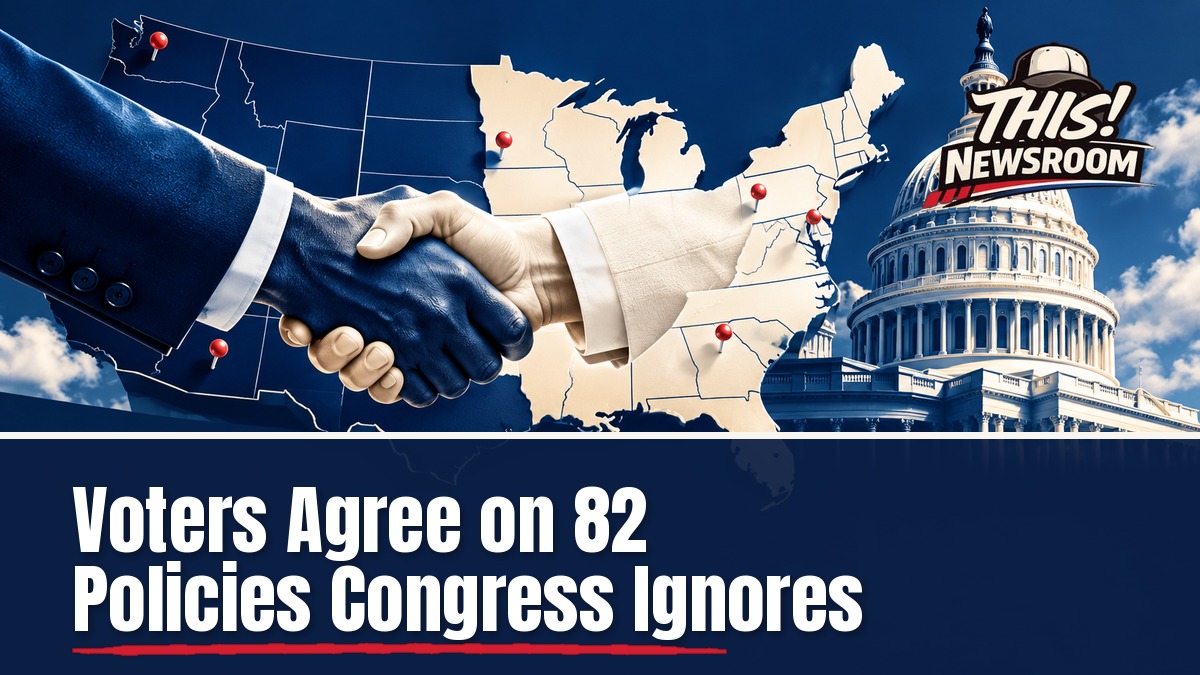
Congress is supposed to vote like the people who sent it there, and voters in 11 battleground states and 28 House districts say it does so just 35% of the time. They say their elected officials make the same decisions as most Americans only that often. That finding points to a surprising amount of bipartisan common ground. It comes from a press release distributed by PR Newswire on Oct. 22 from the University of Maryland’s Program for Public Consultation, which wrapped up a months-long survey series on political common ground.
The pollsters say that gap is the real problem. They brought a pile of numbers to make the case.
What the battleground survey found
The Program for Public Consultation, or PPC, surveyed roughly 40,000 adults across two waves this year. It asked about 14 topics, including AI, housing, healthcare, Social Security, immigration, abortion, taxes and criminal justice. Nearly every question came from real legislation or executive branch proposals.
The headline numbers are striking. Majorities of both Democrats and Republicans agreed on 106 policies nationally. In the battlegrounds, they agreed on 82 policies in every state and district surveyed, and on 101 policies in at least two-thirds of them.
That is a lot of agreement for a country that treats every vote like a blood feud. Housing is one example, since the debate over who actually buys investor homes often gets framed as a partisan fight.
Why voters blame Congress, not each other
The survey also asked people why Washington is stuck. Across party lines, the answer was not each other. Large majorities said polarization comes from elected officials, not the public. Democrats said so at rates of 62 to 88%, and Republicans at 66 to 89%, depending on the state or district.
Then came the question of whether Congress would find shared ground if it listened to voters more. The numbers get lopsided. Between 82 and 97% of Democrats and 80 to 95% of Republicans said yes. In the pollsters’ words, that is an overwhelming bipartisan verdict.
“There is far more common ground among the American people than there is in Congress,” said PPC director Steven Kull.
Here’s the thing: read the fine print on this bipartisan agreement
Before anyone treats this as gospel, a few caveats apply. This is one group’s research, and I found no independent check of it. The samples came from online opt-in panels, not random phone calls. Response rates ran about 7 to 9%, and margins of error reach 8.1 points in the smallest samples.
Also, those big percentages are ranges across all the places surveyed. The release does not rank individual districts on how much their voters want to be heard. So no, this is not a neat roadmap that tells each candidate what their own district wants. Nor does the release claim that gridlock is what blocks action on any one kitchen-table issue.
The policies were not picked at random, either. PPC chose questions that had already drawn bipartisan support in its earlier national surveys, where respondents got briefings and weighed pro and con arguments first. In other words, the project went looking for agreement, and found plenty of it.
One more oddity: the release says 11 states, but it lists 12. I’d ask PPC about that before repeating any state count.
What cross-party agreement means for you
The practical takeaway is not that Congress is about to sign a kumbaya bill. Instead, candidates in swing places face voters who want elected officials to follow public opinion more closely. Anyone who stands up at a town hall and claims to be a bridge-builder now has a poll to be measured against. Consider the Ohio governor race, where both candidates will soon face exactly that test.
The respondents also want the press to do its part. Roughly two-thirds or more of both parties said news reports on policy should include public opinion data most of the time when reliable numbers exist. Between 60 and 85% said it is very or extremely important for outlets to report whether most Americans favor or oppose a bill before Congress votes.
What happens next
This was the capstone of a series released in rolling installments ahead of the November election. The earlier releases covered topics like taxes, Social Security and military force. The release links to the individual state and district results for anyone who wants to check their own backyard. Meanwhile, the fight over who controls the Senate keeps heating up, as a GOP-linked PAC’s $1 million bet in Ohio shows.
So here is the question that matters. If voters in both parties already agree on 82 policies everywhere pollsters looked, what exactly is Congress waiting for?