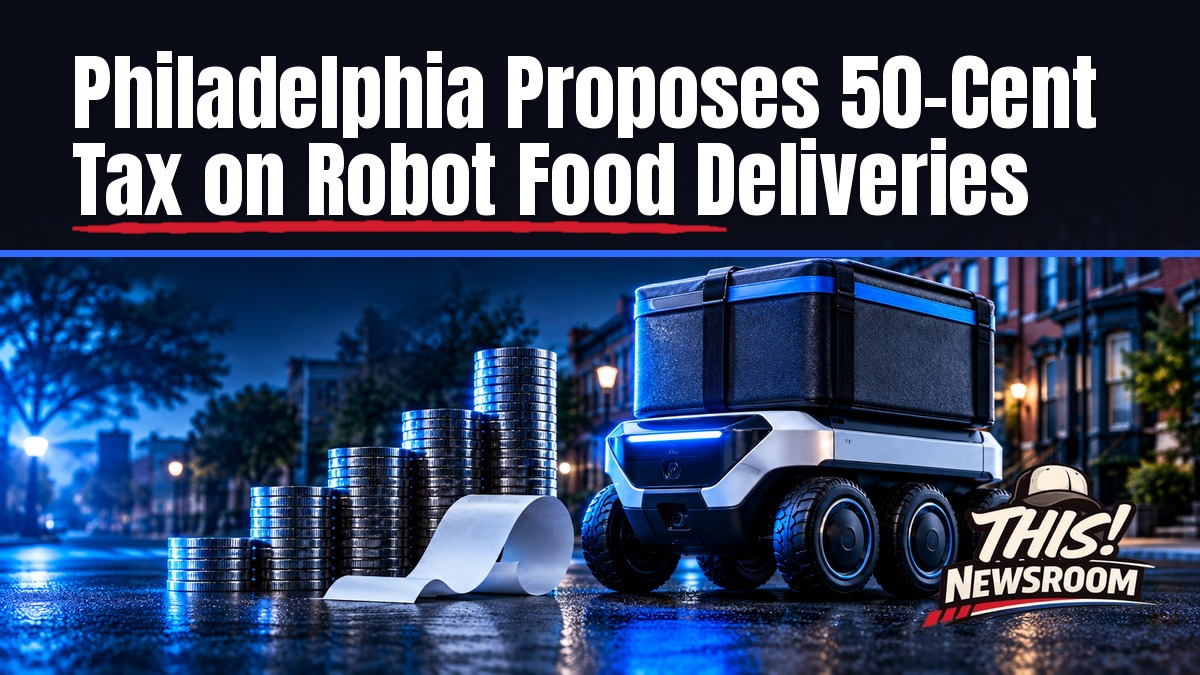
Philadelphia could soon charge delivery robots 5% of the gross cost or 50 cents per delivery, whichever is greater. And the lawmaker behind the delivery robot tax says his best-case outcome is that nobody pays it. Councilmember Jim Harrity wants people to boycott the machines so the tax never gets collected.
Harrity, an at-large Democrat, introduced the bill on Thursday, Oct. 29, The Philadelphia Inquirer reports. The bill is called the Automated Services Displacement Tax. It would hit sidewalk delivery robots, driverless taxis, automated shuttles and driverless freight.
The Philadelphia delivery robot tax, by the numbers
The rates depend on the machine. PhillyVoice reports that robotaxis would owe 5% or $1, whichever is greater. KYW Newsradio adds that the city would tax driverless freight at 3%.
Here’s what that looks like in practice. A $40 order would carry a $2 robot fee, MoneyWise says. An $8 order, however, would owe the 50-cent minimum, because 5% of $8 is only 40 cents.
Who pays a tax on delivery robots, and what it means for your food bill
Here’s the thing for your wallet: the tax lands on the companies that run the robots, not on customers. Whether those companies pass it along is the open question. MoneyWise floats the idea of a hit to your food bill, but nothing confirms pass-through.
So no, your burrito does not cost more today. Still, if you order a lot of cheap deliveries, that 50-cent floor is the number to watch.
There is also a catch that matters for jobs. The robot delivery tax would apply only to robots used in place of a person. A company that keeps human workers would not owe it, PhillyVoice reports. Automation anxiety is also behind Tesla’s push toward a $30K self-driving robotaxi.
Where the money would go
Revenue would fund the Zero Fare Program, which gives free SEPTA rides to low-income residents. Harrity says the larger point is to make up for city losses in wage tax and business income and receipts tax when machines replace workers, WHYY reports. His pitch to Council was blunt: “Robots do not pay into the city they work in.”
Harrity opposed Mayor Cherelle Parker’s rideshare tax last spring, and Council rejected it. Now he is back with a delivery robots tax of his own.
The arrest that made this a national story
The timing made this bill irresistible to national media. On Oct. 14, police cited Carolyn Marvin, 78, a retired Penn communications professor, for disorderly conduct. She had been blocking an Uber Eats robot near Reading Terminal Market, The National Desk reports.
She told CNN, “I was under the impression that I had more rights than the robot did.” She plans to fight the citation on First Amendment grounds and says she will keep blocking robots.
Avride, a third party, runs Uber’s robots in Philadelphia. It launched there in March 2026, the Inquirer reports. In other words, the company that would owe the tax is not even Uber.
What happens next for the delivery robot tax
This is a proposal, not a law. The bill still needs full Council approval, 6abc reports. A committee will hold hearings first, and the rates could change there.
Outlets also differ on the fee basis. PhillyVoice says gross cost, while the Philadelphia Tribune says delivery fee. The bill text will settle that. Pennsylvania’s election-year politics could shape how that debate plays out.
As for Harrity’s dream scenario? “My best outcome for this would be we boycott these robots and the Ubers and nobody pays any tax,” he told KYW. Let’s be honest: that’s a tax designed to raise money, pitched by a man hoping it raises none. If the boycott works, the bill funds nothing. If it fails, he gets his revenue. Either way, it’s a first.