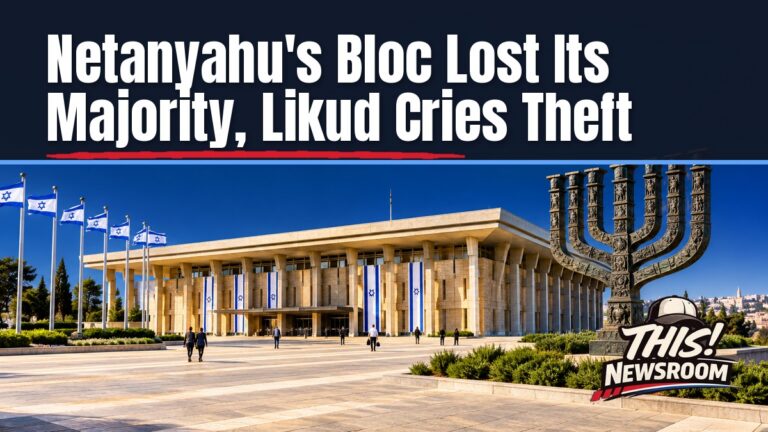
Israel’s votes are counted, Benjamin Netanyahu’s side came up short, and his Likud party has settled on an explanation: the election was stolen. The police have found no evidence for that. That Israel election stolen claim is now the biggest fight in the country.
Here is the scoreboard. According to the count published by the Central Elections Committee, Netanyahu’s bloc won 53 of the Knesset’s 120 seats. A majority takes 61, so this is a gap, not a rounding error. Meanwhile, Yashar party leader and former military chief Gadi Eisenkot’s bloc has 48, and Arab-led parties hold a record 19. For the full picture of what 53 seats means, see our look at how Netanyahu is stuck at 53 seats while the count continues.
Why the Israel election stolen claim is the story
On Wednesday, Likud issued a statement that began, “The elections in Israel have been stolen!” It accused Arab-led parties of bribery, intimidation, forgery and multiple voting. Netanyahu then shared it on X. By Thursday, Likud was warning of a “foreign takeover” of the Knesset, a warning AP says Likud made without evidence.
So what is the evidence? Axios reports that the claims rest on the arrest of three Ra’am activists, suspected of paying a small number of voters in one Arab city. Israeli police said there was no evidence of a stolen election. Three arrests in one city are a long way from a stolen country.
Election officials are not brushing it off, though. The Central Elections Committee says it is reviewing Likud’s complaints as part of routine integrity checks. The Washington Post reports that the Shin Bet is also looking into it. Ra’am leader Mansour Abbas welcomed the investigation and accused Netanyahu of incitement. Eisenkot said Likud is trying to delegitimize the results.
Here’s the thing: the Knesset election results give nobody a majority
This is where the math gets uncomfortable for everyone. Neither main bloc reaches 61 without the Arab parties’ 19 seats. A Netanyahu government would need their votes. So would an opposition one. Yousef Jabareen, who leads the Joint List, told AFP he would cooperate with an opposition-led government to unseat Netanyahu, but not join it.
That makes the Netanyahu stolen election charge awkward. The same Arab parties that Likud accuses of fraud now hold the swing votes. Eisenkot has also rejected serving under Netanyahu, so a unity deal looks unlikely.
A word on the numbers. Outlets disagree on how far Netanyahu’s bloc fell. CNBC puts the drop at 64 seats in the 2022 election, down to 53. The Times of Israel counts the outgoing Knesset at 68. Either way, it is a big slide. Likud is still the largest single party with 27 seats, which is why CNN’s line fits: Netanyahu hasn’t won, but he hasn’t lost either.

What happens next after the Likud stolen vote claims
The committee expects to hand final results to President Isaac Herzog on Wednesday, Nov. 4, after any last inquiries. Those results remain subject to minor adjustments. Herzog then consults the parties and names whoever has the best shot at building a majority. Netanyahu stays prime minister while that plays out.
Expect weeks of haggling. Israel held five elections in under four years between 2019 and 2022, so a repeat of that deadlock is a real fear, and a fresh vote is on the table again. Turnout was already running high, as we noted when 55.7% turnout by 4 p.m. beat 2022.
This was also the first Israeli general election since the Oct. 7 Hamas attack, with turnout at 77.9%. Voters spoke loudly. They just did not hand anyone a clear answer.
For readers here, the near-term picture is simple. Israel will stay in a caretaker-style standoff while the coalition talks drag on, and the fight over who decides the outcome has now spilled into a fight over whether the vote can be trusted. Even the betting markets are jumpy, with Polymarket probing well-timed Israel election bets it cannot undo.
The next date to watch is Nov. 4. The next question is who can count to 61.